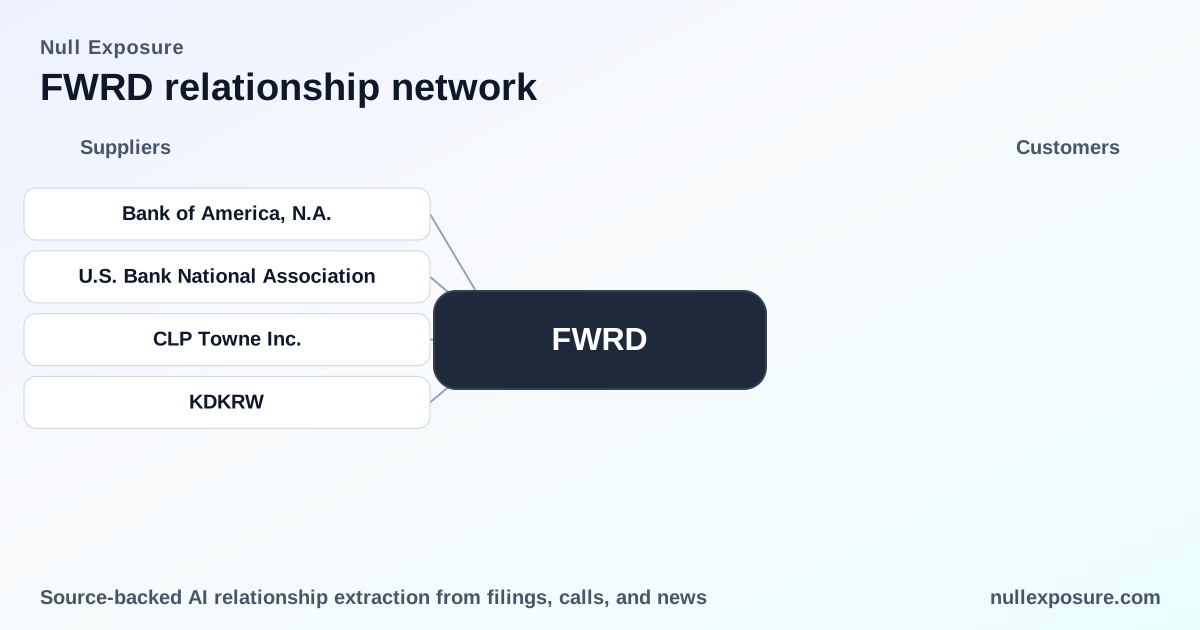
FWRD Supplier Map: How Forward Air Structures Its Capacity and Credit Relationships
Forward Air operates an asset-light, expedited freight network in the United States and Canada and monetizes by selling time‑sensitive transportation services while outsourcing the bulk of hauling capacity. The company generates revenue from freight movement and intermodal services, and it captures margin by controlling pricing, routing and terminal operations while purchasing capacity from third‑party and leased carriers; this operating model concentrates commercial and credit exposure in a small set of supplier and lender relationships. Learn more about supplier exposure and counterparty mapping at https://nullexposure.com/.
The core operating model, in plain English
Forward Air runs terminals, manages customer contracts and sells expedited freight solutions, but most of the actual tractor capacity is provided by external providers under contractual arrangements. That structure produces three investor-relevant signals:
- Contracting posture — long-term relationships for core capacity. The company states it seeks long-term arrangements with Leased Capacity Providers to assure service availability and reliability, and it treats those contracts as containing embedded leases, which shows contractual depth beyond ad-hoc spot hauling.
- Concentration — substantial reliance on leased capacity. For the year ended December 31, 2024, 63.8% of freight capacity came from Leased Capacity Providers, with 33.2% from third‑party motor carriers and only 4.0% from company‑employed drivers. That split creates operational leverage tied to a discrete group of external carriers.
- Cost profile and criticality — purchased transportation is a material, variable spend. The company reported variable lease costs recorded in purchased transportation of $434,689, $409,080 and $440,756 for 2024, 2023 and 2022, respectively, pointing to a recurring, sizable line item that moves with utilization and rate environment.
These characteristics combine to make supplier relationships operationally critical and financially material to Forward Air’s margin and capacity resilience. For deeper platform-level mapping, visit https://nullexposure.com/.
How banking and credit counterparts fit into the picture
Forward Air manages liquidity and capital structure through a syndicated credit facility. The syndicated lenders are financial suppliers whose terms and availability influence the company’s capital flexibility, particularly because the operating model relies on leased capacity and working capital to run terminals and flows.
- Bank of America, N.A.: Forward Air disclosed a credit agreement dated September 29, 2017 naming Bank of America as a lender to Forward Air and its subsidiaries, making Bank of America a primary credit counterparty. According to the company’s 2024 Form 10‑K, this agreement remains a foundational financing relationship for the business (Form 10‑K, FY2024).
- U.S. Bank National Association: The same 2017 credit agreement also names U.S. Bank National Association as a lender, placing U.S. Bank in the core syndicate that supports Forward Air’s working capital and capital spending flexibility (Form 10‑K, FY2024).
These bank relationships are contractual, documented and typical for a logistics operator with leased capacity and variable transport spend.
Operational suppliers, technology partners and M&A activity
Forward Air’s supplier map includes pure hauling providers, technology partners and occasional bolt-on acquisitions that extend capacity or capability.
- CLP Towne Inc.: Forward Air announced an agreement to purchase trucking services provider CLP Towne Inc., integrating its hauling capacity into Forward’s network and increasing direct control over some lane capacity (TruckingInfo, March 9, 2026).
- Kodiak Robotic: Forward Air has a multi‑year operating relationship with autonomous trucking provider Kodiak Robotic; Kodiak reported it had delivered more than 100 loads and driven over 100,000 miles working with Forward since August 2022, illustrating Forward’s use of technology partners to augment capacity on specific long‑haul lanes (TruckingInfo, March 9, 2026).
These operational relationships show a mix of traditional leased carriers, targeted acquisitions and technology partnerships that collectively supply the company’s core service offering.
Quick reference — every supplier relationship found in disclosures and reporting
- Bank of America, N.A.: Forward Air is party to a credit agreement dated September 29, 2017 that lists Bank of America as one of the lenders supporting Forward Air and its subsidiaries (Forward Air 2024 Form 10‑K).
- U.S. Bank National Association: The same credit agreement names U.S. Bank National Association as a syndicate lender to Forward Air (Forward Air 2024 Form 10‑K).
- CLP Towne Inc.: Forward Air agreed to acquire trucking services provider CLP Towne Inc., a transaction the company announced publicly in March 2026 (TruckingInfo, March 9, 2026).
- Kodiak Robotic (KDKRW): Forward Air engaged Kodiak Robotic for autonomous trucking services; Kodiak reported over 100 loads and 100,000 miles moved in partnership with Forward since August 2022 (TruckingInfo, March 9, 2026).
Each relationship above is documented in either the company’s 2024 SEC filing or recent industry reporting.
What this means for valuation, risk and operational resilience
Forward Air’s supplier posture drives four investment conclusions:
- Margin sensitivity to purchased transportation. With purchased transportation and embedded leases as a core cost line, earnings are highly sensitive to capacity pricing and utilization. The company’s 2024 EBITDA of $240.3 million and revenue of $2.495 billion provide scale, but variable lease and purchased transportation costs will be the primary driver of margin compression or expansion (Company financials, FY2024).
- Concentration risk requires active counterparty management. The fact that nearly two‑thirds of capacity is leased implies a small set of counterparties can meaningfully affect service stability; Forward’s long‑term contracting lowers short‑term spot exposure but increases vendor dependence.
- Credit counterparties support operational continuity. The Syndicated Credit Agreement with Bank of America and U.S. Bank underpins working capital flexibility; disruption or covenant stress in that facility would have immediate operational implications given the outsourced capacity model (Form 10‑K, FY2024).
- Technology and M&A are de‑risking and expansion levers. The CLP Towne acquisition and the Kodiak partnership illustrate a deliberate approach to combining owned capacity with innovation to control cost and scale capacity on targeted lanes.
Investors should weigh operational leverage to external carriers against revenue stability and management’s ability to control rates and utilization.
If you want a deeper supplier concentration report or counterparty stress test for Forward Air, start here: https://nullexposure.com/.
Bottom line and action items for investors
Forward Air’s business model is asset‑light but supplier‑dependent. The combination of long‑term leased capacity contracts, concentrated sourcing (63.8% leased capacity) and material variable lease costs produces both operational efficiency and counterparty risk. For portfolio managers and operators, the priority is monitoring purchased transportation trends, covenant language in the credit facility, and how acquisitions or autonomous partnerships change the supplier mix.
For a tailored supplier-risk dashboard or to map counterparty financial exposure across the logistics sector, visit https://nullexposure.com/ for tools and reports.