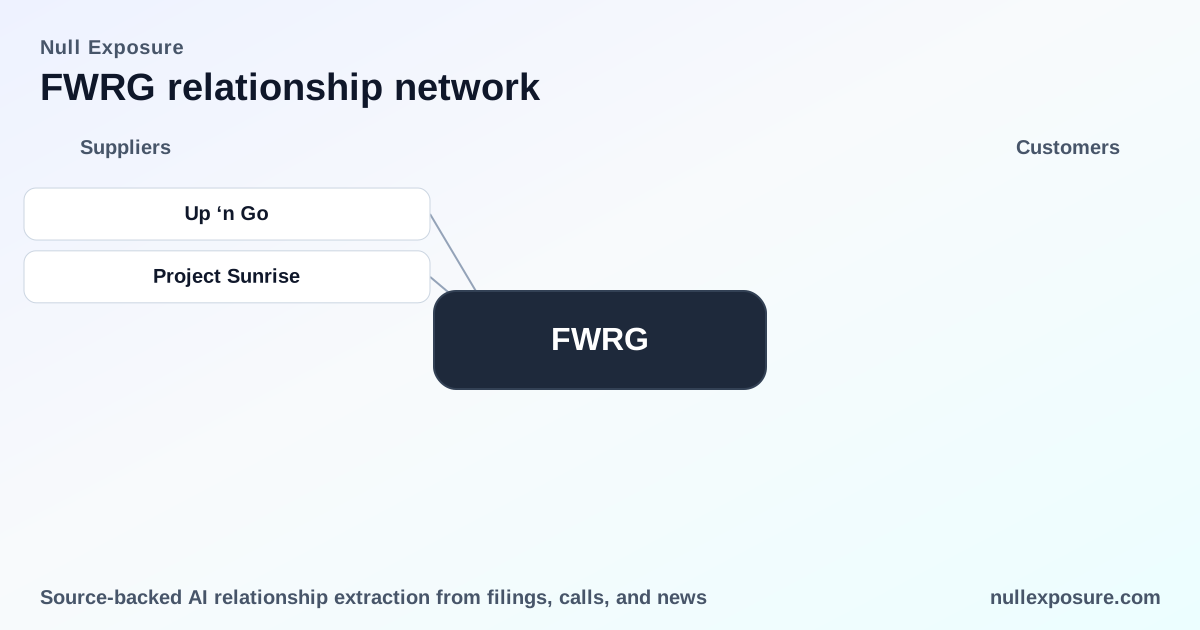
First Watch (FWRG): Supplier relationships that determine margins and roll‑out rhythm
First Watch monetizes by operating and franchising fast‑casual breakfast and brunch restaurants that sell premium, health‑forward menu items at scale; revenue comes from company‑operated restaurant sales, franchise fees and royalties, and a predictable mix of franchising and corporate expansion. Margins depend on tight control of food and coffee supply, efficient in‑store payment flows, and disciplined capital allocation to new openings, making supplier contracts a direct lever on profitability and rollout cadence. Explore deeper supplier intelligence at https://nullexposure.com/.
Quick read: what the company actually buys and why it matters
First Watch runs a high‑volume, low‑ticket dining model focused on breakfast and lunch, which creates continuous purchasing of perishable ingredients, coffee, paper goods and equipment. The company converts foot traffic into repeatable revenue by combining a premium menu with operational continuity — which in turn makes supplier performance and pricing an operational heartbeat, not a peripheral cost.
Supplier relationships on the record
Below are every supplier relationship surfaced in the public results, each with a concise plain‑English takeaway and a source citation.
Up ‘n Go — pay‑at‑table technology deployment
First Watch has deployed Up ‘n Go’s pay‑at‑table system across all corporately owned U.S. restaurants to accelerate dining throughput and reduce friction in payments; this is a company‑level rollout of a single vendor payment solution (FY2024 reporting). According to Verdict Foodservice (March 2026), First Watch implemented Up ‘n Go to enhance the dining experience and speed checkout: https://www.verdictfoodservice.com/news/first-watch-21-restaurants-north-carolina/.
Project Sunrise — coffee sourcing partnership
First Watch offers Project Sunrise coffee in at least some new locations, a socially responsible coffee program supporting independent female farmers in Huila, Colombia; this is a branded specialty coffee relationship that reinforces menu positioning and sustainability credentials (FY2025 reporting). A local news piece (Aug 2025) notes Project Sunrise coffee service in First Watch’s Paramus opening: https://www.boozyburbs.com/2025/08/28/first-watch-paramus-shares-opening-date/.
What the supplier signal set reveals about First Watch’s operating model
The public excerpts and filing language reflect a transactional, centralized procurement posture with a few specific structural characteristics that shape risk and opportunity.
- Short‑term and spot contracting dominates. Company language describes purchase obligations as short‑term purchase orders and purchases at prevailing or negotiated market prices. This gives First Watch operational flexibility to react to price swings but increases exposure to commodity volatility and requires active procurement management.
- Geography is national, but distribution is concentrated. First Watch discloses it contracts with a single “broad line” distributor for virtually all U.S. food distribution, making the distribution relationship operationally central to store supply and openings.
- Supplier concentration is critical. The company acknowledges reliance on a small number of suppliers for a substantial amount of food and coffee, which elevates counterparty and continuity risk versus a highly diversified sourcing base.
- Buyer role with distributor dependency. First Watch is primarily a buyer but relies on a distributor acting as its logistical partner across markets; performance of that distributor directly affects inventory levels, spoilage and delivery timing.
- Capital intensity underscores scale of supplier spend. Management projected capital expenditures in the $150–160 million range for 2025, indicating a > $100M spend band in capex that signals sizable procurement for openings and remodels.
All of the above are company‑level signals drawn from public disclosures and materially inform how procurement decisions influence margins, rollout speed and operational resilience.
Why each relationship matters for margin and rollout
-
Up ‘n Go: A single payment provider rolled out across corporate restaurants is a tech‑ops decision with direct margin impact — faster table turnover and lower labor friction can lift throughput per store and slightly compress labor intensity per transaction. The vendor relationship is low direct spend but high operational leverage; monitor adoption KPIs (payment times, average check per table) for early evidence of ROI. (Source: Verdict Foodservice, Mar 2026 — https://www.verdictfoodservice.com/news/first-watch-21-restaurants-north-carolina/)
-
Project Sunrise: Specialty coffee suppliers influence both brand positioning and input cost. Serving a socially responsible coffee line supports pricing power for breakfast occasions and can justify premium menu items, yet it also concentrates coffee spend with a named supplier group. Track any contractual exclusivity or price pass‑through terms to assess margin sensitivity. (Source: Boozy Burbs, Aug 2025 — https://www.boozyburbs.com/2025/08/28/first-watch-paramus-shares-opening-date/)
Investment implications and an operational risk checklist
First Watch’s supplier footprint creates clear, investor‑relevant implications:
- Cost control lever: Short‑term and spot purchases deliver pricing flexibility; procurement must be active to prevent margin erosion during commodity inflation.
- Single‑distributor concentration is a tactical vulnerability. Any logistical disruption at the “broad line” distributor has outsized impact on store supply, opening schedules and spoilage costs.
- Supplier criticality demands contingency planning. Reliance on a small set of suppliers for key inputs like coffee amplifies risk and requires documented alternate sources or contractual protections.
- Capex‑driven expansion increases spend visibility. With projected 2025 capex of $150–160M, procurement and construction vendors will drive cash flow timing and near‑term working capital needs.
- Operational tech is a scalable efficiency play. The Up ‘n Go rollout is a low‑capex, high‑operational‑impact trade; successful execution supports unit economics even as food costs fluctuate.
These points should be assessed against the company’s valuation context — trailing P/E of 38.5 and a forward P/E near 115 reflect high expectations for margin improvement and growth, making supplier execution an immediate determinant of investor returns.
For a structured view of counterparty risk across retail and restaurant suppliers, visit https://nullexposure.com/ to see how firms are tracking supplier concentration and contract posture.
Practical next steps for investors and operators
- Request or review disclosure language on the “broad line” distributor: counterparty identity, service levels, and continuity plans.
- Monitor rollout KPIs for Up ‘n Go (payment speed, labor per check, average transaction value) to validate expected efficiency gains.
- Validate coffee sourcing economics for Project Sunrise: any premiums, hedging, or pass‑through clauses that affect gross margin.
- Ensure capex schedules and vendor commitments are aligned with cash flow guidance to prevent working capital pressure around openings.
For tailored supplier risk analysis and counterparty scoring for restaurant portfolios, see the NullExposure home page at https://nullexposure.com/ for subscription details and case studies.
Bottom line
First Watch runs a procurement model that is flexible on price but concentrated on counterparty, where short‑term purchasing and a single broad‑line distributor lower contractual rigidity but raise operational concentration risk. Execution of tech upgrades like Up ‘n Go and disciplined sourcing of specialty inputs such as Project Sunrise coffee are immediate levers that will determine whether the firm converts expansionary capex into durable margin improvement. For investors focused on operational drivers of value, supplier governance and contingency planning are as material as unit economics. Learn more about supplier analytics and monitoring at https://nullexposure.com/.