First National Corporation (FXNC): supplier relationships, operating constraints, and investor implications
First National Corporation (FXNC) is a Virginia-based bank holding company that generates revenue through traditional commercial banking activities—net interest income from loans funded by deposits, fee income from customer services, and incremental earnings from targeted acquisitions that expand the deposit and loan base. The company executes a regional consolidation strategy, integrating acquired loan portfolios and branch deposits to lift scale and margins while keeping overhead lean. For an in-depth supplier-risk profile and comparable regional-bank coverage, see NullExposure’s research hub: https://nullexposure.com/
Why supplier relationships matter for a community bank operator
Community banks like First National operate with a compact ecosystem of external partners that underpin everything from funding and liquidity to legal and deal execution. Supplier relationships are operationally critical: borrowing facilities determine liquidity flexibility, legal and advisory partners support M&A activity, and third-party vendors run portions of the bank’s technology and investment services. Those relationships directly influence capital deployment, earnings volatility, and integration risk following acquisitions.
For investors focused on execution and concentration risk, the mix of counterparties—both large-system lenders and boutique advisors—signals where the bank sources capacity and expertise. To review supplier exposure across banks and how it maps to balance-sheet risk, visit NullExposure: https://nullexposure.com/
Material relationships in plain English
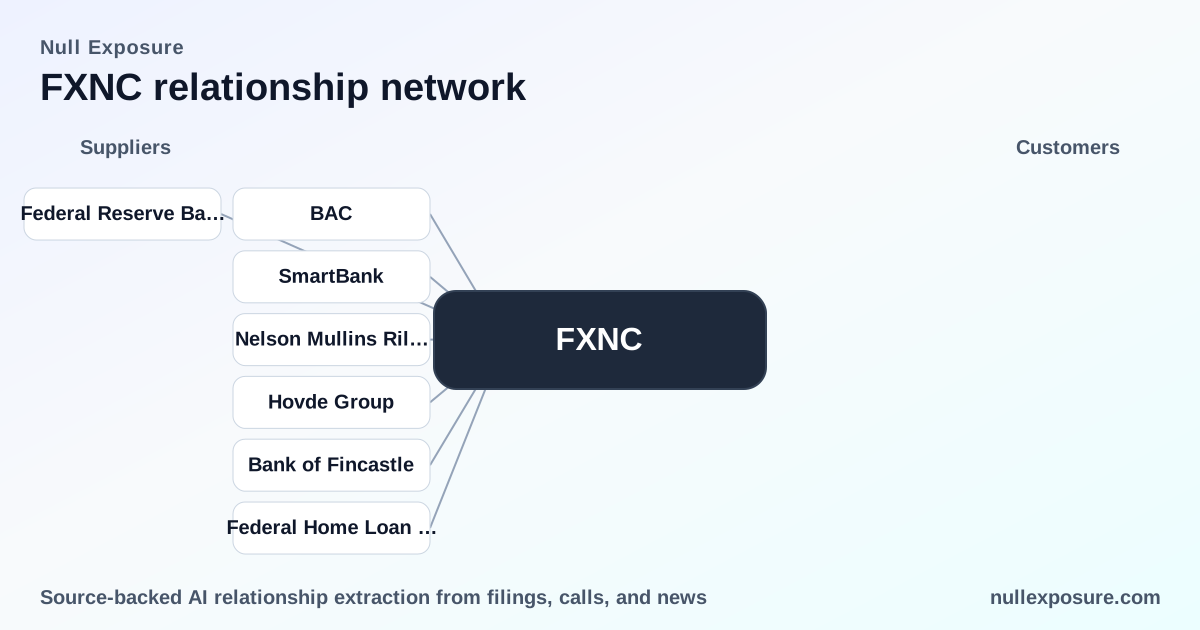
Below are every supplier relationship flagged in public reporting and local press for First National, summarized with sources.
Bank of America
First National expanded across Virginia by purchasing six Bank of America branches and roughly $200 million in deposits, a transaction that materially increased its deposit funding and scale in targeted local markets. According to Richmond BizSense (March 27, 2024), those branch acquisitions took place in markets including Waynesboro, Staunton and Woodstock. (Richmond BizSense, 2024)
SmartBank
First National acquired an approximately $82–83 million local loan portfolio and a team of seven bankers from Tennessee-based SmartBank, a transaction that strengthened its Richmond presence and added commercial lending capacity. CityBiz and GlobeNewswire described the SmartBank portfolio sale and the team join in 2021–2022 as part of First Bank’s regional growth push. (CityBiz/GlobeNewswire, 2022–2024)
Nelson Mullins Riley & Scarborough
First National retained Nelson Mullins Riley & Scarborough as legal counsel for acquisition and strategic transactions, supporting deal structuring and regulatory compliance during expansion activity. Richmond BizSense reported the firm acted as First National’s law counsel in coverage of the Touchstone Bank acquisition. (Richmond BizSense, 2024)
Hovde Group
Hovde Group served as First National’s financial advisor on M&A engagement, providing valuation, buyer/seller negotiation support and execution oversight for the bank’s recent acquisitions. Richmond BizSense listed Hovde Group as the financial advisor in the Touchstone Bank deal announcement. (Richmond BizSense, 2024)
Bank of Fincastle
First National acquired Bank of Fincastle in 2021, a deal that extended the bank’s footprint in western Virginia and delivered incremental loan and deposit balances that underpin local-market lending. Richmond BizSense chronicled the Bank of Fincastle acquisition as part of First National’s acquisition cadence. (Richmond BizSense, 2024)
Federal Home Loan Bank
First National used borrowings from the Federal Home Loan Bank as part of its short-term funding profile, with disclosure showing $25.0 million in outstanding FHLB borrowings at June 30, 2025 that were absent by September 30, 2025. A company press release detailed the timing of those borrowings and repayments. (GlobeNewswire, Oct 30, 2025)
Federal Reserve Bank
First National accessed Federal Reserve liquidity through the Bank Term Funding Program in 2024, recording $50.0 million in borrowings on September 30, 2024 that were repaid during the fourth quarter of 2024. This use of Fed facilities was disclosed in the company’s earnings release. (GlobeNewswire, Oct 30, 2025)
What the relationship map implies about operating posture and risk
-
Contracting posture: First National demonstrates an active contracting stance—outsourcing specialized functions (legal, financial advisory) while selectively using external funding sources (FHLB, Reserve programs) to manage liquidity and growth. The firm structures deals with third-party advisers to accelerate M&A execution and regulatory navigation, indicating a pragmatic mix of in-house and external capabilities.
-
Concentration and counterparty mix: The supplier set blends large-system providers (Federal Reserve, Federal Home Loan Bank) and regional or boutique partners (SmartBank, Hovde, Nelson Mullins). Liquidity dependence on central-bank facilities is episodic and transactional, while legal and advisory relationships are durable and repeatable across deals. The deposit and branch acquisitions from a large national bank (Bank of America) reduced geographic concentration risk by diversifying funding sources.
-
Criticality: Technology and operational third parties are flagged as material service providers to core functions (data processing, online banking, network access). Those services are foundational: any disruption to third-party processing or connectivity would directly affect customer access and transaction recording, making vendor stability a high-priority risk for management and regulators.
-
Maturity of relationships: The bank’s acquisition history—multiple deals including Bank of Fincastle, portfolio purchases from SmartBank, and branch roll-ins from Bank of America—shows a practiced M&A playbook. Legal and advisory engagements with established firms indicate institutionalized sourcing for transaction execution rather than ad-hoc arrangements.
The constraints data explicitly identifies a service-provider role with moderate confidence (0.80) and notes that third parties handle data processing and investment management functions. This is a company-level signal that operational resilience depends on third-party continuity and integration discipline, not a relationship-specific finding.
For a supplier-risk comparison across regional banks, visit NullExposure: https://nullexposure.com/
Key investor takeaways
- Growth-through-acquisition is embedded in First National’s model. The bank consistently uses portfolio purchases and branch acquisitions to scale deposit bases and loan originations, which lifts revenue without proportionate fixed-cost expansion.
- Liquidity management is active and pragmatic. Use of Federal Reserve facilities in 2024 and FHLB borrowings in 2025 show the bank accesses short-term wholesale liquidity strategically during periods of funding need or acquisition funding.
- Operational dependence on third parties is material. Critical functions—payments processing, online banking and investment management—are run partly by external vendors, so vendor governance and redundancy are principal operational risks.
- Advisors and counsel are high-quality and repeat players. Engagements with Hovde Group and Nelson Mullins signal disciplined, professional execution of deal activity.
What to watch next
- Monitor follow-on disclosures for recurring FHLB usage or new Federal Reserve program drawdowns that would indicate changing funding economics.
- Watch vendor contracts and any public incidents affecting third-party processors; outages or regulatory notices at providers would have outsized impact at a compact bank.
- Track integration metrics (cost-to-income, efficiency ratio) following future acquisitions to assess whether external advisors are translating into measurable operating leverage.
For ongoing supplier exposure monitoring and comparatives across the regional banking sector, revisit NullExposure’s research: https://nullexposure.com/
Final action: analyze management’s next-quarter commentary on vendor oversight and liquidity strategy, and review the next SEC or press release for updated borrowings and advisor engagements to confirm execution against the strategic playbook.