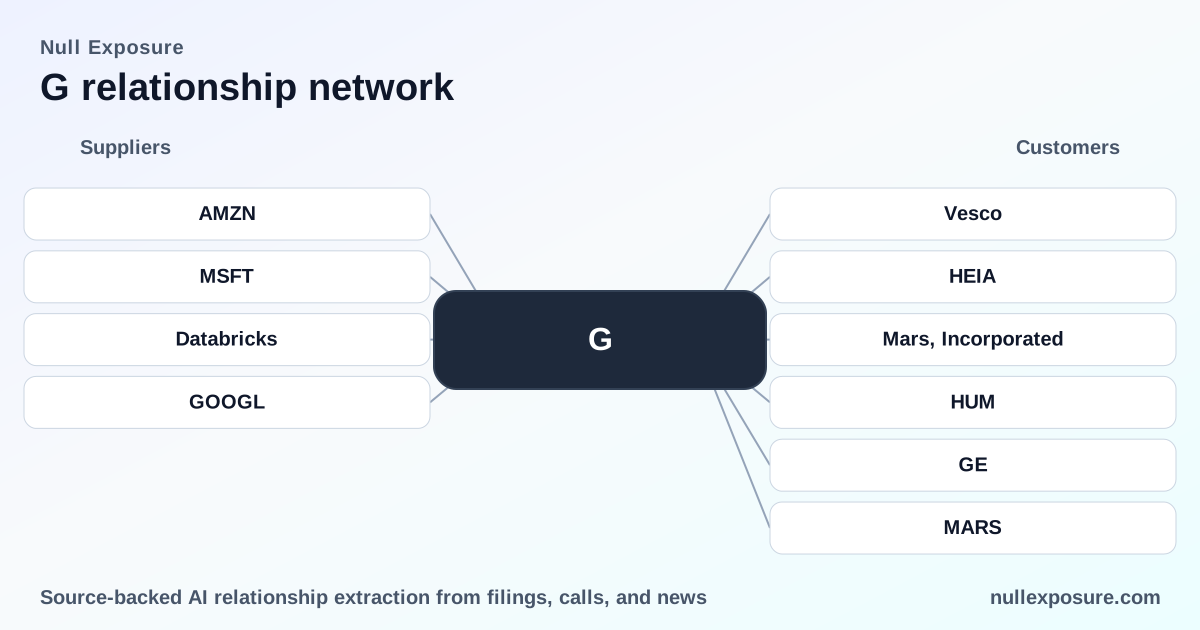
Genpact Limited (G) — How cloud and analytics suppliers drive the service model and revenue
Genpact operates as a global provider of IT and business process outsourcing services and monetizes by selling outcome-based and managed services to enterprise clients across industries, with meaningful scale in finance, insurance, and supply chain functions. Revenue primarily flows from long-term contracts and recurring service engagements; margins are driven by process automation, analytics-led transformation, and increasingly, partnerships that embed cloud and AI platforms into Genpact’s solutions — evidence in FY2025–FY2026 commentary and product announcements show the company explicitly positioning these supplier relationships as growth levers. For a consolidated view of supplier exposure and signal-driven monitoring, visit https://nullexposure.com/.
Why Genpact’s cloud and AI partners matter for investors
Genpact has moved from pure BPO to a higher-value, software-and-services hybrid. Partnerships with major cloud and analytics providers are not decorative — they are functional enablers of productization, speed-to-market, and margin expansion. These alliances shorten time-to-value for clients adopting AI-led workflows and allow Genpact to layer intellectual property and process expertise on top of third-party compute, models, and tooling.
Operationally, this means:
- Contracting posture: Genpact sells services that depend on third-party cloud stacks; contracts with enterprise clients will often reference specific cloud capabilities and SLAs provided by those suppliers.
- Concentration and criticality: Major cloud partners are strategic — reliance on them concentrates vendor risk but also enhances product competitiveness by leveraging their scale and technology.
- Maturity: Public disclosures show Genpact is comfortable positioning these suppliers within go-to-market narratives and product launches, indicating mature commercial and technical integrations.
- Counterparty risk signal: Company-level disclosures indicate Genpact regularly contracts with banks and other financial institutions and considers counterparty non-performance risk immaterial, reflecting a seasoned contracting and credit posture in high-stakes sectors.
These dynamics are central to assessing operational leverage and vendor risk for the supplier role Genpact plays. For a focused, ongoing tracker of these supplier relationships and market signals, see https://nullexposure.com/.
Mapping every named partner and what management said
Below are the supplier relationships captured in the public record and the plain-English summaries investors should use when modeling partner exposure.
AWS (Amazon Web Services)
Genpact explicitly lists AWS among the cloud partners accelerating its AI-led transformation strategy, linking AWS to faster deployment of analytics and automation capabilities on client engagements. This came directly from management remarks on the Q4 2025 earnings call transcript (InsiderMonkey, March 2026).
Microsoft
Genpact names Microsoft as a strategic partner in AI initiatives and has launched insurance-focused automation suites powered by Microsoft Azure AI Foundry Models and Azure Analytics Services, making Azure a platform anchor for productized industry offerings. These points are drawn from the Q4 2025 earnings call transcript and a ReinsuranceNews write-up describing the FY2025 insurance product release (InsiderMonkey, March 2026; ReinsuranceNews, FY2025).
Databricks
Management cited Databricks alongside cloud providers as a key collaborator that supports Genpact’s data and AI pipelines, highlighting the company’s reliance on modern data engineering and lakehouse technologies to scale analytics across client workflows. The linkage was stated on the Q4 2025 earnings call transcript (InsiderMonkey, March 2026).
GCP (Google Cloud Platform)
Genpact includes GCP in the same class of strategic cloud partners, indicating multi-cloud alignment across its AI and analytics initiatives and the ability to deliver solutions tied to Google’s data and AI services. This reference is from the Q4 2025 earnings call transcript (InsiderMonkey, March 2026).
Operational constraints and what they signal about risk
Genpact’s supplier relationships are shaped by its role as a service provider and by the company-level contracting practices disclosed in filings and commentary. A company-level signal in the public record states that Genpact enters into contracts with banks and other financial institutions and considers the risk of counterparty non-performance not material, which speaks to seasoned contract negotiation and risk management when operating in regulated, high-stakes verticals.
Taken together, these constraints imply:
- Commercial sophistication: Contracts are negotiated with credit-aware counterparties and structured to mitigate counterparty risk, which reduces revenue volatility from client defaults.
- Dependency management: While the cloud partners are strategic, Genpact’s multi-cloud posture (AWS, Microsoft/Azure, GCP, plus Databricks data layer) reduces single-vendor lock-in and supports client-specific requirements.
- Execution criticality: Delivering claims automation, finance transformation, or analytics requires reliable integration with these suppliers; failure or price shifts from a cloud provider would directly affect delivery economics.
- Maturity of arrangements: Public product launches and earnings commentary suggest these are integrated go-to-market relationships, not simple reseller referrals.
Each of these is a company-level operating signal unless a specific constraint names a partner explicitly.
Investment implications — where to focus operational due diligence
Genpact’s supplier mix is a strategic asset that amplifies its ability to productize services and expand margins, but it also concentrates vendor dependency on a small set of cloud and data platform providers. Investors and operators should prioritize:
- Contract terms and pass-through costs: Understand how cloud price changes and model licensing are passed to clients or absorbed by Genpact.
- Multi-cloud execution capability: Verify that multi-cloud and Databricks integrations are operational at scale and reflected in client case studies and referenceable deployments.
- Vertical productization: Track wins where Azure-powered insurance suites or AWS/GCP-enabled analytics are tied to measurable outcomes and recurring revenue.
- Counterparty stability: Given the company-level signal that counterparty non-performance is immaterial, confirm the robustness of credit terms in high-concentration client sectors such as banking and insurance.
For a concise, business-focused supplier intelligence view that supports these checks, visit https://nullexposure.com/.
Final read: pragmatic bullishness with vendor vigilance
Genpact’s supplier relationships — AWS, Microsoft/Azure, Databricks, and GCP — are structural partners in its transition toward AI-embedded services and productized industry offerings. The company’s public statements and product announcements show these partners are deliberately woven into go-to-market and delivery models; that is a positive for scale and margin trajectory. At the same time, investor diligence must focus on contract economics, pass-through risk, and execution evidence across multi-cloud integrations. In portfolio terms, Genpact represents a managed-services story where supplier partnerships are growth multipliers but also a concentrated operational risk vector that requires active monitoring.
For continuous monitoring and supplier-focused intelligence tailored for investors and operators, go to https://nullexposure.com/.