Gaia Inc. (GAIA): Supplier footprint and what it signals for investors
Gaia operates a subscription-driven streaming service and member community focused on niche wellness and consciousness programming, monetizing primarily through recurring subscriptions and third-party distribution agreements that place the service on consumer platforms. Revenue mix depends on direct membership economics plus fees and revenue shares from platform distribution and licensing, so supplier relationships that govern distribution, content delivery, licensing and regulatory settlement administration are materially relevant to cash flow stability and margin profile.
Explore how these supplier ties shape Gaia’s operating risk and upside on the company profile page: https://nullexposure.com/
The quick take: why suppliers matter to Gaia’s economics
Gaia’s economics are sensitive to distribution partners and a small number of material contracts. The company combines direct-to-consumer subscription revenue with placement on larger platform ecosystems; that reduces customer-acquisition cost per user but creates dependency on platform agreements and content delivery. Short-dated financing and lease obligations push near-term liquidity planning onto the same horizon as some supplier contracts, while a mid-sized licensing outlay in 2024 evidence indicates episodic capital deployment into intellectual property.
Key short-form implications for investors:
- Distribution dependency: Platform placements expand reach but concentrate counterparty risk.
- Contract mix: Evidence of both short-term and long-term contracts—cash management is therefore operationally important.
- Material one-off spend: A license purchase in the mid-eight-figure range is a tangible capex-style event that affects free cash flow.
If you want a concise supplier risk score and ongoing monitoring for Gaia, visit: https://nullexposure.com/
How the supplier relationships line up (relationship-by-relationship)
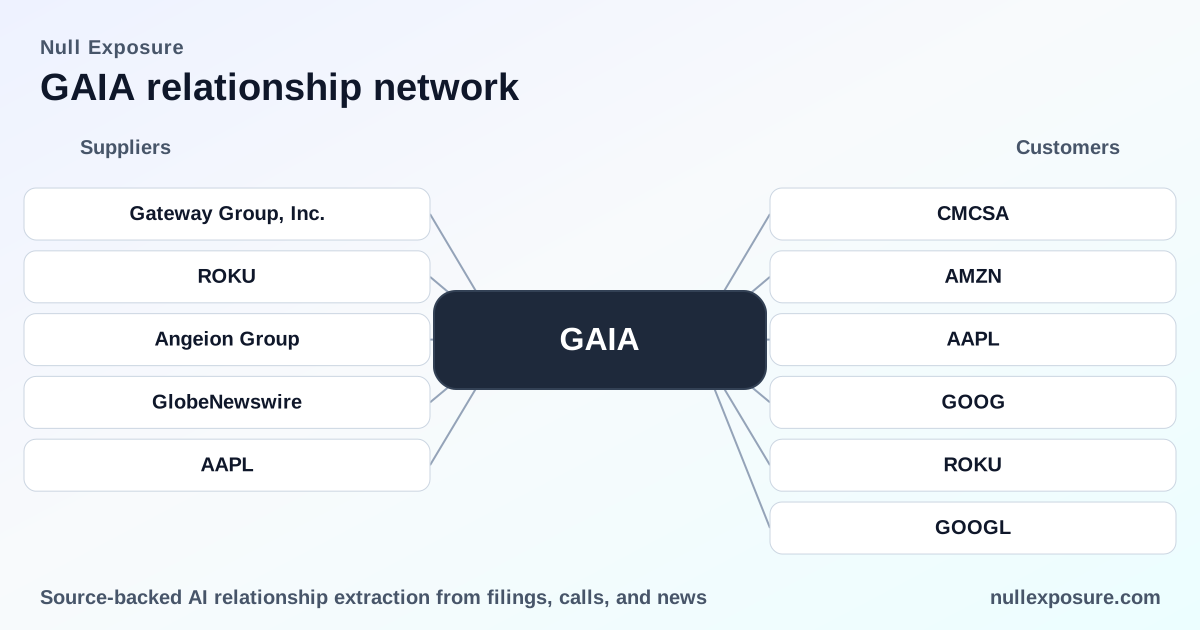
Below are every supplier relationship surfaced in the available materials with a plain-English summary and source reference.
-
Gateway Group, Inc. — Gateway Group functions as Gaia’s investor relations contact and a point of logistics for investor communications, including hosting conference-call connection support. According to investor notices in 2025–2026, Gateway Group was listed as the contact for conference calls and IR outreach (Cody Slach, Gateway Group, 949-574-3860). Source: company notices posted via Sahm Capital and QuiverQuant (FY2025–FY2026).
-
Roku (ROKU) — Roku is a live distribution channel for Gaia’s streaming service; Gaia lists Roku among the platforms on which its app is available, supporting reach into connected-TV audiences. Gaia’s earnings releases in 2025–2026 explicitly state availability on Roku alongside other platforms. Source: GlobeNewswire press releases reporting Gaia’s quarterly results (FY2025–FY2026).
-
Apple TV (AAPL) — Apple TV is likewise a platform distribution partner; Gaia reports availability on Apple TV as a component of its multi-platform distribution strategy that broadens device coverage for subscribers. Source: Gaia quarterly disclosures distributed through GlobeNewswire (FY2025).
-
Angeion Group — Angeion Group acted as the settlement administrator for a VPPA-related settlement involving Gaia, indicating third-party administration of legal or regulatory remediation. Public settlement materials name Angeion as the administrator for the Gaia VPPA settlement. Source: claims and settlement notices published on ClaimDepot (FY2024).
-
GlobeNewswire — GlobeNewswire is a distribution channel for Gaia’s press releases; investor and earnings communications are propagated through GlobeNewswire, and some republished summaries were flagged as automated by secondary aggregators. QuiverQuant and other news services republished Gaia releases distributed via GlobeNewswire in 2025–2026. Source: press releases and redistribution notices (FY2025–FY2026).
Each relationship above plays a distinct operational role—from investor communications and legal administration to platform distribution and corporate disclosure.
What the constraint signals say about Gaia’s operating posture
Gaia’s supplier-related evidence points to a mixed contract portfolio and mid-sized one-off licensing commitments. Notable signal-level constraints and what they imply for investors:
-
Licensing spend and concentration: A one-time royalty-free license purchase totaling $16.2 million (cash, equity and related consideration) demonstrates a willingness to deploy material capital to secure IP rights; this is a mid-capital transaction that sits in the $10m–$100m spend band, and it alters the company’s asset mix by converting third-party technology into owned rights. This transaction is a deliberate, strategic outlay rather than recurring operating spend.
-
Short-term financing and maturities: Multiple disclosures reference credit facilities, mortgages and letters of credit that mature in 2025, indicating near-term refinancing or liquidity focus. Short-term debt maturity concentration requires active treasury management and increases counterparty exposure over the next reporting cycle.
-
Long-term real-estate commitment: A master lease extending through 2030 (with possible extensions) signals long-dated fixed-cost exposure that balances the short-term financing pressure and suggests operational permanence for corporate facilities.
-
Service-provider dependency: Gaia explicitly uses third-party cloud services and content delivery networks to stream content at scale, which makes CDN and cloud providers critical service providers for uptime, streaming quality and member experience. Interruptions or price changes in these services translate directly into customer experience risk.
-
Relationship stage and spend maturity: Lease terms and remaining durations indicate active, mature relationships rather than nascent pilots; some obligations are long-dated while other financial relationships are short-term, creating a mixed maturity profile that must be managed tactically.
These constraints describe a company that balances strategic IP investments and platform distribution dependence against the need to manage short-term maturities and fixed-cost leases.
If you need a deeper breakdown of supplier exposure and contractual timelines for Gaia, get a tailored report at https://nullexposure.com/
Risk and upside — what investors should watch
-
Risk: platform concentration. Distribution via Roku, Apple TV and similar channels accelerates subscriber growth but concentrates commercial risk in the event of contract changes, fee renegotiations, or de-listing. Platform economics and revenue-share terms are therefore high-leverage items for Gaia’s margin outlook.
-
Risk: liquidity timing. Short-term maturities in 2025 create refinancing risk that could compress financial flexibility if subscriber growth or ARPU underperforms.
-
Upside: owned IP and content control. The multi-million-dollar licensing transaction converting third-party technology into owned rights improves gross margin optionality over time and reduces future content-cost inflation pressure.
-
Operational risk: CDN and cloud costs. Third-party streaming infrastructure is a non-negotiable input for a streaming business; changes in pricing or performance at these suppliers have a direct and immediate impact on churn and net revenue retention.
Bottom line and next steps
Gaia’s supplier profile is a mix of distribution dependency, strategic IP investment and concentrated short-term financing obligations. For investors, monitoring platform contract terms, near-term maturity refinancing, and the integrity of CDN/cloud relationships provides the clearest forward-looking signal set.
To monitor supplier changes and subscribe for alerts on GAIA, visit https://nullexposure.com/
For a customized supplier risk brief or to commission ongoing monitoring for Gaia and peer comparables, learn more at https://nullexposure.com/