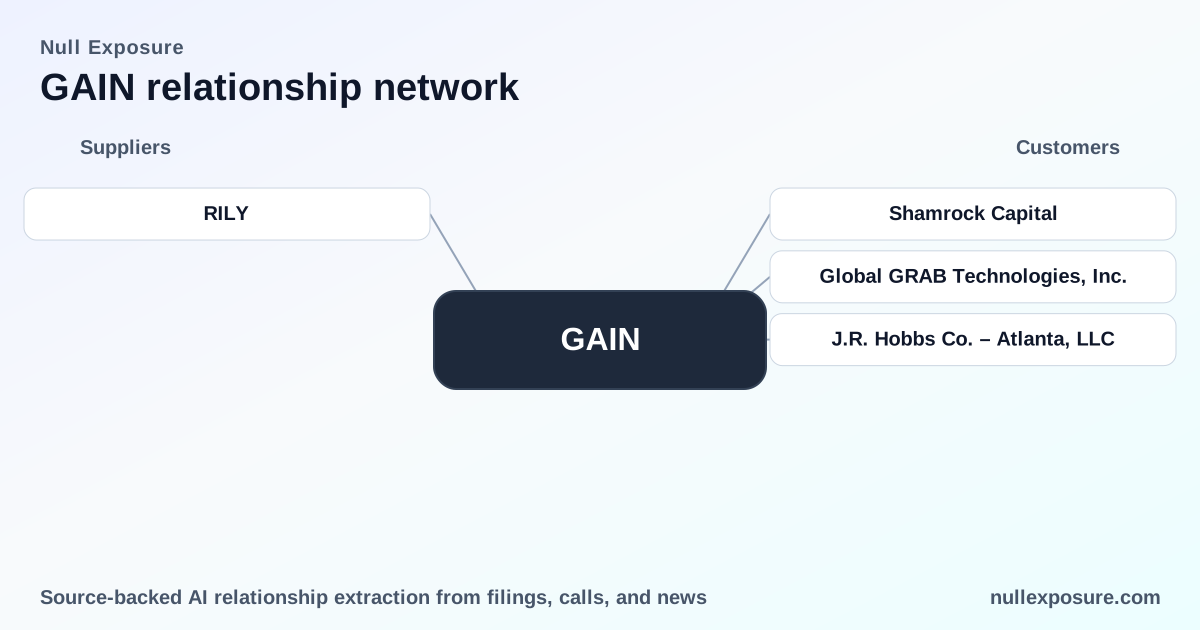
Gladstone Investment (GAIN): supplier map and what it means for investors
Gladstone Investment Corporation (GAIN) is a publicly traded business development company that originates and holds debt and equity in lower middle‑market private companies, then monetizes through interest, fees and capital appreciation as those investments mature or exit. The firm’s revenue model centers on portfolio income from credit and equity positions plus recurring management fees tied to an external adviser structure, while capital structure activity (note offerings) finances portfolio growth and liquidity. For quick access to our platform and provider intelligence, visit https://nullexposure.com/.
Quick snapshot investors need up front
GAIN runs a concentrated, income‑focused allocation: market capitalization roughly $556m, book value $14.95 per share and a dividend yield near 6.85% (trailing dividend per share $0.96). The company reports return on equity of about 22% and a trailing P/E of ~4.4, reflecting the earnings profile of a leveraged BDC; the balance sheet shows public note issuances in the hundreds of millions that fund the strategy. These metrics underline a classic BDC trade: yield plus capital risk, amplified by leverage and concentrated private positions.
Why supplier relationships matter for Gladstone’s model
Gladstone operates as an externally managed and administered BDC, which structurally places the Adviser and Administrator at the center of operations. Gladstone Management Corporation is the SEC‑registered adviser and Gladstone Administration, LLC provides administrative services, both of which are named in company disclosures and constitute essential service‑provider relationships. These relationships are not peripheral: the adviser controls investment decisions and the administrator handles day‑to‑day operations, making service continuity and contractual terms critical to the firm’s operating capacity and governance.
Several company‑level constraints frame the commercial posture:
- Contracting posture — long‑term orientation. The firm’s debt investments generally carry multi‑year terms (typical debt security term cited as five years), and note issuances are structured with multi‑year maturities; this reflects longer funding and investment horizons rather than short cyclical turnover.
- Counterparty profile — lower middle‑market focus. Gladstone targets U.S. and Canadian private companies with EBITDA commonly in the $4m–$15m band, which shapes credit risk, monitoring intensity and the types of legal and operational covenants required.
- Geographic footprint — North America centric. Portfolio reporting separates U.S. and Canada exposure explicitly, indicating primary concentration in North America and related regional underwriting practices.
- Concentration and materiality — meaningful single exposures. The five largest investments accounted for ~41% of portfolio fair value as of March 31, 2025, signaling high single‑name and sector concentration that increases idiosyncratic risk.
- Spend and funding scale — large note programs. Outstanding public notes include multiple series totaling well over $100m per issue, which evidences reliance on capital markets funding and elevates interest‑rate and refinancing considerations.
- Operational role — active and ongoing. The company reports an active investment portfolio across 25 companies and uses third‑party services for management and administration, indicating mature outsourcing arrangements rather than nascent vendor relationships.
These characteristics together describe a mature, externally managed alternative asset manager that leverages long‑term investment contracts, operates with material concentration risk, depends on capital markets and requires resilient service providers.
For a deeper look at provider exposures and to track similar supplier relationships, see https://nullexposure.com/.
Supplier relationships: who Gladstone is working with (what the record shows)
The public relationship evidence in our dataset identifies one recurring external capital markets partner that participated in a recent debt offering for Gladstone.
B. Riley Securities — B. Riley served as the sole book‑running manager for Gladstone Investment’s offering of 6.875% notes due 2028, a placement that complements the firm’s existing note programs and supports funding of its portfolio strategy. This engagement underscores Gladstone’s reliance on investment‑banking counterparties to access institutional debt capital markets. According to press releases in March 2026 published by Green Bay Press‑Gazette, GreenvilleOnline and The Patriot Ledger, B. Riley Securities acted as sole book‑running manager for the offering in FY2026 (press releases dated March 9, 2026).
- Green Bay Press‑Gazette reported on March 9, 2026 that B. Riley Securities acted as sole book‑running manager for the offering of 6.875% notes due 2028 for Gladstone Investment Corporation.
- GreenvilleOnline issued a press release on March 9, 2026 repeating that B. Riley Securities functioned as sole book‑running manager on the same offering.
- The Patriot Ledger’s March 9, 2026 press release likewise confirmed B. Riley Securities’ role as sole book‑running manager for Gladstone’s 6.875% notes due 2028.
These three contemporaneous releases document the same capital‑markets engagement across syndicated press channels and validate the counterparty role.
What investors should take away — risk and opportunity
- Funding strategy is active and market‑facing. The use of public note issuance managed by investment banks confirms Gladstone’s dependence on market access for liquidity and leverage management; this creates refinancing and interest‑rate sensitivity for total returns.
- Service providers are operationally critical. The Adviser and Administrator are contractually central to investment selection, execution and compliance; service continuity and alignment with shareholders are material governance factors investors must monitor.
- Portfolio concentration increases dispersion of outcomes. With the top five positions representing roughly 41% of portfolio fair value, idiosyncratic events in a few names can materially move NAV and distributable earnings.
- Lower middle‑market exposure requires active credit underwriting. Investing in companies with EBITDA in the $4m–$15m range demands hands‑on monitoring and bespoke debt structures, which favors managers with deep operational credit capabilities.
For investors evaluating counterparties, counterpart risk and funding pathways, the B. Riley placement is an observable example of how Gladstone structures external capital relationships to support the core investment program.
Explore supplier mappings across other funds and counterparties at https://nullexposure.com/ to benchmark.
Final read: position and next steps
Gladstone Investment operates a classic externally‑managed BDC model: fee and yield generation from private credit/equity, financed by public and private debt, with outsourced management and administration that are central to continuity and governance. Key near‑term monitoring items are note maturities and refinancing terms, the health of the largest portfolio companies that comprise a material share of asset value, and the stability of adviser/administrator arrangements.
If you are assessing GAIN for portfolio inclusion or counterparty risk, prioritize disclosure monitoring around large holdings, note issuance activity and any material amendments to management or administration agreements. For ongoing supplier intelligence and to track relationships across alternative asset managers, visit https://nullexposure.com/ for curated supplier profiles and alerts.