GAING: What Gladstone’s 7.125% Notes Tell Investors About Counterparty and Distribution Risk
Gladstone’s listed instrument offers a straightforward yield product for income investors: 7.125% fixed‑rate notes marketed to institutional buyers and retail channels, monetized through traditional debt issuance and secondary market trading. The company raises capital by placing long‑dated notes with underwriters and earns an implicit funding arbitrage by allocating proceeds to its middle‑market lending and investment platform; investor returns come from the coupon, while Gladstone captures spread on its deployed capital and management fees on the underlying BDC assets. For investors and operators evaluating supplier relationships, the most actionable signal is how Gladstone sources distribution and underwriting — a direct determinant of funding cost, secondary liquidity, and execution risk. Explore portfolio implications or vendor diligence support at https://nullexposure.com/.
One observable relationship and why it matters to the funding story
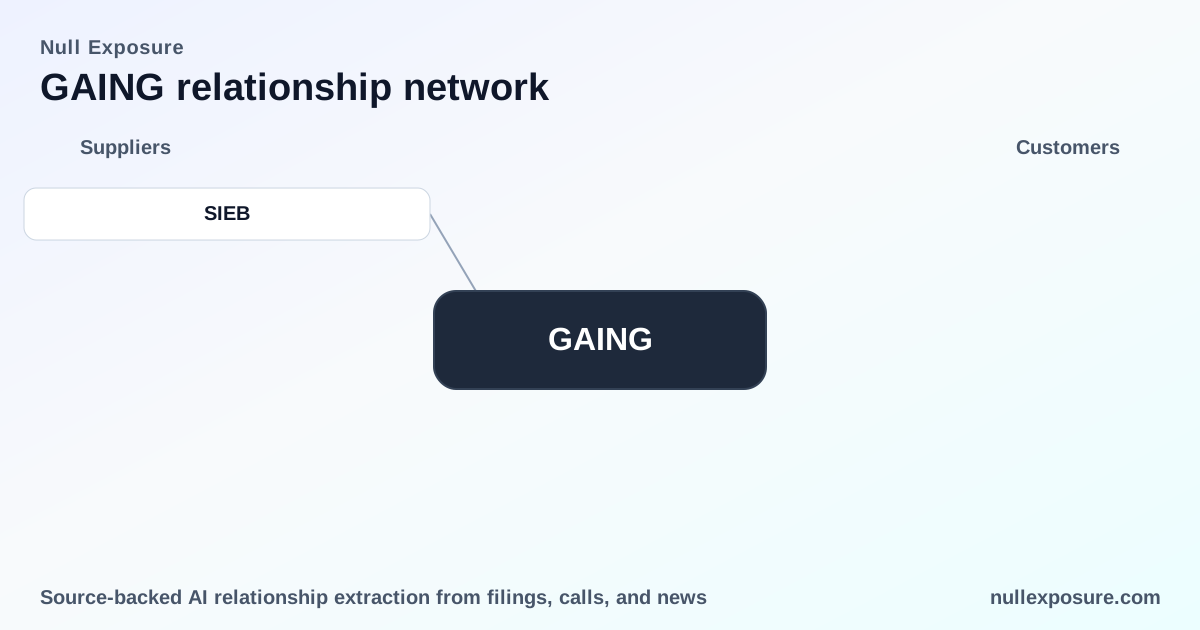
Gladstone’s public footprint in the supplier channel is narrow in the available record: Siebert served as a joint book‑runner on a $100 million offering of Gladstone’s 7.125% notes, which demonstrates reliance on capital markets intermediaries for primary distribution. AdvisorHub reported on March 9, 2026 that Siebert acted as an active joint book‑runner on the $100 million offering of 7.125% Notes; the full article documents the underwriting role and placement context: https://www.advisorhub.com/resources/siebert-served-as-joint-book-runner-on-100-million-gladstone-investment-corporation-notes-offering/.
Relationship detail — Siebert
Siebert supported Gladstone’s note placement as a joint book‑runner on a $100 million deal, confirming an active underwriting and distribution relationship used to access fixed‑income investors. The AdvisorHub report dated March 9, 2026 records this underwriting role and the public offering terms: https://www.advisorhub.com/resources/siebert-served-as-joint-book-runner-on-100-million-gladstone-investment-corporation-notes-offering/.
Reconciling issuer identity and instrument details
Gladstone’s listing information references 7.125% Notes (variously reported with maturity in 2030 or 2031) as the instrument headline, which positions the security as a long‑dated fixed income claim in investor portfolios and as a structural funding tool for the BDC sponsor. The company overview describes a 7.125% note due 2031, while market reporting around the underwriting cites a $100 million offering of 7.125% notes due 2030; both are present in public records as issued and marketed instruments. For credit and liquidity analysis, the coupon level, tenor, and placement size are the primary drivers.
What the single visible supplier tie implies for investors and operators
- Distribution concentration: The available evidence shows at least one underwriting partner supporting market access; this suggests a reliance on securities firms to execute financing strategies. From a diligence standpoint, underwriter capabilities and placement reach are critical levers for pricing and execution.
- Contracting posture: Gladstone operates with a market‑facing funding model that contracts capital via public offerings and underwriter agreements rather than captive funding lines, which increases transparency but ties execution to capital market conditions.
- Criticality and maturity: Debt placement is a core operational dependency — the ability to place long‑dated notes at attractive coupons directly impacts portfolio leverage and return targets. The maturity profile (long‑dated fixed coupon) creates medium‑term refinancing and interest rate exposure considerations.
- Supplier maturity and redundancy: With one clear book‑runner visible in public reporting, redundancy appears limited in the record, raising the importance of monitoring alternative distribution partners and standby channels.
For operational teams and investors seeking deeper counterparty intelligence or a broader supplier map, get customized diligence and relationship scoring at https://nullexposure.com/.
Risk and opportunity framed for portfolio decisions
- Funding risk: If primary distribution becomes constrained, Gladstone would face higher funding costs or be forced to tap more expensive channels; underwriter relationships therefore have direct P&L sensitivity.
- Liquidity signal: A successful $100 million placement at a fixed coupon points to market appetite and potential secondary liquidity for these notes; distribution success is a positive signal for tradability.
- Concentration risk: With a limited visible set of underwriters, counterparty concentration is a governance and operational risk that investors should monitor through ongoing filings and placement announcements.
- No documented constraints: There are no explicit contractual constraints or supplier limitations listed in the available relationship data, which is a company‑level signal that no restricted supplier clauses or prohibitive covenants appear in the captured record.
How to use this intelligence in portfolio and vendor strategy
- For fixed‑income investors: stress test yield vs. refinancing scenarios given the tenors and the dependence on public placement channels; monitor subsequent placements and secondary trade volumes to validate liquidity assumptions.
- For credit analysts: Incorporate underwriter performance and placement cadence into probability of refinancing models and scenario analysis on funding spreads.
- For corporate operators: Diversify distribution partners and formalize continuity plans with multiple book‑running firms to reduce execution risk; document backup facilities and pre‑market commitments.
Final read: what matters most for GAING counterparties
The single publicly observed supplier relationship — Siebert’s role as joint book‑runner on a $100 million 7.125% notes offering — is material for funding execution, pricing, and secondary liquidity. Investors should treat underwriter relationships as operationally critical counterparties and monitor placement activity as a real‑time signal of market access. For active diligence, portfolio impact studies, or vendor concentration analysis tied to Gladstone instruments, visit https://nullexposure.com/ for authoritative supplier intelligence and actionable reports.
Key source: AdvisorHub coverage of the underwriting role, published March 9, 2026: https://www.advisorhub.com/resources/siebert-served-as-joint-book-runner-on-100-million-gladstone-investment-corporation-notes-offering/.