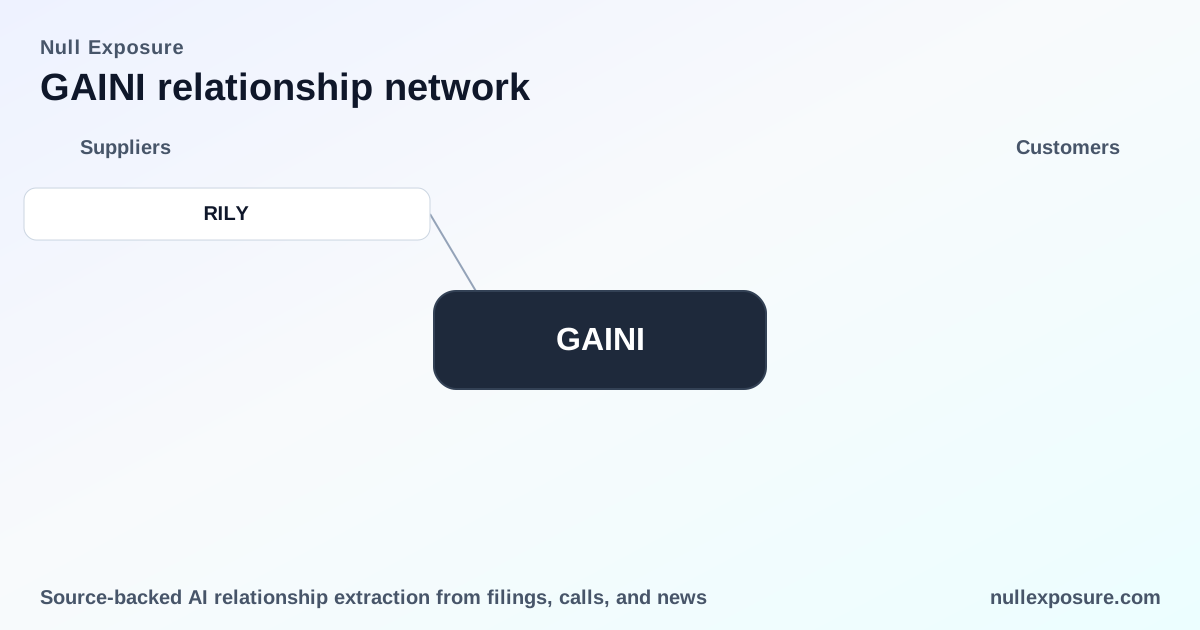
GAINI (Gladstone Investment) — Capital partners and supplier signal review for investors
Gladstone Investment Corporation operates as an externally managed business development company that originates and holds secured, income-generating loans to small and mid-sized companies and monetizes through interest income, management and incentive fees, and capital markets funding such as corporate notes. The 7.875% notes issued under ticker GAINI represent a financing vehicle that supplies durable, contract-level cash flow to the capital structure while the firm deploys proceeds into its loan portfolio to generate yield for shareholders. For deeper counterparty mapping and supplier diligence, visit https://nullexposure.com/.
Quick take: why supplier relationships matter to holders of GAINI
Gladstone’s operating model is highly dependent on external providers for portfolio management, administration and capital markets execution. That structure concentrates operational criticality outside the corporate balance sheet even while credit exposure resides squarely on Gladstone’s loan book. Understanding who underwrites, administers, and manages the company—plus the tenor and geography of its investments—changes how investors should frame liquidity and refinancing risk.
What the newsroom entries reveal about underwriting partners
Two press releases identified in March 2026 consistently name B. Riley Securities as the underwriting partner for a Gladstone debt offering. Each release states that B. Riley acted as sole book-running manager, indicating a concentrated capital markets relationship for those transactions.
- According to a Kitsap Sun press release dated March 9, 2026 (FY2025), B. Riley Securities acted as sole book-running manager for Gladstone’s offering; the release is specific to that notes offering and placement activity.
- A Lansing State Journal press release on March 9, 2026 (FY2026) contains the same characterization that B. Riley Securities served as sole book-running manager for a Gladstone notes offering, reinforcing continuity in underwriting coverage.
These public announcements show recurring use of a single lead manager across consecutive fiscal-period filings, which signals operational simplicity in issuance but also concentration risk if the issuer becomes dependent on a single intermediary for placement.
Complete list of supplier relationships discovered
- B. Riley Securities — FY2025: Press coverage reports B. Riley acted as sole book-running manager for Gladstone’s notes offering, indicating B. Riley led the transaction syndicate and placement efforts (Kitsap Sun, March 9, 2026).
- B. Riley Securities — FY2026: A second press release reiterates that B. Riley again served as sole book-running manager for a subsequent Gladstone offering, consistent with repeat engagement behavior (Lansing State Journal, March 9, 2026).
Company-level constraints that shape supplier risk and strategy
The available excerpts reveal several company-level signals about Gladstone’s operating constraints that investors must fold into counterparty assessment:
- Long-term contracting posture: Gladstone’s investment inventory and borrowing profile reflect long-tenor instruments. The firm holds secured first- and second-lien loans with multi-year maturities, and its revolving credit facility has defined expiration and backstop dates that create refinancing milestones. Those contractual maturities embed refinancing risk into the capital stack and influence when underwriting partners will be required.
- Geographic concentration with domestic diversification: Investments are concentrated in the United States across South, Midwest, West, and Northeast regions with a modest Canada allocation (roughly 3% as of March 31, 2025). This represents domestic exposure with regional diversification rather than global spread.
- Service-provider dependence and operational criticality: Gladstone is externally managed by Gladstone Management Corporation and administered by Gladstone Administration, LLC; it has no employees and pays management and administration fees. The firm’s operational continuity and compliance posture are therefore critically tied to these affiliates and to counterparties listed in its credit agreements. Excerpts show explicit agent roles for third-party banks in the credit facility documentation.
- Active supplier relationships: Relevant agreements are actively renewed and compensated—the Administration Agreement was renewed through August 31, 2025, and the Advisory Agreement continues to govern management fees—indicating that supplier arrangements are operational and currently executed.
These constraints collectively indicate an issuer whose funding and operational model is bankroll- and partner-dependent: long-term assets funded with a mix of facility availability and public notes, run by outsourced managers and administrators.
Risk / opportunity balance for operators and investors
Gladstone’s structure creates a straightforward risk/reward frame:
- Risks: refinancing and liquidity timing risk driven by the credit facility timeline and note maturities; concentration of capital markets execution if a small number of underwriters (e.g., B. Riley) are relied upon for placement; operational single-point dependency because the Adviser/Administrator provide essential services.
- Opportunities: high coupon debt such as GAINI can offer stable cash flow capture for investors while the BDC harvests spread income from secured loans; repeat engagements with a lead manager reflect an ability to access institutional desks for issuance.
Investors should underweight exposure to the issuer if they require diversified underwriting relationships or if they are highly sensitive to concentrated operational risk. Operators assessing counterparty limits should incorporate the Adviser/Administrator dependency and the timing of the credit facility’s revolving end date into concentration stress tests.
Further diligence and counterparty mapping are available at NullExposure
The underwriting relationship: what B. Riley’s role implies
B. Riley acting as sole book-running manager in consecutive press releases implies Gladstone uses trusted, repeat underwriters to execute debt placements. That suggests efficient execution and likely favorable placement economics for the issuer, but it also means investors should monitor underwriting concentration as a liquidity vulnerability if market access tightens.
How to act with this information
- For fixed-income investors evaluating GAINI, prioritize scenario analysis around the credit facility expiration and next big note maturities—understanding when Gladstone will need capital markets access is essential.
- For buy-side operational risk teams, assign higher operational-impact scores to external management/service-provider relationships (Gladstone Management & Gladstone Administration) and include those relationships in third-party oversight programs.
- For counterparty managers, track the continuity of underwriter engagement (B. Riley) and monitor market appetite for similar BDC debt to anticipate placement risk.
Concluding: Gladstone’s model is capital-markets-driven and service-provider dependent; the B. Riley press coverage confirms repeat underwriting behavior, while contractual excerpts highlight long-term loan profiles and active external management. For transaction-level or counterparty exposure decisions, integrate these supplier signals into refinancing timelines and operational continuity scenarios.
Visit NullExposure for full supplier intelligence and ongoing monitoring