Gladstone Investment Corporation (GAINN) — supplier relationships that shape funding and operations
Gladstone Investment Corporation issues publicly traded notes (including the GAINN 5.00% notes due 2026) and operates as a business development company that generates yield by financing small- and mid-sized private companies through debt and equity securities while outsourcing portfolio management and back-office functions to affiliated service providers. The company monetizes via interest and dividend income from its investments and through contractual advisory/administration arrangements with affiliates that deliver investment selection, portfolio management, and corporate administration services. For investors, the key read is twofold: capital markets activity and affiliate service agreements drive funding flexibility and operating leverage, and both require active monitoring. Read the relationship roll call below and then decide whether GAINN’s funding mix and supplier concentration match your risk appetite. For more supplier relationship intelligence, visit https://nullexposure.com/.
Capital markets moves that matter right now
Gladstone continues to access public debt markets and underwrite new notes to manage maturities and fund investments. On February 10, 2026 the company executed an underwriting agreement for $100 million of 7.125% notes due 2031, a transaction that used internal affiliates as the issuer’s administration and management counterparties and an external underwriter as the representative of the syndicate; this demonstrates an active liability-management posture and continuing reliance on both affiliate and external capital markets partners (press release, The Globe and Mail, Feb 10, 2026).
Liquidity relationships and credit lines — practical implications
Liquidity is supplemented with bank commitments: Gladstone expanded its credit facility to include City National Bank with a $30 million commitment, a sign that the company is diversifying funding sources beyond public notes and affiliate-provided capital (earnings call transcript, Q3 FY2026). That incremental capacity is material for short-term working capital and opportunistic investments.
Service providers and corporate plumbing that run the business
The company is externally managed and administrated by Gladstone affiliates, and it uses market infrastructure providers for shareholder and listing services. Computershare handles share purchases under the company’s plan, and the firm remains listed on NASDAQ under the GAIN symbol, supporting liquidity for equity instruments (FY2025 10‑K; earnings call transcript, Q3 FY2026).
Relationship roll call — concise takeaways for each counterparty
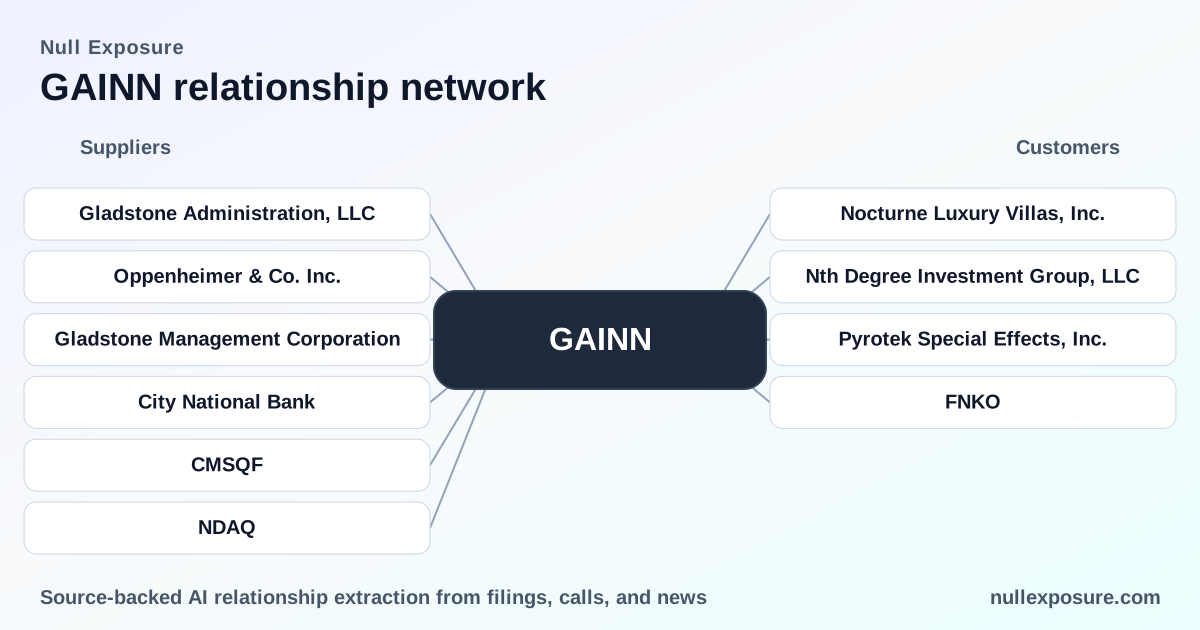
Gladstone Administration, LLC
Gladstone Administration provides administrative services under an Administration Agreement and is an affiliated provider for rent, payroll and corporate officers who carry out day-to-day administration; this arrangement is a core part of GAINN’s operating model and is actively in force (company 10‑K disclosures describing the Administration Agreement and related allocations).
Oppenheimer & Co. Inc.
Oppenheimer served as the representative of the underwriters on the $100 million notes offering, acting as the external distribution partner for Gladstone’s 2026–2031 liability management; this places Oppenheimer in the role of capital markets intermediary for the transaction (press release, The Globe and Mail, Feb 10, 2026).
Gladstone Management Corporation
Gladstone Management is the external adviser that provides investment advisory and management services under the Advisory Agreement; the adviser relationship is active, integral to portfolio construction, and a principal driver of operating performance (10‑K disclosures on the Advisory Agreement and management arrangements).
City National Bank
City National Bank was added to Gladstone’s credit facility with a $30 million commitment, expanding the company’s bank lending capacity and providing near-term liquidity access outside the public note market (earnings call transcript, Q3 FY2026).
Computershare (CMSQF)
Computershare is used for share repurchases and plan-related purchases, executing transactions in the open market on Gladstone’s behalf in accordance with the company’s plan obligations (FY2025 10‑K, filing gainn-2025-03-31).
NASDAQ (NDAQ)
Gladstone’s common stock and preferred securities trade on NASDAQ (common symbol GAIN), which provides the public-market listing and trading venue for the company’s equity and preferred instruments (earnings call transcript, Q3 FY2026).
What the documented constraints reveal about how GAINN operates
- Contracting posture is short-term for core administration: the firm’s board approved an annual renewal of the Administration Agreement through August 31, 2025, signaling that at least some administrative contracts are renewed annually and subject to governance review — a company-level signal that creates periodic re‑negotiation and governance checkpoints.
- Geographic exposure is North America‑centric: investments are concentrated in U.S. regions (South, Midwest, West, Northeast) with a small Canadian allocation (3% as of March 31, 2025), implying portfolio credit and economic sensitivity is primarily to U.S. regional cycles (FY2025 filings).
- Service-provider model and concentration: Gladstone is externally managed and administered by affiliates (Gladstone Management Corporation and Gladstone Administration, LLC), an active and central operating construct that lowers in-house overhead but creates operational concentration and counterparty dependency (Advisory and Administration Agreement excerpts).
- Stage and segment clarity: relationships are active and oriented to services — advisory, administration and capital-raising — which makes these counterparties critical to ongoing operations and to funding execution.
These signals together mean that investors should treat affiliate management and administration as operationally critical and funding counterparties (banks and underwriters) as the levers for solvency and growth.
Midstream investor action — what to monitor
- Monitor upcoming maturities (GAINN notes due 2026) and how the company executes refinancing or repayment.
- Watch the status of administration/advisory agreements at each renewal date; annual renewals create governance decision points that affect continuity.
- Track bank commitments and underwriter relationships for signs of widening funding costs or reduced capacity.
For a structured view of supplier risk and financing counterparties, review our platform at https://nullexposure.com/ — the supplier map clarifies counterparties, contract terms, and concentration metrics.
A concise checklist for investors
- Confirm maturity ladder and recent notes issuance activity; treat the 2026 notes maturity as immediate priority.
- Review the FY2025 10‑K disclosures on related-party agreements and expense allocations to understand fee flows to affiliates.
- Monitor credit facility usage with City National Bank and other banks for signs of liquidity strain or covenant pressure.
- Evaluate geographic concentration risk given heavy U.S. regional exposure and limited Canadian allocation.
For ongoing supplier intelligence and to track changes in these relationships in real time, visit https://nullexposure.com/.
Bottom line: GAINN runs a capital-markets‑driven funding strategy paired with an affiliate-centric service model. That combination delivers scale and predictable operating overhead but concentrates operational and reputational risk in a small set of affiliated providers and a small number of external funding partners. Investors should prioritize watching funding spreads, affiliate contract renewals, and the near-term maturity schedule to assess whether the return profile compensates for supplier concentration and refinancing risk.