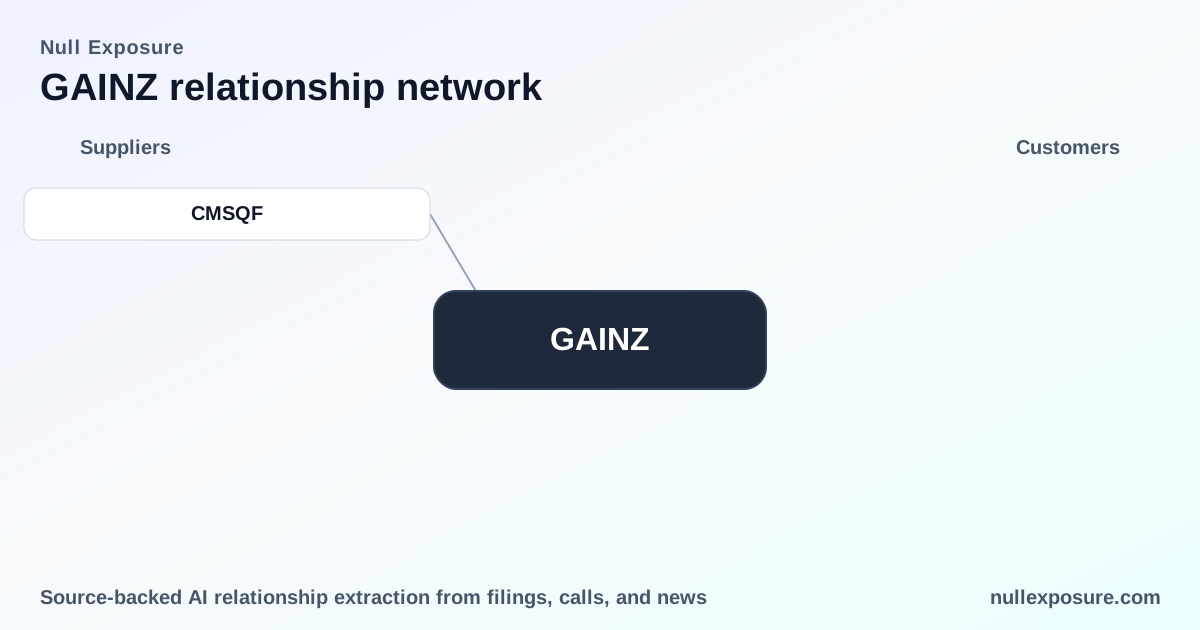
GAINZ: Supplier relationships and operational footprint investors need to price in
Gladstone Investment Corporation’s 4.875% Notes due 2028 (ticker: GAINZ) funds a business development company that originates and holds debt and equity in lower‑middle‑market U.S. companies, earning through interest, servicing fees and capital appreciation while using public note issuance for liquidity and financing. The company is externally managed and reimburses administrative costs, so counterparty relationships drive both operating leverage and operational risk — investors should evaluate supplier roles as financial dependencies as much as operational ones. For sourcing further diligence, visit https://nullexposure.com/.
How GAINZ structurally makes money and where suppliers plug in
Gladstone Investment Corporation operates as a BDC that lends to and takes equity in small and medium private firms, targeting companies with EBITDA generally between $4 million and $15 million and holding instruments often with ~five‑year terms. Income streams are:
- Interest and yields on debt investments (many indexed to 30‑day SOFR or fixed rates).
- Management and incentive fees paid to the external Adviser and loan servicing fees tied to the firm’s credit portfolio.
- Capital gains or equity appreciation from portfolio exits.
The security in question, the 4.875% Notes due 2028, is a financing instrument that complements operational funding — investors receive a fixed coupon while the issuer maintains a portfolio whose cash flow supports distributions. The FY2025 filing highlights the company’s emphasis on U.S./Canadian regional exposure and a significant services allocation within its investments. According to the FY2025 Form 10‑K, the firm discloses this operating model and fee structure in its Advisory and Administration arrangements.
Supplier and counterparty profile that matter to due diligence
The company filing and extracted evidence present a consistent portrait of outsourced operations and mid‑market credit concentration. Key company‑level signals:
- Long‑tenor credit posture. Debt investments typically have a five‑year term and are priced with SOFR‑linked variable interest (FY2025 Form 10‑K), which creates both rate sensitivity and a predictable maturity ladder for portfolio cash flows.
- Mid‑market credit focus. Portfolio counterparties are primarily lower‑middle‑market businesses (EBITDA $4M–$15M), concentrating credit risk into a particular borrower profile and underwriting bandwidth.
- Regional concentration. Investments are reported across the U.S. and Canada, anchoring legal, tax and recovery regimes to North American norms.
- Externally managed operating model. The Adviser and Administrator play material operational roles; the company reimburses the Administrator for staff, rent and IT, and pays management/incentive fees to the Adviser (10‑K disclosures).
- Service supplier ecosystem. The Adviser uses an independent third‑party information technology service provider (ISP) for IT strategy, and the credit facility naming KeyBank indicates bank counterparty involvement in financing arrangements (10‑K).
These characteristics create predictable points of focus for investors: counterparty concentration in underwriting skill and operational execution (Adviser/Administrator), rate and refinancing exposure from SOFR‑linked loans and public notes, and operational dependency on third‑party service providers for IT, administration and trustee/transfer functions.
The supplier relationships found in the filings
Computershare — Computershare purchases shares in the open market in connection with the obligations under the plan; the FY2025 Form 10‑K records this activity, indicating Computershare performs share‑acquisition operations tied to the company’s plan obligations (FY2025 10‑K). This implies a standard transfer/agent or share‑settlement role for Computershare in executing repurchases or plan deliverables (source: Gladstone’s FY2025 Form 10‑K, filing dated March 31, 2025).
(That completes the set of supplier relationships identified in the search results. For a broader view on counterparties named in the same filings, see the next section.)
Other counterparties named in the filings and what they do
- Adviser / Administrator — The company is externally managed by an SEC‑registered Adviser and reimburses the Administrator for staff and rent; the Adviser also collects base and incentive management fees and a loan servicing fee as disclosed in the FY2025 Form 10‑K. These arrangements make the Adviser and Administrator central to operations and governance (FY2025 10‑K).
- KeyBank National Association — Named in an amendment to the credit agreement, KeyBank serves as administrative agent and lead arranger for the firm’s credit facility, anchoring external financing capacity (Amendment No. 7 to the Fifth Amended and Restated Credit Agreement, incorporated by reference in the FY2025 filing).
- Independent ISP (IT service provider) — The Adviser uses an independent third‑party ISP to manage IT strategy, indicating outsourced IT governance that is material to trade execution, reporting and compliance (FY2025 10‑K).
These named counterparties are documented in the company’s regulatory disclosures and represent core operational and financing relationships that investors should monitor for contract renewals, fee structure changes and operational resilience.
Visit https://nullexposure.com/ for deeper supplier mapping and to view how these relationships compare across peer BDCs.
What this means for investors and operators — risks and monitoring priorities
- Operational concentration risk: Externalized management concentrates operational execution with the Adviser/Administrator; any disruption or contract renegotiation could materially affect costs and governance. Monitor advisory fee schedules and contract amendments.
- Credit concentration and recovery profile: Lower‑middle‑market credit can produce outsized volatility in economic downturns; track portfolio sector exposures and default/loss rates rather than headline yields alone.
- Funding and rate exposure: SOFR linkage across loans plus public notes due in 2028 creates a refinancing timeline and rate sensitivity; stress test cash flows against rising funding costs and earlier credit impairments.
- Counterparty operational resilience: KeyBank, the ISP and Computershare provide critical services; require routine confirmation of SLAs, custody arrangements and disaster recovery plans as part of operational diligence.
Key actions for an investor or operator: obtain the latest Advisory/Administration agreements and credit facility terms, request breakdowns of portfolio maturities and sector concentration, and validate the operational continuity plans for the Administrator and IT provider.
Bottom line and next steps
GAINZ offers a yield profile supported by a mid‑market lending strategy and an externally managed operating structure that creates both leverage and dependency on third‑party suppliers. For active investors, the material questions are whether the Adviser’s underwriting can sustain credit cycles, whether the Administrator and service providers maintain operational continuity, and whether refinancing risk around the 2028 note maturity is priced appropriately.
For a tailored supplier risk map and comparative supplier analytics across BDCs, start your review at https://nullexposure.com/. Conducting direct contract reviews for Adviser/Administrator agreements and the credit facility will answer most near‑term operational and credit questions.