Gain Therapeutics (GANX): supplier and service relationships investors should price-in now
Gain Therapeutics develops small-molecule therapies targeting protein misfolding and monetizes through advancing clinical-stage assets toward partner licensing deals or commercialization; the company is currently pre-revenue, outsources manufacturing and clinical execution, and funds operations through capital markets transactions and investor relations activities. Key operational levers for investors are clinical progress, the ability to access financing, and the stability of outsourced manufacturing and CRO relationships. For a concise supplier and partner intelligence briefing, visit https://nullexposure.com/.
How Gain runs the business and where it makes (or will make) money
Gain is a classic early-stage biotech: no product revenues and negative operating results, with value concentrated in its pipeline and intellectual property. The company has no internal manufacturing capacity and explicitly relies on third-party contract manufacturing organizations (CMOs) and contract research organizations (CROs) to advance trials and, in the future, to produce commercial supply. Financially, Gain shows negative EBITDA and zero revenues for the trailing period, a market capitalization of roughly $97 million, and an analyst consensus target price of $7.60 anchored by a largely buy-side analyst universe.
This operating model produces these practical characteristics for investors:
- Outsourced contracting posture: core execution—manufacturing and clinical trial conduct—is delegated to external partners, making counterparty quality and contracting terms material to commercial viability.
- Concentration risk: constraints identify a primary manufacturer located in China (WuXi AppTec), creating country and supplier concentration that is strategically relevant given recent policy scrutiny.
- Criticality of third parties: CMOs and CROs are mission-critical; disruption to these suppliers delays clinical milestones and forces dilution via more frequent financing.
- Maturity signal: absence of revenue and negative returns on assets place Gain in the high-binary, high-valuation-variance category typical of small-cap biotech names.
Supplier, investor-relations and banking relationships to know
Below are the relationships surfaced in recent public reporting. Each relationship is described in plain English with the reporting source cited.
-
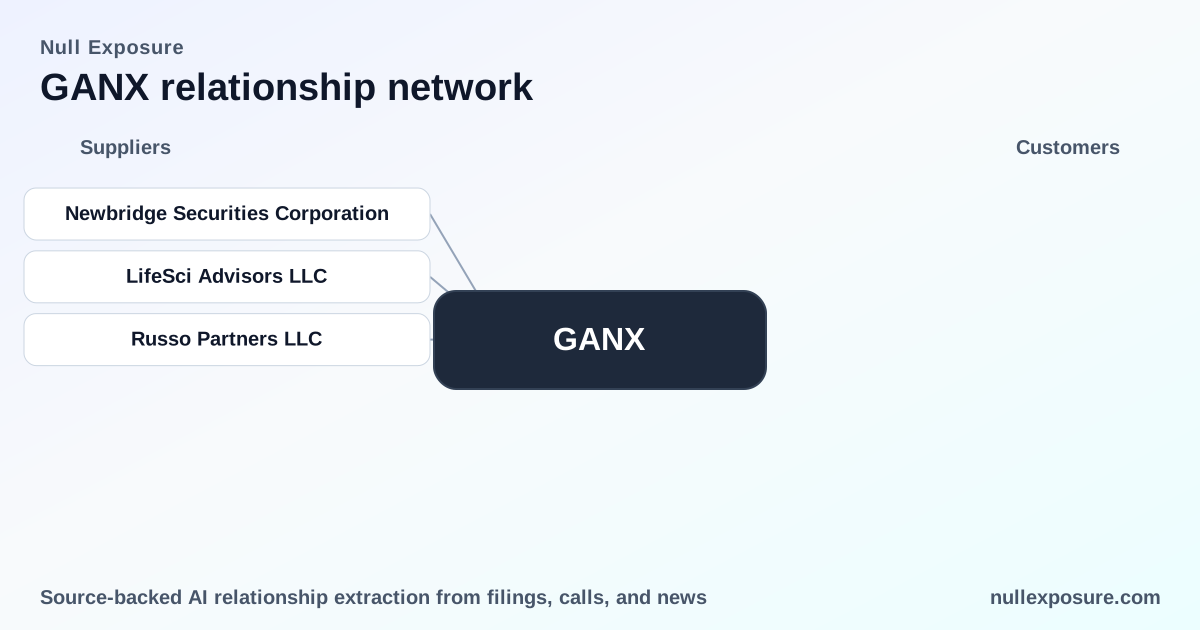
Newbridge Securities Corporation is serving as the sole book-running manager for a proposed public offering for Gain Therapeutics, indicating an active equity financing process to support near-term funding needs; this was disclosed in a press release shared on Yahoo Finance on March 9, 2026. According to the March 2026 Yahoo Finance release, Newbridge is leading the deal process for the proposed offering.
-
LifeSci Advisors LLC is listed as a point of contact for investor relations and public relations in Gain’s announcement about presenting at the Oppenheimer 36th Annual Healthcare & Life Sciences Conference, reflecting an outsourcing of IR functions to a specialist agency; this appears in a GlobeNewswire announcement carried by The Manila Times on February 19, 2026. A GlobeNewswire release (reported by The Manila Times, Feb 19, 2026) shows LifeSci Advisors as an IR contact.
-
Russo Partners LLC is identified as the media relations firm supplying press and outreach support for Gain’s conference presentation, signaling outsourced communications for media strategy and coverage; this is also recorded in the same GlobeNewswire/Manila Times posting on February 19, 2026. The Feb 19, 2026 GlobeNewswire notice (via The Manila Times) lists Russo Partners as media contacts for the company.
What these relationships tell investors about capital strategy and execution risk
The Newbridge engagement is the most consequential signal for near-term valuation: the appointment of a sole book-runner strongly implies an imminent equity raise or shelf takedown, which will materially affect dilution and the financing runway. Gain’s lack of revenue and persistent negative EBITDA make access to capital a recurring strategic priority, and the Newbridge relationship is directly tied to that priority.
Outsourced IR and media (LifeSci Advisors, Russo Partners) reflect a deliberate externalization of investor communications. That choice is consistent with small-cap biotechs that rely on specialized agencies to amplify messaging around clinical readouts and financing events. Investor communications quality can directly influence market reception of financings and the volatility of the stock around milestones.
Mid-cycle CTA: for a deeper supplier and partner risk map and to monitor announcements tied to these relationships, consult https://nullexposure.com/.
Supply-chain and geopolitical risk — company-level constraints to price
Company-level constraints flag the following, all of which are material to execution and valuation:
- A named primary manufacturer, WuXi AppTec in China, is identified as a supplier and is subject to elevated U.S. government scrutiny, raising geopolitical and export-control risk for manufacturing continuity.
- No internal manufacturing capability: Gain’s program timelines and commercialization risk are contingent on third-party CMOs, so contract terms, capacity prioritization, and secondary sourcing options are critical.
- Heavy reliance on CROs and clinical sites for trial operations makes the timely execution of studies dependent on external project management and regulatory compliance by third parties.
These constraints collectively create a profile where single-supplier exposure, offshore manufacturing, and outsized funding dependence are the primary operational risks investors must monitor.
How to watch these relationships and signals in practice
- Track SEC filings and the prospectus tied to the Newbridge-managed offering for deal size, use of proceeds, and lock-up/overallotment structure.
- Monitor press releases and conference presentations (e.g., Oppenheimer conference activity noted in February 2026) for clinical updates that will drive capital needs and investor sentiment.
- Watch any disclosures about alternative CMOs or redundancy plans; announcements of additional manufacturing partners materially reduce concentration risk.
- Evaluate IR and media outputs for messaging consistency and timing—LifeSci and Russo Partners will shape the narrative around financing and clinical milestones.
Bottom line — what investors should do now
Gain Therapeutics is a pre-revenue, development-stage biotech whose value hinges on clinical progress and the firm’s ability to finance operations. The Newbridge relationship signals imminent capital activity; outsourced IR and media relationships indicate deliberate market-facing communications; and company-level constraints identify material supplier concentration and geopolitical risk tied to a primary CMO in China. For investors, the trade is clear: upside is driven by successful clinical data and partnerships, while downside is driven by manufacturing disruption and funding shortfalls.
Final CTA: to track these supplier and partner developments in real time and integrate them into investment workflows, go to https://nullexposure.com/.
Make any financing filings and CMO announcements the immediate triggers for portfolio action: adjust position sizing ahead of prospectus terms or confirm diversification of manufacturing partners before increasing exposure. For targeted alerts and deeper supplier intelligence, see https://nullexposure.com/.