Golub Capital BDC (GBDC): who supplies the engine and what it means for investors
Golub Capital BDC (GBDC) is an externally managed BDC that generates returns primarily from interest income on senior‑secured and unitranche loans to U.S. middle‑market companies, while outsourcing operations to affiliated managers that collect base and incentive fees. The company’s economics hinge on lending spreads, leverage from credit facilities and repurchase agreements, and predictable fee flows to its external adviser and administrator. For investors evaluating supplier relationships, the critical facts are who runs the credit book, who provides administrative continuity, and how financing lines and service fees shape margin and liquidity. Learn more about supplier intelligence and relationship signals at https://nullexposure.com/.
The commercial logic behind the supplier footprint
Golub Capital BDC’s operating model is built around a few concentrated service relationships that are material to both operations and costs. The investment adviser and administrator execute sourcing, underwriting, portfolio monitoring and back‑office functions; their fees are a primary operating expense. At the same time, the company uses a blend of long‑term secured credit (a JPMorgan facility) and short‑term repo financing to warehouse loans and manage liquidity. These elements create a supplier posture that is service‑provider heavy, moderately concentrated, and structurally critical to ongoing cash generation.
- Contracting posture: the firm runs both long‑dated secured credit (JPMorgan facility maturing 2030) and short‑term repurchase lines, which together balance term funding with tactical liquidity.
- Concentration and criticality: advisory/administrative relationships are material — advisory fees and administrative charges show up as the company’s primary operating expenses and thus are central to margin sustainability.
- Maturity and stage: advisory agreements and administrative arrangements are active and approved recently (board approval in 2025), indicating stable, ongoing engagements rather than transient contracts.
- Geography and counterparty profile: lending is concentrated on U.S. middle‑market companies, while the broader platform draws on the resources of a very large Golub Capital platform ($85B+ AUM referenced in filings).
These signals are drawn directly from the company’s filings and contemporary coverage: the JPMorgan facility terms and repurchase agreements are described in SEC filings through FY2025–FY2026; management and administrative arrangements are detailed in investor materials and 10‑Q summaries.
Supplier-by-supplier: what investors need to know
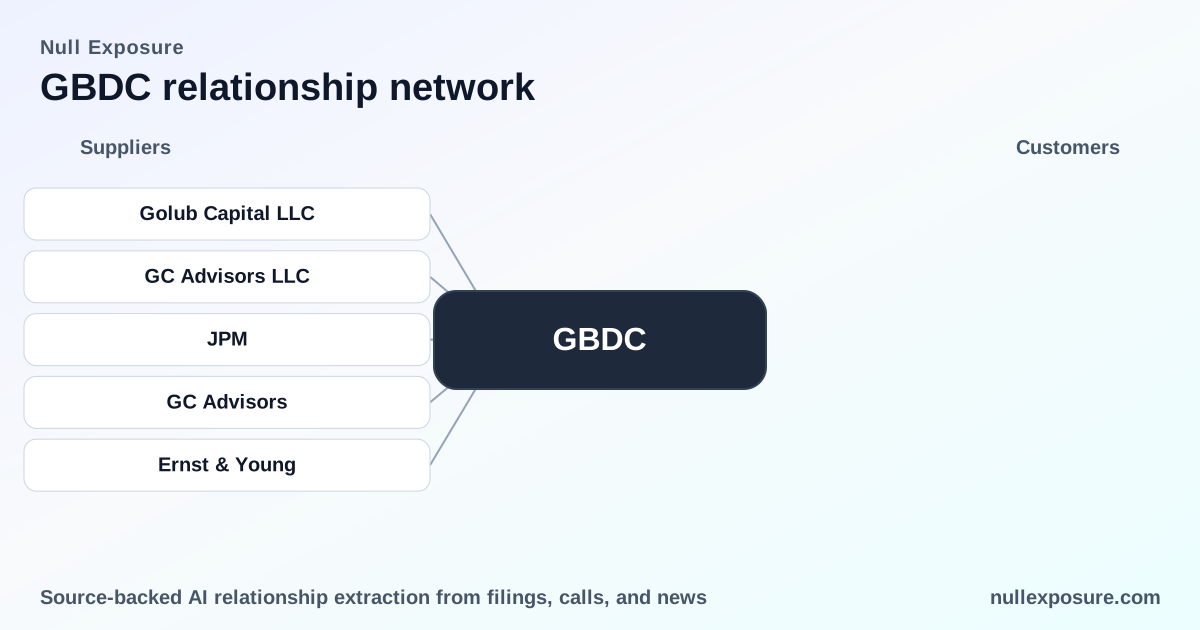
Golub Capital LLC
Golub Capital LLC functions as the Administrator, providing office facilities, clerical, bookkeeping and recordkeeping services that enable day‑to‑day operations. According to media coverage and the company’s administration agreement language, Golub Capital LLC supplies core administrative support that is contractually significant to GBDC’s operations (MarketBeat instant alert, Mar 8, 2026 — https://www.marketbeat.com/instant-alerts/golub-capital-bdc-inc-nasdaqgbdc-receives-consensus-rating-of-buy-from-analysts-2026-03-08/).
GC Advisors LLC
GC Advisors LLC is the investment adviser that manages sourcing, diligence, structuring and portfolio monitoring, and it collects base management and incentive fees that are a material component of operating expense. Coverage focused on the manager’s emphasis on credit quality and scalable business models confirms GC Advisors’ central operating role (SureDividend profile, FY2025 — https://www.suredividend.com/high-dividend-gbdc/).
GC Advisors (operational reference in filings)
The company’s SEC filings and 10‑Q summaries describe GC Advisors as the entity responsible for day‑to‑day investment activities and for implementing the firm’s cybersecurity and collateral‑management programs; the board provides independent oversight, but GC Advisors runs the engine. This operational description is captured in a TradingView synopsis of the company’s FY2026 10‑Q (TradingView news, FY2026 SEC 10‑Q summary — https://www.tradingview.com/news/tradingview:77b9be479f95f:0-golub-capital-bdc-inc-sec-10-q-report/).
JPMorgan
JPMorgan is the administrative agent and collateral agent on the senior secured revolving credit facility that provides multiyear committed liquidity; the facility terms (including a maturity date of April 4, 2030 and ~$1.998M in reported capacity as of Sep 30, 2025) position JPMorgan as the firm’s primary long‑term lender. There is also public commentary that the company amended JPMorgan credit agreements to improve borrowing flexibility (SureDividend coverage, FY2025 — https://www.suredividend.com/high-dividend-gbdc/; company credit facility language in filings through FY2025).
Ernst & Young
Ernst & Young serves as the independent auditor, a standard but essential supplier that ratifies financial reporting and internal controls; the auditor was ratified at the company’s recent virtual annual meeting (Finviz news, FY2026 — https://finviz.com/news/289488/golub-capital-bdc-gbdc-seen-as-defensive-play-in-new-lucid-capital-coverage).
How supplier structure translates to investor risk and return
The supplier map creates a clear set of investment implications:
- Operational concentration risk: the adviser/administrator duo (GC Advisors / Golub Capital LLC) handle both investment decisions and back‑office continuity; advisory fees are material and therefore operational failure or contract disruption would be earnings‑negative. This is visible in the company’s fee disclosures and administration agreement language.
- Liquidity and leverage profile: the combination of a long‑term JPM credit facility (maturing 2030) and active repurchase agreements provides flexibility but introduces counterparty and refinancing risk if market conditions tighten. Filings through 2025 document the facility size and repo usage.
- Counterparty mix: portfolio exposure is concentrated in U.S. middle‑market borrowers, which supports yield but increases sensitivity to cyclical credit stress in that segment; the platform’s access to a large Golub Capital franchise partially offsets underwriting risk.
- Spend and governance signals: disclosed spend bands and explicit management fees indicate predictable cost lines (base management fee, administrative service fee), and the board’s recent approval of the Investment Advisory Agreement signals governance continuity.
If you want a consolidated supplier risk brief or model-ready relationship map, visit https://nullexposure.com/ for a tailored report.
Practical takeaways for investors and operators
- Primary value driver: interest income on senior‑secured and unitranche loans; the adviser is directly compensated for generating and managing that income stream.
- Primary risk driver: reliance on a small set of service providers for both investment decisions and administration, paired with leverage from a JPMorgan facility and repo lines.
- Monitoring priorities: track contract renewal terms and any amendments to the JPM credit facility, watch advisory fee structure and incentive fee triggers, and review auditor continuity and board independence disclosures.
For deeper supplier intelligence and to see how these relationships compare across the sector, get a tailored supplier analysis at https://nullexposure.com/.
Final recommendation: investors should underwrite GBDC’s returns assuming ongoing fee outflows to its adviser/administrator and structural leverage, and stress‑test scenarios where advisory continuity or financing terms deteriorate. For an operationally-focused risk brief and supplier remediation checklist, visit https://nullexposure.com/ to request a custom analysis.