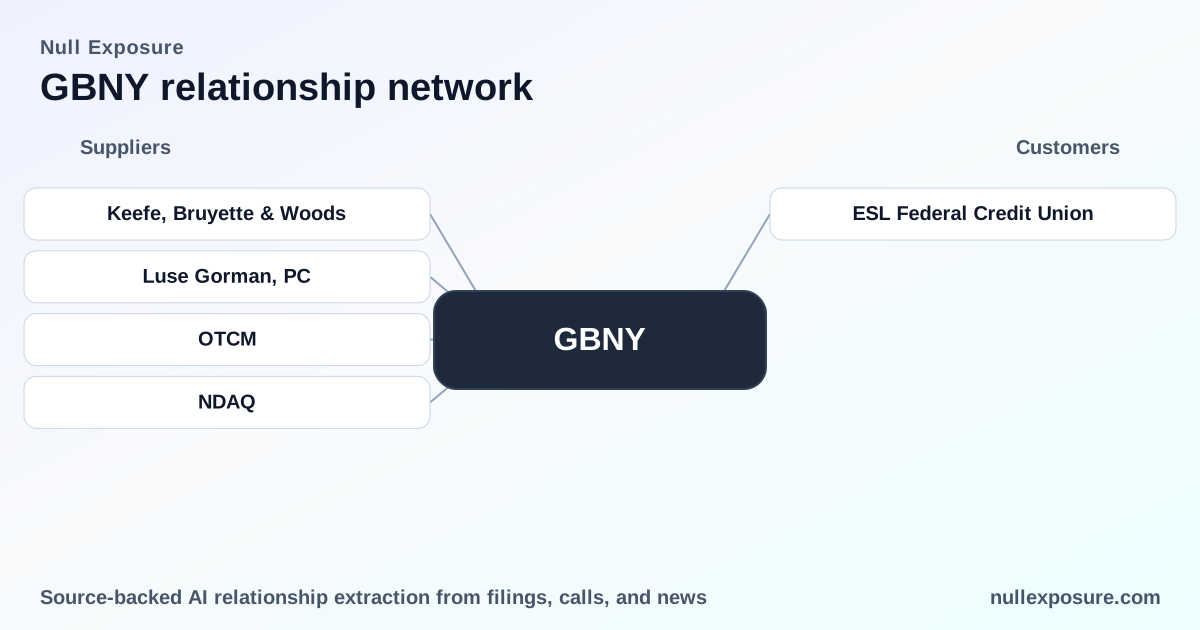
Generations Bancorp NY (GBNY): A compact regional bank with transactional supplier map
Generations Bancorp NY operates as the holding company for Generations Bank, a small regional commercial bank based in Seneca Falls, NY, that generates revenue through traditional banking channels — interest income on loans, deposit spreads, and fee income — supplemented by occasional balance-sheet actions such as loan purchases and disposition activity. The company’s commercial posture is that of a regional lender with concentrated regional exposure, transactional advisor relationships tied to capital markets activity, and a deliberate move off the Nasdaq that reduces public reporting and liquidity. For a concise supplier/advisor risk readout, continue to the supplier section below or explore our broader supplier coverage at NullExposure.
Financial backdrop and what matters to counterparties Generations is a low‑market‑cap regional bank (market capitalization roughly $33.5 million) running a small revenue base (Revenue TTM ~$7.65 million) with negative reported EPS and margins (Diluted EPS TTM: -1.23; Profit Margin: -62.4%). Price-to-book is roughly 0.97, signaling that the market values the company close to its book equity but reflects persistent earnings weakness. Institutional ownership is effectively nil while insiders control a material share (~17.5%), a structural factor that influences negotiating dynamics with suppliers and advisers. The company voluntarily delisted from Nasdaq and expects quotation on OTCQX, a shift that reduces regulatory disclosure and public liquidity — relevant for counterparties that price risk by public transparency.
Supplier and advisor relationships that matter Below are all supplier/partner exposures disclosed in recent public sources, with short, plain-English summaries and the cited press coverage.
Keefe, Bruyette & Woods
Generations retained Keefe, Bruyette & Woods, a Stifel company, as its exclusive financial advisor in connection with strategic transaction activity tied to the bank’s disposition process. This relationship identifies the firm as the lead investment-bank advisor on the transaction referenced in market reports. According to CityBiz coverage, Keefe, Bruyette & Woods acted as exclusive financial advisor (CityBiz, March 2026).
Luse Gorman, PC
Luse Gorman served as legal counsel to Generations in the same strategic transaction, handling transaction documentation and regulatory legal work. CityBiz reported that Luse Gorman, PC was engaged as legal counsel in the transaction process (CityBiz, March 2026).
OTC Markets Group Inc. (OTCM)
OTC Markets Group is the operator of the OTCQX market where Generations expects to be quoted after voluntary Nasdaq delisting. The move to OTCQX repositions the company into a less-liquid, less-regulated trading venue that nonetheless maintains a structured quotation service for OTC securities. OTC Markets Group confirmed Generations’ qualification to trade on OTCQX (OTC Markets Group press release as relayed via Globe and Mail, 2026).
OTCQX Market
Generations formally announced expectations to quote its common stock on the OTCQX Market following Nasdaq delisting, retaining the ticker symbol GBNY for the OTC quotation. The company communicated the operational step to transition trading to OTCQX in a PR Newswire release discussing voluntary Nasdaq delisting and SEC deregistration (PR Newswire, FY2024 disclosure).
The Nasdaq Stock Market LLC (Nasdaq)
Generations announced a voluntary delisting from The Nasdaq Stock Market LLC and its intention to deregister securities with the SEC, concluding its prior relationship as a Nasdaq‑listed issuer. The company publicly disclosed its voluntary delisting and deregistration intent in its announcement to the market (PR Newswire, FY2024), and media coverage highlights that the company previously traded on Nasdaq (Globe and Mail, 2026).
NASDAQ (as referenced in press)
Press coverage reiterates that Generations previously traded on NASDAQ before the delisting process, underscoring the transition in public-market relationships and the resulting implications for trading liquidity and disclosure. The Globe and Mail press release noted the prior Nasdaq listing in the context of the OTCQX qualification (Globe and Mail, 2026).
Operating model constraints and what they signal for suppliers and investors Generations’ public materials and excerpts provide company-level signals that matter for supplier risk assessment:
-
Regional concentration and asset sourcing posture. Evidence that the bank purchases high‑quality automobile loans originated in the Northeastern United States and that it began purchasing owner‑occupied residential loans from a third‑party originator in 2022 indicates an active asset purchase strategy that supplements originated lending. This structure increases dependence on third‑party originators for loan volume and can concentrate credit and operational risk regionally.
-
Service‑provider and transactional orientation. The engagement of an exclusive financial advisor and outside counsel for a disposition process reflects a transactional vendor posture: the company hires specialist advisors for discrete strategic events rather than sustaining broad capital‑markets teams internally. That approach reduces fixed costs but elevates vendor criticality during transactions.
-
Disclosure and liquidity constraints. Voluntary Nasdaq delisting and SEC deregistration reduce disclosure frequency and market liquidity. Suppliers and counterparties must price for lower public transparency and a concentrated insider ownership base that affects governance and negotiation leverage.
-
Maturity and counterparty concentration. The bank’s modest scale, limited revenue base, and negative earnings metrics indicate a lower maturity profile relative to larger regional peers, and a higher probability that single transactional counterparties (advisors or originators) are consequential to near-term outcomes.
Why these relationships change the commercial calculus
-
Advisory and legal engagements demonstrate active exit or recapitalization strategy. The presence of an exclusive financial advisor and legal counsel in reported filings directly ties to the company’s strategic transaction (including a reported acquisition by ESL Federal Credit Union). For counterparties, advisors' reputations and transactional outcomes materially affect counterparty recovery and operational continuity.
-
Transition to OTCQX alters counterparty risk pricing. Trading on OTCQX preserves a quotation venue but reduces daily liquidity and analyst coverage; counterparties that rely on public market signals will apply wider risk premia and request tighter contractual protections.
-
Loan purchase activity increases operational dependency on originators. Buying auto and residential loans from third parties brings sourcing flexibility but concentrates operational and credit oversight responsibilities on the bank — vendors providing loan servicing, representations & warranties insurance, or data validation services become more critical.
Explore detailed supplier mapping, contract visibility, and counterparty risk analytics at NullExposure — useful for underwriters, treasury teams, and institutional buyers assessing transactional risk.
Investor takeaways and recommended next steps Generations Bancorp NY is a small, regionally concentrated banking franchise that is actively managing balance-sheet sourcing and strategic options. Key investment takeaways are: modest market capitalization, ongoing negative profitability, executed voluntary Nasdaq exit, and a patchwork of transactional relationships (investment bank, legal counsel, OTC market operator) that together reduce public liquidity while preserving a pathway for strategic closure. For suppliers and counterparties, the most pressing considerations are counterparty concentration on originators, the elevated role of transactional advisors during strategic events, and reduced public transparency post‑deregistration.
For due diligence or to model counterparty exposure across the bank’s advisor and market relationships, consult our supplier intelligence and scenario playbooks at NullExposure. For tailored risk reports or portfolio-level supplier scoring, visit NullExposure to contact our team.