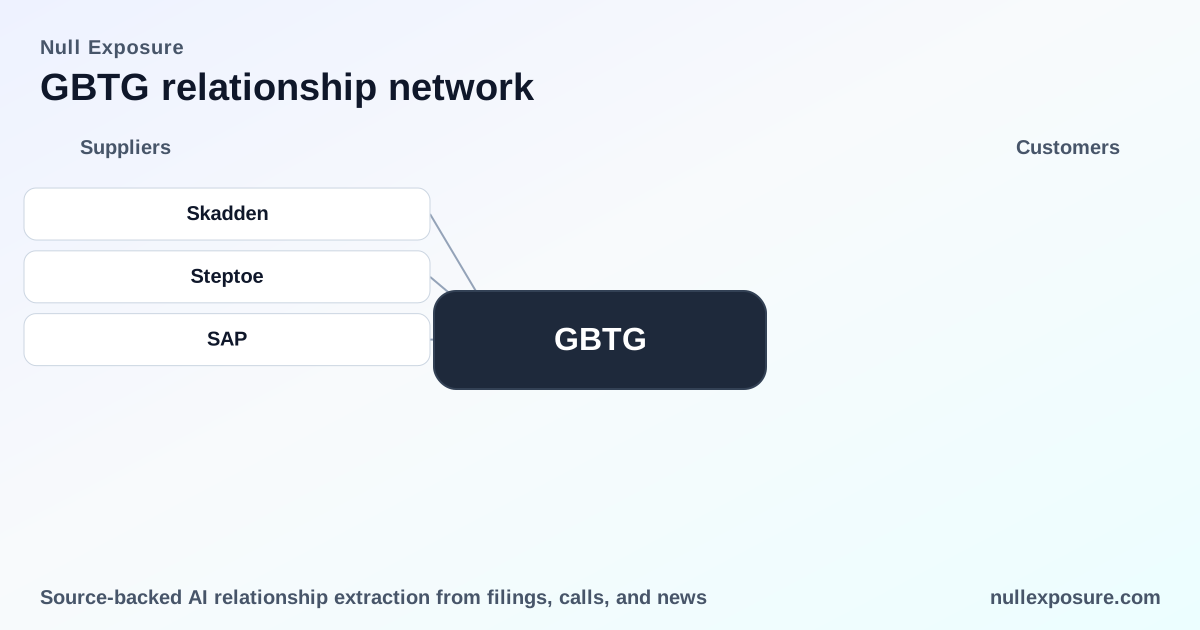
Global Business Travel Group (GBTG): supplier relationships that shape margins and strategic optionality
Global Business Travel Group, Inc. (NYSE: GBTG) operates a B2B travel platform that monetizes through travel booking commissions, service fees, and brand licensing, while expanding into expense and payments revenue via strategic alliances. The company’s core economics combine recurring booking volumes with higher-margin platform and services revenue; EBITDA of $328m on $2.72bn trailing revenue underlines a business that scales with transaction flow but depends on a small set of strategic commercial and legal relationships to protect growth and the American Express-branded franchise. For a focused supplier risk and opportunity assessment, see more at https://nullexposure.com/.
Why supplier relationships matter for investors
GBTG’s business model is operationally interdependent: booking flow, supplier inventory access and the branded customer relationship drive revenue, while legal and technology partners determine how cleanly the company can execute deals and expand into adjacent revenue streams. The company-level signals from recent disclosures show a mix of long-term brand licensing, short-term operational handoffs, and active alliances to extend payments and expense monetization — a mix that creates both upside (new revenue streams) and concentrated operational risks (brand dependency and transition exposures).
Key company-level operating signals
- Long-term trademark licensing: GBTG holds an 11-year amended and restated trademark license with American Express that grants worldwide rights to operate under the Amex GBT brands; this is a structural feature of the firm’s go-to-market positioning and brand economics (company filing language describing the A&R Trademark License Agreement).
- Short-term operational arrangements exist: certain operational services for the Egencia business were provided by an Expedia affiliate under an up-to-18-month operating agreement signed May 1, 2024, underscoring transitional service risk where third-party providers temporarily support operations.
- Global supplier footprint and spend scale: GBTG positions itself as a global intermediary to airlines, hotels, car rental firms and GDSs; reported supplier costs in the $10–100m band for discrete items underline material counterparty spend and negotiation leverage as an investor-level risk factor.
- Service-provider roles are diverse: the company sources legal, advisory and technology services from external firms and counts both long-standing suppliers (airlines, hotels, GDSs) and short-term transition providers in its operating model.
Explore a practical market view and supplier exposure map at https://nullexposure.com/ for more granular signals.
Legal partners in the spotlight: Steptoe and Skadden
Steptoe and Skadden provided antitrust and litigation representation for Amex GBT during a DOJ review tied to a significant acquisition challenge. According to a Steptoe news release (Mar 9, 2026), Steptoe led the representation through the DOJ Antitrust Division investigation and worked in collaboration with Skadden in subsequent litigation (Steptoe press release, March 2026: https://www.steptoe.com/en/news-publications/steptoe-represents-amex-gbt-in-doj-dismissal-of-challenge-to-cwt-acquisition.html).
- Steptoe: Acted as the firm’s antitrust counsel during the DOJ investigation and litigation, a relationship that reduces transactional regulatory execution risk by supplying specialist litigation capability (Steptoe news release, Mar 9, 2026).
- Skadden: Worked alongside Steptoe in the matter, providing additional high‑end litigation resources and reinforcing GBTG’s legal defense posture in a material M&A-related antitrust matter (Steptoe news release noting collaboration with Skadden, Mar 9, 2026).
Technology and expense management: the SAP Concur alliance
Amex GBT announced a long-term strategic alliance with SAP Concur to integrate travel, expense and payments experiences and to expand expense-based revenue streams. A Silicon Canals piece outlines the alliance as a deliberate move to transform business travel and expense management (Silicon Canals, March 2026: https://siliconcanals.com/amex-gbt-and-sap-concur-forge-alliance-to-transform-business-travel-expense-and-payments-experience/). Management reiterated in the Q3 2025 earnings call transcript that the SAP Concur agreement is intended to accelerate growth and develop a larger expense revenue stream (earnings call transcript, InsiderMonkey, Q3 2025: https://www.insidermonkey.com/blog/global-business-travel-group-inc-nysegbtg-q3-2025-earnings-call-transcript-1643498/).
- SAP Concur: The alliance is a strategic product and distribution tie designed to convert travel booking customers into expense-management customers, increasing lifetime value per corporate client and diversifying revenue mix (Silicon Canals and Amex GBT management commentary, 2025–2026).
Midway through your diligence, compare relationship footprints and risk profiles on the Nillexposure platform: https://nullexposure.com/.
How these relationships shape contract posture, concentration and criticality
Putting the relationships and explicit constraints together produces a clear operational picture:
- Contracting posture is mixed: GBTG holds at least one multi-year exclusive trademark license (11 years) that secures brand identity and franchise economics, while operational dependencies—such as the Expedia affiliate operating agreement for Egencia—are short-term and transitional, creating measurable execution risk during handoffs.
- Concentration and criticality are material: the Amex branding license is a strategic asset that is critical to customer-facing value, concentrating brand and reputational risk with a single licensor/licensing arrangement described in company disclosures.
- Maturity and supplier stage vary: longstanding supplier networks (airlines, hotels, GDSs) are operationally mature and active, whereas some supplier relationships are deliberately short or temporary to facilitate transitions or service migrations.
- Spend and negotiating leverage: cited supplier costs in the $10–100m range for recent years indicate meaningful commercial exposure and negotiating heft, but also highlight dependence on favorable commercial terms to protect margins.
Investor takeaways and risk checklist
- Growth vector: the SAP Concur alliance is a direct lever to expand higher-margin expense and payments revenue beyond booking commissions; this is a positive catalyst for multiple revenue streams.
- Earnings sensitivity: GBTG’s EBITDA and margins depend on stable booking volumes and supplier terms; supplier cost bands and transitional service agreements create episodic margin pressure if negotiations weaken or transition costs rise.
- Regulatory/legal risk: active engagement with top law firms (Steptoe, Skadden) illustrates that GBTG manages complex antitrust and transactional exposures with high-quality counsel, which reduces but does not eliminate execution risk on large deals.
- Brand dependency: the 11‑year American Express trademark license is a structural asset that also concentrates counterparty risk around brand agreements and sublicensing rights.
For a deeper supplier exposure analysis and to map these relationships against contract clauses and spend bands, visit https://nullexposure.com/.
Final perspective
Global Business Travel Group combines scale in bookings with targeted strategic partnerships to enlarge margin-bearing services; the mix of long-term brand licensing and short-term operational arrangements creates a dual risk/return profile that investors must underwrite. Focus diligence on the health of the Amex licensing channel, the economics of the SAP Concur alliance, and the operational plans for any short-term service providers that support core product delivery. For actionable exposure maps and supplier-level clauses that matter for underwriting, start here: https://nullexposure.com/.