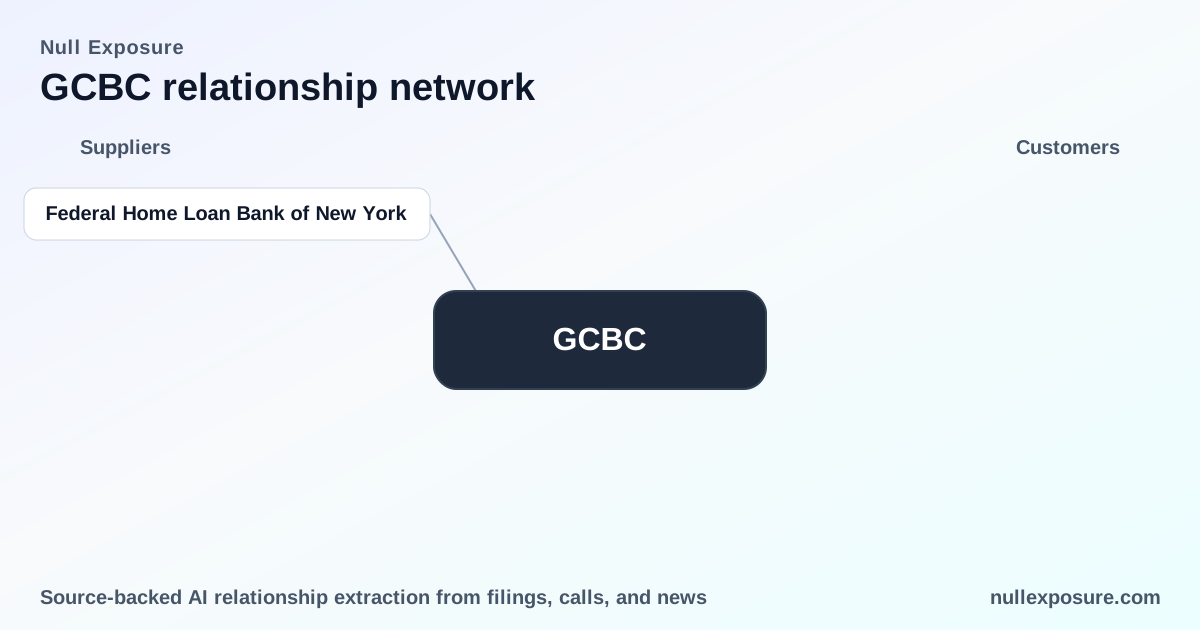
Greene County Bancorp (GCBC): liquidity relationships drive the balance sheet
Greene County Bancorp operates as the holding company for The Bank of Greene County, earning net interest margin and fee income through regional lending and deposit services while using secured and unsecured wholesale borrowings to manage liquidity and capital. The company's core monetization is traditional community banking—lending against local collateral and funding with a mix of deposits and committed credit lines—and its counterparty relationships, especially with government-sponsored liquidity providers, directly determine funding flexibility and balance-sheet risk. For a deeper supplier-risk lens on GCBC, visit https://nullexposure.com/.
Why the borrowing map matters more than the loan book in practice
GCBC is a classic regional bank: it earns interest on loans, pays deposit costs, and supplements funding with external borrowings when deposit flows or growth push beyond internal capacity. The firm’s fundamentals—a trailing P/E of 11.19, return on equity around 14.5%, and a dividend yield near 1.7%—indicate profitable underwriting, but these profit metrics coexist with a funding profile that relies on significant counterparty credit lines. Market-cap is roughly $377 million and insider ownership is high (about 59%), which amplifies the governance tilt toward long-term stewardship but reduces the traditional institutional investor buffer.
GCBC’s liquidity posture is not passive: the bank actively uses overnight and term facilities to smooth cash flows, a necessity for community lenders operating in thin markets. That dependency elevates counterparty selection and contract terms to strategic, not administrative, importance. If you evaluate bank counterparty exposures, begin with the following relationship focal point.
Visit https://nullexposure.com/ for supplier intelligence and partner mapping.
The supplier landscape: government-sponsored banks and correspondent lines
GCBC’s disclosed borrowing relationships include government-backed and industry counterparties. The company maintains lines of credit and pledges collateral across several providers, which creates a layered funding architecture: immediate liquidity through overnight FHLB resources, term notes and subordinated capital, plus supplementary lines through correspondent banks.
- Government-sponsored liquidity is central. The bank uses the Federal Home Loan Bank system for overnight and longer-dated borrowings and has lines with the Federal Reserve Bank of New York.
- Diversification exists but is limited. Atlantic Community Bankers Bank and “three other depository institutions” are named as additional counterparties, indicating a mix of wholesale sources beyond the FHLB/FRB core.
This configuration positions GCBC to access low-cost, secured funding in stressed markets, but also concentrates operational reliance on a small set of counterparties.
Federal Home Loan Bank of New York — the liquidity backbone
GCBC reports substantial borrowings from the Federal Home Loan Bank of New York: $180.0 million in overnight borrowings, $4.2 million of long-term borrowings, and $29.9 million of fixed-to-floating rate subordinated notes as of December 31, 2025, per the company’s earnings release and press distribution. According to the GlobeNewswire release dated January 21, 2026—and republished by major outlets in March 2026—these balances are part of the bank’s active funding strategy for the quarter ended December 31, 2025. A Yahoo Finance summary of the same material reiterated the figures on March 9, 2026.
Constraints and what they reveal about GCBC’s operating model
The disclosed constraints in GCBC’s filings and press material reveal structural characteristics investors should treat as factual inputs to risk modeling:
- Counterparty type: government-affiliated. Company disclosures explicitly show large, pledged collateral and borrowing arrangements with the Federal Home Loan Bank of New York, and lines with the Federal Reserve Bank of New York—clear evidence that GCBC uses government-sponsored institutions as primary liquidity providers (disclosed as of June 30, 2025 and FY2026 periods). This gives stable, low-cost secured funding, but also creates dependence on access to those facilities and the eligibility of pledged collateral.
- Relationship role: service provider / lender. The company explicitly lists the FHLB, FRB, Atlantic Community Bankers Bank and several depository institutions as providers of lines of credit and other borrowings. This indicates a contracting posture where GCBC is the counterparty client and these entities are service-providing lenders.
- Contracting posture and maturity mix. The combination of overnight borrowings and long-term term borrowings/subordinated notes reflects tactical use of both immediate liquidity and structural capital. Overnight facilities are tactical and highly rate-sensitive; term and subordinated notes are strategic capital anchors.
- Concentration and criticality. The bank pledged approximately $634.6 million of mortgage collateral to support FHLB borrowings as of June 30, 2025, signaling high collateralized exposure to one system. That level of pledged collateral creates high counterparty criticality—the FHLB is not optional in a funding stress scenario.
- Maturity and flexibility trade-offs. Reliance on overnight FHLB borrowings increases interest-rate and rollover risk in the short run, while subordinated notes support regulatory capital but limit flexibility due to covenants and structural subordination.
Those constraints are company-level signals derived from public disclosures; they define GCBC’s operating risk profile rather than a single transaction-level anomaly.
What investors should watch next
- Funding concentration risk: monitor quarterly disclosures for changes in FHLB exposure and pledged collateral. A reduction in pledged assets or a move toward diversified correspondent lines would materially lower liquidity concentration.
- Cost of funds sensitivity: because a chunk of funding is overnight, rising short-term rates will compress margins quickly; track deposit beta and repricing schedules.
- Capital adequacy versus subordinated notes: the $29.9 million fixed-to-floating subordinated issuance supports Tier capital but introduces structural obligations—follow covenant language in subsequent filings.
- Governance and ownership signals: with insiders holding ~59% of shares, strategic decisions around liquidity and capital are likely owner-driven; institutional ownership is relatively light (~15%), which alters the market’s disciplinary dynamics.
Key takeaways:
- The FHLB is a strategic, not tactical, counterparty for GCBC.
- Funding is diversified across government and correspondent providers, but concentration risk is material.
- Liquidity structure mixes overnight and term funding, creating short-term rate sensitivity and longer-term capital stability.
For ongoing monitoring and supplier relationship mapping for regional banks like GCBC, see https://nullexposure.com/ for detailed tracking and alerts.
Final assessment and action points
GCBC’s operating model is fundamentally interest-rate and liquidity-driven: profitable lending is supported by aggressive use of secured and subordinated borrowings. Investors should treat the Federal Home Loan Bank relationship as a primary risk dial—stress tests of GCBC should model reduced access to overnight FHLB borrowing and changes in collateral eligibility. Under normal market conditions GCBC’s funding architecture supports growth; under stress, concentration in FHLB exposure is the single largest supplier-related vulnerability.
If you manage counterparty exposure or are evaluating GCBC as a borrower or partner, prioritize covenant review, collateral schedules, and short-term funding rollovers. For supplier-intelligence tools and tailored reports, visit https://nullexposure.com/ to request a supplier-risk briefing.