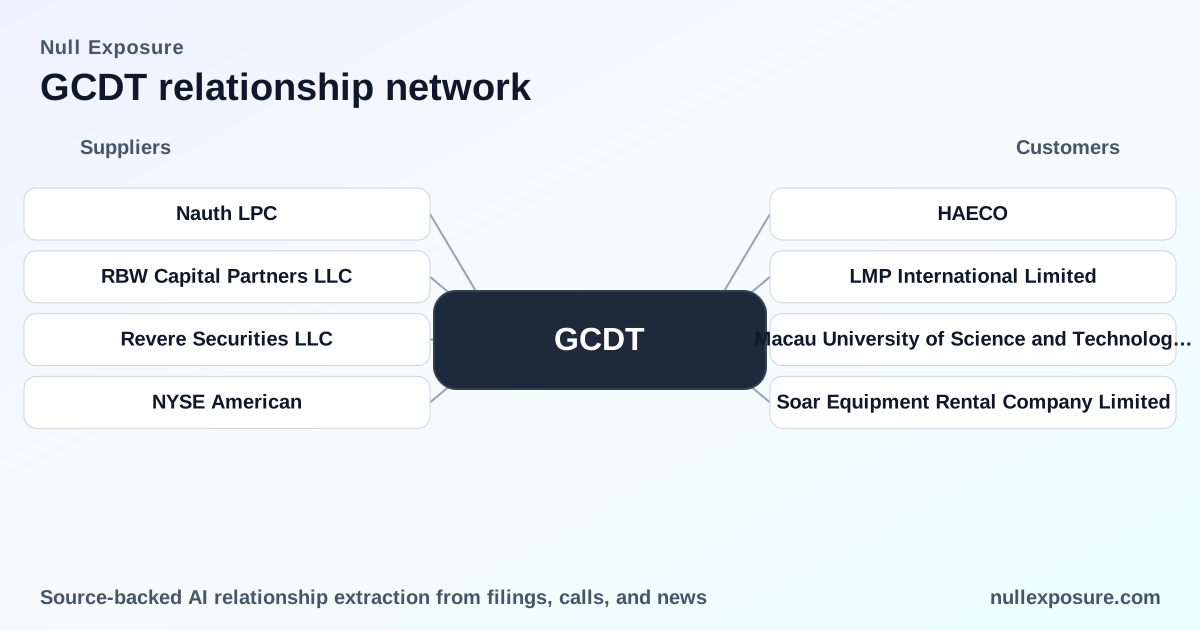
Green Circle Decarbonize Technology (GCDT): Capital markets relationships that shape the supply and listing playbook
Green Circle Decarbonize Technology Limited designs, develops and manufactures energy-saving hardware through its subsidiaries and monetizes primarily through product sales and related engineering services. The company recently completed a U.S. capital markets transaction and listing activity that centralized external underwriting and legal support—an important dynamic for investors assessing near-term liquidity, control, and go‑to‑market execution. Understanding who ran the offering and how the company is contracting for U.S. market access is essential for gauging execution risk and timing for commercial scale.
For detailed supplier and market relationship intelligence, visit https://nullexposure.com/.
Why the underwriters and counsel matter now
GCDT’s entry onto the NYSE American and the execution of a sale of shares represent a pivot from private funding to public market discipline. Underwriters and securities counsel are not ceremonial: they determine distribution breadth, price stability, and regulatory compliance in U.S. markets. The recent offering relied on small, regionally-focused brokers rather than large bulge‑bracket banks, which signals a capital-raising strategy optimized for speed and cost rather than broad institutional placement.
This capital-markets posture ties directly to operational priorities: the firm needs public liquidity and visibility to fund scaling of manufacturing and customer deployments. The choice of underwriters and counsel therefore functions as a proxy for the company’s contracting posture and market access strategy. For more on supplier mapping and partner concentration, see https://nullexposure.com/.
Supplier and capital-market relationships you need to track
Nauth LPC — U.S. securities counsel for the offering
Nauth LPC acted as GCDT’s U.S. securities counsel for the offering, handling the legal work required to complete the sale and listing process in the United States (Yahoo Finance, 2026-03-09: https://finance.yahoo.com/news/green-circle-decarbonize-technology-limited-011200894.html). This relationship establishes the company’s reliance on external U.S. legal expertise for regulatory compliance during capital raises.
RBW Capital Partners LLC — lead underwriter and offering representative
RBW Capital Partners LLC served as the representative underwriter for the offering, leading distribution and book-building activities for the sold shares (Yahoo Finance, 2026-03-09; Intellectia.ai, 2026-03-09: https://finance.yahoo.com/news/green-circle-decarbonize-technology-limited-011200894.html / https://intellectia.ai/news/stock/green-circle-decarbonize-technology-closes-sale-of-375000-shares). RBW’s role signals a targeted placement strategy that prioritizes regional broker-dealer networks and speed to market.
Revere Securities LLC — co-manager on the offering
Revere Securities LLC acted as co-manager alongside RBW, supporting distribution and investor outreach for the transaction (Yahoo Finance, 2026-03-09; Intellectia.ai, 2026-03-09: https://finance.yahoo.com/news/green-circle-decarbonize-technology-limited-011200894.html / https://intellectia.ai/news/stock/green-circle-decarbonize-technology-closes-sale-of-375000-shares). Having a co-manager supplements deal execution capacity but does not replace the concentrated placement function led by the representative underwriter.
NYSE American — listing venue for ticker GCDT
The company listed on the NYSE American under ticker GCDT, a listing that increases public visibility and trading access while imposing U.S. listing compliance and reporting obligations (Intellectia.ai, 2026-03-09: https://intellectia.ai/news/stock/green-circle-decarbonize-technology-closes-sale-of-375000-shares). The choice of NYSE American reflects a trade-off between market profile and the listing standards appropriate for smaller-cap industrials.
Operating-model constraints and company-level signals
Because explicit constraint excerpts are not present in the record, present company-level signals should guide evaluation:
- Contracting posture: GCDT outsources critical capital markets functions (underwriting and U.S. securities counsel), indicating a transactional external contracting posture for market access rather than in-house capabilities. This reduces fixed overhead but increases dependence on third-party execution quality.
- Concentration and control: Insider ownership is highly concentrated (about 69.6%), creating a tight governance profile where insiders control strategic outcomes and public float is limited. Institutional ownership is effectively zero, limiting institutional liquidity support.
- Criticality of partners: Underwriters and U.S. counsel are critical for public market credibility and compliance in the near term; any frictions in these relationships would directly affect liquidity, cost of capital, and secondary offerings.
- Maturity and financial posture: Financials show negative profitability (profit margin -23.3%) despite revenue about $23.5M and gross profit near $4.08M for the trailing year, implying the business is at a growth or early commercial stage rather than a margin-stable industrial. Market multiples are elevated (EV/Revenue 12.79) while EV/EBITDA is stretched, reflecting market expectations for either heavy growth or scarcity of comparable listed peers.
Investment implications and a short checklist for operators and research teams
- Liquidity and float risk: High insider ownership and a recent small offering compress free float; trading liquidity will remain thin until larger institutional interest or follow‑on offerings emerge.
- Execution risk from third parties: The company’s reliance on boutique underwriters and external counsel makes execution quality and market stabilization capabilities a key risk factor.
- Capital need for scaling: Operating margins and negative EPS underline a capital-hungry scaling path; investors must track burn, inventory financing, and any follow-on underwriting engagements.
- Regulatory and listing cost: NYSE American listing improves visibility but enforces periodic reporting and compliance costs that will be a recurring expense as the company grows.
What investors and operators should do next
- Request the underwriting agreement terms, lock‑up durations, and any stabilization arrangements to understand near-term supply of shares and potential dilution.
- Monitor trading volumes and insider transactions to gauge float dynamics and potential insider-led liquidity events.
- Map counterparty dependencies beyond capital markets—suppliers, contract manufacturers, and key customers—and stress-test scenarios if access to capital tightens.
For a deeper relationship map and ongoing alerts on GCDT, visit https://nullexposure.com/ to subscribe to vendor and capital-markets monitoring.
In short, Green Circle Decarbonize Technology’s recent reliance on boutique underwriters and external U.S. counsel to complete its NYSE American entry tells a clear story: this is a small-cap industrial in transition to public markets with concentrated control and meaningful reliance on third-party execution for its next growth phase. Investors and operators should prioritize monitoring underwriting arrangements, insider concentration, and capital needs as the company scales. For continuous supplier relationship intelligence and market context, go to https://nullexposure.com/.