GCLWW — Legal Counsel and Supplier Signals for GCL Global Holdings Ltd Warrants
GCL Global Holdings Ltd operates as a developer, publisher and distributor of video games, activation keys and entertainment content across Asia, Europe and the United States, monetizing through retail sales, distribution agreements and licensing of digital activation inventory. For investors and operators assessing supplier relationships, the most relevant signal is that GCL behaves like a mid‑market digital distribution operator with thin public market liquidity, low market capitalization, and operating leverage that compresses profitability despite material top‑line revenue. Learn more about how third‑party supplier relationships affect exposure and counterparty risk at https://nullexposure.com/.
Quick read: what the company does and what matters to counterparties
GCL’s business model is focused on content acquisition, digital activation key distribution and global retail channels; cash flow and supplier payments hinge on distribution reach and inventory sourcing. According to company-reported financials through the quarter ended 2025-06-30, GCL reported roughly $190 million in trailing revenue but slim gross margin and negative operating EBITDA, which makes counterparty performance and legal scaffolding important for transaction certainty.
What the relationship data shows — one supplier surfaced
Below I cover every supplier relationship returned in the dataset and explain the practical relevance for business partners and investors.
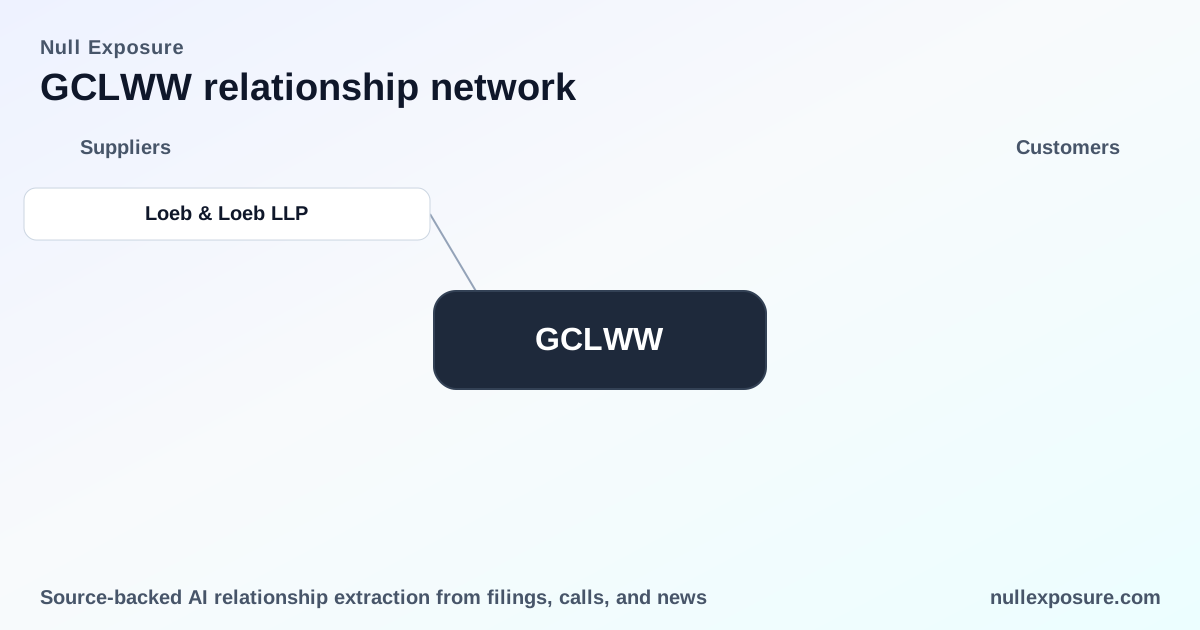
Loeb & Loeb LLP — legal counsel to the combined company
A Quiver Quant news item dated March 9, 2026 reports that Loeb & Loeb LLP served as legal counsel to GCL and the Combined Company in connection with GCL’s business combination with RF Acquisition Corp and Nasdaq listing activity. This relationship is legal‑service oriented and supports corporate transactions and compliance processes (Quiver Quant, March 9, 2026: "GCL Global Limited Completes Business Combination...").
- Why it matters: engagement of a recognized law firm for the business combination reduces execution risk around corporate governance and listing mechanics, which is material when counterparties require documented legal authority for contracts, escrow arrangements, or title to digital inventory.
Constraints and company‑level operating signals
The dataset contains no explicit supplier constraints flagged against any named vendor; however, company financials and market structure generate important operational constraints that affect supplier relationships.
- Market liquidity and financing posture: Market capitalization is approximately $417,000 as of the latest public snapshot and shares outstanding are modest, which indicates very limited public market liquidity and elevated funding risk for working capital. Contracts that require collateral, credit terms, or long settlement windows will face counterparty concerns given the company’s small market cap.
- Profitability and margin pressure: Trailing revenue is approximately $189.9 million with gross profit around $25.1 million, but EBITDA is negative (roughly -$0.76 million) and operating margin is negative. This combination signals operational leverage — revenue is material, but earnings convert poorly to free cash — raising the importance of contract terms that protect suppliers (upfront payments, shorter net terms, or escrow).
- Concentration and governance: Public data shows negligible institutional and insider holdings on record, suggesting limited analyst coverage and potentially concentrated private control; counterparties should require clear representations and warranties in supplier agreements.
- Maturity and strategic criticality: The company’s business is commercially active across multiple regions and benefits from recognized distribution channels, which gives suppliers commercial scale benefits but also exposes them to geopolitical and regional payment flows that should be negotiated explicitly.
A compact summary of operational constraints for commercial negotiation:
- Very low market cap and thin liquidity increase counterparty credit risk.
- Negative operating metrics require protective commercial terms for suppliers.
- Limited public ownership and coverage amplify the need for strong contractual controls.
If you want a structured supplier‑risk profile for GCL and comparable coverage across tens of thousands of counterparties, visit https://nullexposure.com/ for tailorable reports.
How the Loeb & Loeb relationship fits the operational picture
Legal counsel engagements, such as the Loeb & Loeb assignment documented during the business combination, are transactional — they do not by themselves resolve enterprise credit or operational risks, but they do reduce procedural execution risk for corporate restructurings and listings. For suppliers evaluating exposure, the presence of a recognized law firm on the transaction is a positive procedural signal: it supports clarity of title, enforceability of transaction documents, and the mechanics of transfer or escrow when the company completes corporate reorganizations.
Investment and operational implications for counterparties
- Contracting posture: Given negative operating margins and small market cap, suppliers should insist on commercial protections — shorter payment terms, advance payments where feasible, and clear dispute resolution clauses.
- Concentration risk: The company’s revenue scale versus public capitalization suggests private or concentrated ownership and complex capital structure (warrants and listing events); counterparties should obtain up‑to‑date corporate authority and signatory verification before extending credit.
- Criticality: For suppliers providing scarce digital inventory or payment services, GCL represents a commercially meaningful but financially constrained counterparty; prioritize contractual protections commensurate with exposure.
Final takeaway and recommended next steps
GCL is a revenue‑generating content distributor with structural profitability pressure and extremely low public market liquidity; legal counsel engagement for the business combination reduces transactional execution risk but does not eliminate supplier credit risk. Counterparties should combine rigorous contractual protections with operational monitoring of cash conversion and corporate governance.
For a tailored supplier risk assessment or to benchmark GCL against peer counterparties, start here: https://nullexposure.com/. If you want a custom report or monitoring feed for GCL and its counterparties, visit https://nullexposure.com/ and request supplier‑level analysis.
Sources referenced:
- Company financial overview and reported metrics through quarter ended 2025-06-30 (company filings and corporate disclosures).
- Quiver Quant news item reporting Loeb & Loeb LLP’s role in the business combination (March 9, 2026): https://www.quiverquant.com/news/GCL+Global+Limited+Completes+Business+Combination+with+RF+Acquisition+Corp%2C+Nasdaq+Trading+to+Commence+on+February+14%2C+2025.