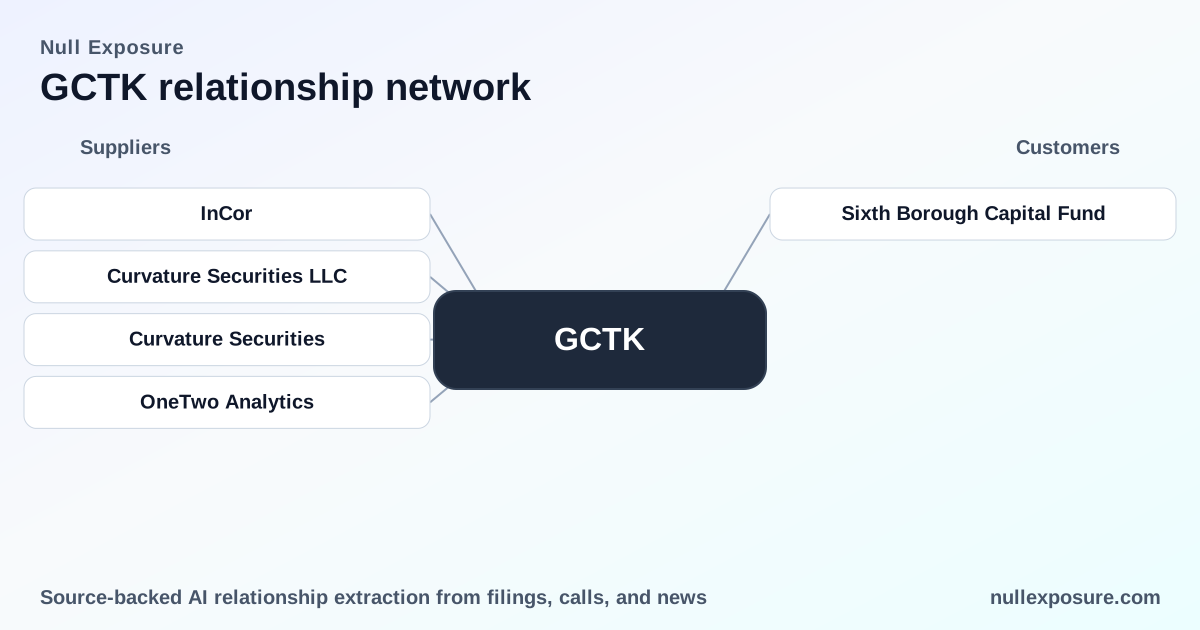
GCTK supplier relationships: what investors need to know
Thesis — Glucotrack (ticker GCTK) develops non‑invasive continuous glucose monitoring (CGM) hardware and monetizes through device commercialization coupled with grant funding and recurring capital raises; the company relies on a mix of clinical service providers, specialized analytics firms, and placement agents to execute trials and financing, making supplier relationships both operationally important and visibility‑rich for investors. For a concise overview of supplier risk and market positioning, visit the NullExposure homepage: https://nullexposure.com/.
Market context and what supplier ties reveal Glucotrack is in a capital‑intensive commercialization phase where clinical validation and access to capital are the immediate value drivers. Supplier relationships here are operational levers: clinical investigators enable trial enrollment and data credibility, analytics partners translate raw study outputs into regulatory‑facing evidence, and placement agents turn development milestones into liquidity. For active investors, these supplier links are short‑cycle indicators of R&D progress and financing runway.
If you want a structured supplier risk profile for investment diligence, start at NullExposure: https://nullexposure.com/.
Supplier map — the relationships documented in public sources Below I list every supplier relationship surfaced in the available public signals, with a plain‑English summary and source for each entry.
InCor — clinical investigator on first‑in‑human enrollment
Glucotrack identified Dr. Alexander Abizaid at InCor in Brazil to treat the first person enrolled in its implantable glucose monitor trial, signaling active clinical recruitment and local investigator engagement in FY2025. Source: Clinical Leader report (March 2026): https://www.clinicalleader.com/doc/medtech-ceo-shares-lessons-from-fih-implantable-glucose-monitor-trial-0001
Curvature Securities LLC / Curvature Securities — sole placement agent for private placement
Curvature Securities acted as the sole placement agent on a $4.0 million private placement and, in a related communication, Glucotrack disclosed a 7% cash fee plus agent warrants issued to Curvature as part of transaction economics in FY2025–FY2026. This underscores an active capital‑raising relationship that directly affects liquidity and dilution. Sources: company press release via The Globe and Mail and Yahoo Finance (March 2026) and TradingView coverage noting the 7% fee and agent warrants:
- https://www.theglobeandmail.com/investing/markets/stocks/GCTK-Q/pressreleases/36400667/glucotrack-inc-announces-pricing-of-the-market-under-nasdaq-rules-with-a-single-institutional-investor/
- https://finance.yahoo.com/news/glucotrack-inc-announces-pricing-4-130000254.html
- https://tradingview.com/news/tradingview:2be178d8e8570:0-glucotrack-signs-multiple-material-agreements/
OneTwo Analytics — independent data analysis for human study results
OneTwo Analytics conducted the data analysis for Glucotrack’s human study and reported that 92% of CBGM measurements fell within the clinically acceptable green zone of the Diabetes Technology Society Error Grid, which is a published signal of favorable analytical validation performance in FY2025. Source: Clinical Trial Vanguard (March 2026): https://www.clinicaltrialvanguard.com/news/glucotracks-continuous-glucose-monitor-shows-positive-results-in-human-study/
Operating model characteristics and what they imply for investors The public disclosures and snippets assemble a clear operating posture for Glucotrack as a small medtech company that outsources specialized capabilities and relies on external capital markets. Key constraints and the investor takeaways:
- Contracting posture — mixed maturity. The company runs a combination of short‑term operational contracts (for example, a 3‑year lease that commenced March 1, 2024) and long‑standing service relationships (the company’s auditor has served since 2010). These show a pragmatic approach: fixed short leases for cost control, coupled with durable professional services for continuity, as disclosed in company filings (2024–2025).
- Framework arrangements for capital — active use of ATMs. Glucotrack has an at‑the‑market (ATM) sales agreement with Dawson James (up to $8.23 million) reflecting an ongoing framework to source equity capital on a flexible schedule (company disclosure, Dec 17, 2024). That framework is a structural element of the financing model rather than a one‑off deal.
- Counterparty concentration — reliance on large enterprise platforms for critical infrastructure. Filings note use of major cloud providers and a major U.S. bank for cash deposits, implying concentration in a small number of enterprise counter‑parties for IT and treasury functions (company filings, 2024).
- Criticality and regulatory sensitivity. The company requires critical suppliers and manufacturing partners to meet regulatory standards where devices will be marketed, highlighting high operational criticality for a narrow set of compliant suppliers (company disclosure).
- Service provider posture — outsourcing across functions. The company lists providers for accounting, IT security, reimbursement consultancy and leasing, indicating a service‑provider heavy model where external expertise substitutes internal scale.
- Spend and contingent liabilities — limited near‑term royalty exposure. Disclosed contingent royalty exposure was approximately $93 (as of Dec 31, 2024), a sub‑$100k contingent liability, which signals low current royalty cash risk while commercialization is nascent.
For investors, these constraints translate into a profile of operational leverage with concentrated external dependencies: a handful of service providers and placement agents materially affect both execution and cash. That makes supplier diligence a meaningful part of counterparty risk assessment.
Risk vectors that matter for valuation
- Execution risk in clinical operations. Investigator‑level engagement (e.g., InCor) and analytics rigor (OneTwo Analytics) are immediate drivers of regulatory traction; missed milestones here delay product revenue. Clinical Leader and Clinical Trial Vanguard reporting document those relationships (March 2026).
- Financing and dilution risk. Use of placement agents (Curvature) and ATM frameworks (Dawson James) confirms continued reliance on equity issuance; the 7% fee and agent warrants on the recent placement are explicit dilution and cash‑cost items (company press releases and TradingView, March 2026).
- Supply chain / regulatory compliance. A small supplier base that must meet regulatory requirements is a single point of failure if a compliant OEM or manufacturer relationship breaks down (company disclosures).
Actionable investor steps
- Review the latest clinical readouts and investigator commitments to verify enrollment cadence and data quality; clinical partners like InCor and analysts such as OneTwo are the proximate signals of trial progress.
- Model financing scenarios that incorporate ATM capacity and discrete placements via placement agents; the Curvature engagement and the Dawson James ATM provide concrete parameters for cost and dilution.
- Audit regulatory supplier readiness: ensure manufacturing and critical suppliers referenced in filings meet the jurisdictions targeted for commercialization.
If you want a vendor‑level exposure map or a supplier‑risk scorecard for GCTK, find tailored research at NullExposure: https://nullexposure.com/.
Conclusion — decision points for investors Glucotrack’s supplier footprint reveals a company in active clinical validation and financing phases: clinical investigators and analytics firms are driving the near‑term technical value, while placement agents and ATM arrangements determine the cash runway and dilution profile. Investors should prioritize milestone verification on clinical endpoints and incorporate explicit financing economics (fees, warrants, ATM bandwidth) into valuation. For deeper supplier analytics and commercial counterparty monitoring, consult NullExposure: https://nullexposure.com/.
Key takeaway: supplier relationships for GCTK are operationally critical and financing‑sensitive — they are leading indicators for both product viability and near‑term capital needs.