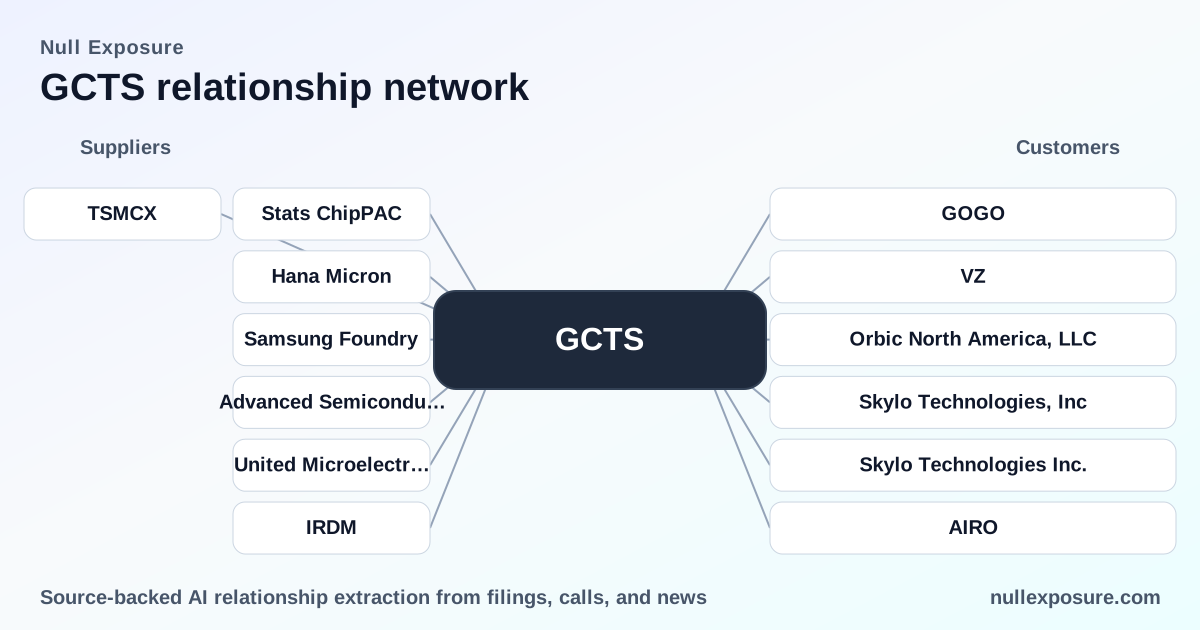
GCTS supplier network: where foundries, OSATs and strategic partners determine execution risk
GCT Semiconductor Holdings Inc. (GCTS) is a fabless semiconductor designer that monetizes by selling integrated chipsets (4G/5G baseband and RF solutions) and by contracting development services with foundries and partners. The company outsources wafer fabrication, assembly and test, and funds discrete product development agreements—creating a cost base that is a mix of purchase‑order manufacturing expenses and multi‑million dollar R&D commitments. For investors, the business is defined by execution risk in its supply chain (node availability and OSAT capacity) and by the economics of its product agreements. Learn more at https://nullexposure.com/.
How GCT structures manufacturing and what that implies for investors
GCT runs a classic fabless model: design and product engineering in‑house, manufacturing and assembly outsourced to third parties. The FY2024 Form 10‑K states that the company uses third‑party foundries and OSATs on a purchase‑order basis for assembly and testing, while simultaneously entering multi‑year or one‑off development agreements to secure process support and IP (for example, a February 2024 foundry product development agreement). This mix produces two distinct contracting postures:
- Routine production is short‑term and transactional (purchase orders and small noncancellable commitments; the 10‑K discloses $0.2 million outstanding purchase commitments as of December 31, 2024).
- Strategic node development and mass‑production readiness require larger, bespoke agreements and R&D fees (the company recorded substantial R&D spending and disclosed product development fees in the low‑millions to tens of millions range).
Geography and supplier maturity shape criticality: GCT relies primarily on Asia‑Pacific suppliers, which concentrates geopolitical, logistics and capacity risk in that region. Operating leases and modest fixed commitments indicate a relatively low fixed‑cost manufacturing posture, but dependence on external nodes and OSAT capacity makes supplier execution the primary single‑point risk for revenue delivery.
Supplier map: every relationship and what it means
Below are the supplier and partner relationships disclosed in the available filings and reporting, with plain‑English takeaways and source pointers.
Samsung Foundry
GCT uses Samsung Foundry for leading and advanced nodes: 28nm for mixed‑signal/digital 4G baseband and 8nm for 5G baseband products, establishing Samsung as a strategic node supplier for higher‑performance parts. According to GCT’s FY2024 Form 10‑K, Samsung provides process and mass‑production support for select product families (FY2024 10‑K).
United Microelectronics Corporation (UMC)
UMC is listed alongside Samsung as a main foundry vendor, indicating GCT keeps capacity and node diversity across Taiwanese foundry capacity as part of its fabrication mix. This is disclosed in the FY2024 10‑K.
TSMC
GCT sources 40nm RF, mixed‑signal and digital CMOS processes from TSMC for 4G RF‑only production, isolating RF production to a mature node at a leading foundry. The FY2024 Form 10‑K specifically notes TSMC’s role in 40nm RF manufacturing (FY2024 10‑K).
Hana Micron
Hana Micron is one of the assembly and testing partners GCT uses on a purchase‑order basis for most assembly and testing requirements, making it part of the OSAT trio that handles back‑end processing for finished devices (FY2024 10‑K).
Stats ChipPAC
Stats ChipPAC is named alongside Hana Micron and ASE as a primary OSAT provider for assembly and test under purchase orders, representing another back‑end capacity partner in APAC (FY2024 10‑K).
Advanced Semiconductor Engineering, Inc. (ASE)
ASE is included in the company’s list of assembly and test vendors used for most assembly and testing needs on a purchase‑order basis, showing GCT’s reliance on major OSATs to complete chip production (FY2024 10‑K).
Iridium Communications Inc. (IRDM)
GCT is collaborating with Iridium to integrate the Iridium NTN Direct service into GCT’s GDM7243SL chipset, indicating a product‑level partnership that extends GCT’s chipset capability into satellite NTN services; this collaboration was reported by EE Times Asia in March 2026. (EE Times Asia, March 9, 2026).
Concentration, spend profile and operational constraints investors should read together
GCT’s disclosures provide concrete company‑level signals about contract size, geography and role:
- APAC concentration: The firm explicitly relies on customers and suppliers primarily in the Asia‑Pacific region, concentrating supply chain and geopolitical risk there.
- Fabless & third‑party manufacture: The 10‑K confirms GCT is fabless and uses third‑party foundries and OSATs—this makes foundry and OSAT uptime and technology roadmaps a primary operational dependency.
- Mixed spend bands: The company reports small short‑term purchase commitments ($0.2m) but also larger R&D and development fees (examples: a $7.6m foundry product development agreement and a broader $21.1m R&D services figure), indicating episodic but material capitalized and expensed commitments tied to product development cycles.
These constraints translate into practical investor considerations: short-term production is relatively flexible, but strategic node access and successful ramp of bespoke process development are the levers that determine product availability and margin realization.
What strategic partnerships and product moves signal
Samsung’s historical R&D and manufacturing support (a 2020 R&D agreement provides development and IP support and mask sets) functions as both a technical enabler and a commercial safeguard for product qualification and ramp. The Iridium collaboration broadens the company’s addressable market into satellite NTN connectivity for specific chipsets—this is a revenue‑adjacent product extension that can lift realized ASPs for compatible parts (EE Times Asia, March 2026; FY2024 10‑K).
If you want a consolidated view of supplier exposures and contract risk for competitive benchmarking, visit https://nullexposure.com/ for our supplier analytics and supplier‑risk matrix.
Investment implications and action plan
- Upside driver: Successful ramp at Samsung and TSMC nodes (8nm, 28nm, 40nm RF) scales higher‑margin 5G and RF products into revenue.
- Primary risks: APAC concentration; OSAT capacity constraints at Hana Micron, Stats ChipPAC and ASE; and the need to manage episodic multi‑million dollar development payments.
- Tactical steps: Monitor node allocation disclosures, OSAT lead times, and any changes to multi‑year development commitments announced in SEC filings or partner press releases.
For a deeper supplier risk breakdown and ongoing monitoring, check https://nullexposure.com/.
Final takeaways
- GCT is a fabless semiconductor designer whose performance is tightly coupled to foundry node access and OSAT execution.
- Samsung, UMC and TSMC provide the wafer processes that determine product feasibility; Hana Micron, Stats ChipPAC and ASE complete the back‑end capacity.
- Strategic development fees and partnerships (e.g., Samsung R&D support and the Iridium NTN integration) are the levers that expand product capability but increase episodic cash commitments.
Assess supply continuity, foundry node allocations, and OSAT lead times as the primary inputs to any valuation or operational diligence on GCTS. For continuous supplier intelligence and comparative analytics, visit https://nullexposure.com/.