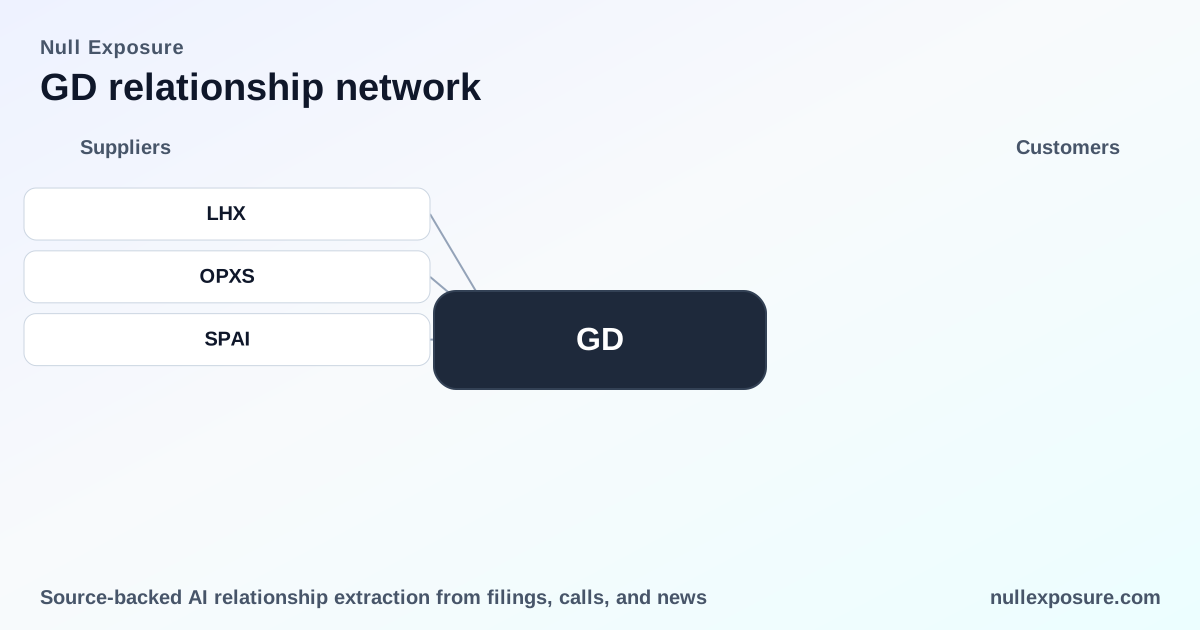
General Dynamics (GD) — supplier map and implications for investors
General Dynamics operates as a diversified defense prime, monetizing through long-term, program-level contracts with U.S. and allied governments and through downstream prime/prime‑subcontractor relationships across land systems, marine, and mission systems. The company captures value by integrating complex platforms (armored vehicles, submarines, communications suites) and outsourcing specialized subsystems to a concentrated base of qualified suppliers who deliver engineered hardware, sensors, electronics, and software over multi-year production ramps.
Explore the underlying supplier relationships and program-level exposures on the Null Exposure platform: https://nullexposure.com/
The supplier network in plain language — what each relationship means for GD
Below are every supplier relationship flagged in the dataset, summarized in one to two sentences with source context for investors tracking counterparties and program risk.
-
Elbit Systems (ESLT): General Dynamics Ordnance and Tactical Systems awarded Elbit a US$228 million, three‑year contract to supply the Iron Fist Active Protection System for upgraded Bradley M2A4E1 fighting vehicles, reflecting a program‑level subcontract for vehicle survivability hardware. According to SimplyWallSt and Army‑Technology reporting in March 2026, this follows prior orders in 2024 and links Elbit directly into GD land‑systems modernization programs.
-
L3Harris Technologies (LHX): L3Harris will supply 26 complete shipsets of communications equipment to General Dynamics Electric Boat for Virginia‑ and Columbia‑class submarines, a full‑rate production award that places L3Harris as a critical marine electronics supplier. Reporting from OvertDefence and Bitget in March 2026 shows the contract was awarded via prime contractor General Dynamics Electric Boat.
-
Cadre Holdings (CDRE): Cadre won multi‑year Med Eng contracts to supply vehicle protection systems for General Dynamics programs and a Cadre subsidiary secured an $86 million set of awards from General Dynamics European Land Systems. SahmCapital, Finviz and company call transcripts in May 2026 confirm Cadre’s role as a recurring supplier across GD’s land platforms and international affiliates.
-
Optex Systems Holdings (OPXS): Optex derives a large share of gross revenue from a small number of customers including direct U.S. government agencies and prime contractors such as General Dynamics, highlighting acute customer concentration consistent with defense supply‑chain structures. AlphaStreet coverage in March 2026 flags Optex’s customer concentration (roughly 70% of gross revenues from five major customers).
-
Safe Pro Group / Safe Pro Group Inc. (SPAI): Safe Pro announced demonstrations integrating its NODE AI threat‑detection engine with General Dynamics Mission Systems’ GeoSuite mission toolkit at the U.S. Army’s TiC 2.0 event, indicating an emerging software/AI integration relationship with GD’s mission systems. Press releases and trade coverage from GlobeNewswire, The Globe and Mail and DigitalJournal in March 2026 describe the planned demonstration at Fort Hood.
-
TechPrecision (TPCS): TechPrecision executives referenced capacity constraints and existing production relationships that include supplying parts for customers in the naval and aerospace supply chain, and indicated that TechPrecision is already part of multi‑vendor programs that General Dynamics primes operate. Investing.com and earlier call transcripts (FY2025 / FY2023 mentions) describe TechPrecision’s role on component programs and capacity dynamics (May 2026 and prior).
-
ATI Inc. (ATI): ATI reported being named General Dynamics Land Systems’ 2025 Supplier of the Year for high‑performance titanium plate and sheet used in ground armor, signaling a recognized, high‑value materials relationship on armor programs. This recognition was mentioned on ATI’s Q1 call reporting in May 2026 and covered by InsiderMonkey.
-
Mobix Labs (MOBX): Mobix received production orders for components that protect aircraft electronics from electromagnetic interference for Gulfstream, and also noted orders for components used by major aerospace customers; the company’s disclosures referenced production work that intersects GD’s supplier footprint on systems requiring EMI protection. Investing.com reporting in May 2026 includes these production order disclosures.
-
BWX Technologies (BWXT): BWXT indicated continued support for existing programs that include work for Electric Boat and other U.S. Navy initiatives, positioning BWXT as a supporting industrial supplier inside submarine and naval programs that GD primes. SahmCapital coverage in April–May 2026 references BWXT’s role in supporting Electric Boat projects.
-
Kodiak (KDK): Public reporting on collaborative technology demonstrations lists Kodiak among partners in new autonomous high‑power microwave systems integrated into commercial vehicles for military use, with General Dynamics Land Systems identified in coverage as an integrator or program stakeholder. FinancialContent markets reporting in March 2026 referenced Epirus, General Dynamics Land Systems, and Kodiak teaming on counter‑UAS systems.
-
Moog (MOG‑A): Moog demonstrated its RIwP weapon platform mounted on General Dynamics Land Systems’ TRX Defender robotic combat vehicle at AUSA, showing Moog’s turret and weapon systems are being integrated on GD robotic platforms. ArmyRecognition coverage of AUSA (2024 event) documents the TRX Defender integration.
-
BETA (BETA): On a 2025 Q3 earnings call, the company stated it delivered its first products to General Dynamics during that quarter, indicating an active supplier relationship and initial production shipments. This was recorded in the company’s Q3 earnings call excerpt (2025Q3).
-
COPT (CTO): A single‑tenant office property in Reston, Virginia is leased to General Dynamics for $18.5 million, demonstrating a real‑estate counterparty relationship where GD is a material tenant. This appears in a 10‑K style disclosure for FY2024 (document cto‑2024‑12‑31).
Operating model constraints and what they signal for investors
Company filings and disclosure excerpts included in the dataset show two company‑level signals about GD’s supplier posture:
-
Government counterparty presence — GD identifies U.S. government entities within its counterparty mix (an excerpt notes “Our U.S. government customer is a supplier for some of our programs”), which signals direct program interdependence with government customers and agencies and reinforces the regulated, schedule‑driven nature of GD contracts.
-
Active supplier network during production ramps — Management disclosures confirm GD “continues to develop and work with our growing network of approximately 3,000 suppliers to support the growth related to concurrent production of the two submarine programs,” indicating high supplier scale and active onboarding during multi‑year submarine production ramps.
Together these reflect a contracting posture dominated by long‑term, program‑specific agreements, high supplier concentration by capability, and critical supplier roles for a limited set of trusted vendors during production scale‑up.
What this means for investors — principal takeaways
-
Concentration and criticality drive both value and risk. Prime contractors like GD rely on a small set of specialized suppliers (communications, armor materials, active protection systems); those suppliers capture pricing power inside program windows but introduce single‑vendor dependency risks when production volume is significant.
-
Program maturity matters. Awards to Elbit (Iron Fist) and L3Harris (submarine shipsets) are program‑level production contracts; investors should segregate developmental demonstrations (Safe Pro NODE at TiC 2.0) from awarded production commitments when modeling revenue timing and risk.
-
Geography and customer type constrain cash flow profiles. The government counterparty signal confirms GD’s revenue cadence is tied to public budget cycles and contractual milestones, which implies higher backlog visibility but lower optionality relative to commercial markets.
-
Supply chain scale is a double‑edged sword. Management’s reference to ~3,000 suppliers for submarine programs implies scale and diversification, but defense supply chains retain pockets of single‑source criticality (e.g., titanium armor, APS, submarine communications).
If you’re modeling GD’s margins or assessing vendor credit, incorporate supplier concentration, program award timelines, and the distinction between demonstration partnerships and firm production contracts.
Explore the supplier roster and program linkages in detail at Null Exposure for deal‑level transparency: https://nullexposure.com/
Final risk checklist for analyst models
- Reconcile demonstration vs. firm production awards when forecasting supplier revenue recognition.
- Stress single‑vendor dependencies (e.g., armor materials, APS) under supply disruption scenarios.
- Map government budget timing to program cashflow milestones; treat submarine full‑rate production as multi‑year cash drivers.
- Monitor supplier concentration disclosures (like Optex) that signal revenue sensitivity to a small number of primes.
Investor action: use the supplier summaries above as inputs to counterparty risk tables and scenario P&L modeling. For deeper counterparty evidence and source documents, visit Null Exposure: https://nullexposure.com/
Sources referenced in summaries include company filings and call transcripts (FY2023–FY2026), press coverage from SimplyWallSt, Army‑Technology, OvertDefence, AlphaStreet, GlobeNewswire, DigitalJournal, Investings.com, SahmCapital, InsiderMonkey, Bitget and related trade coverage dated March–May 2026.