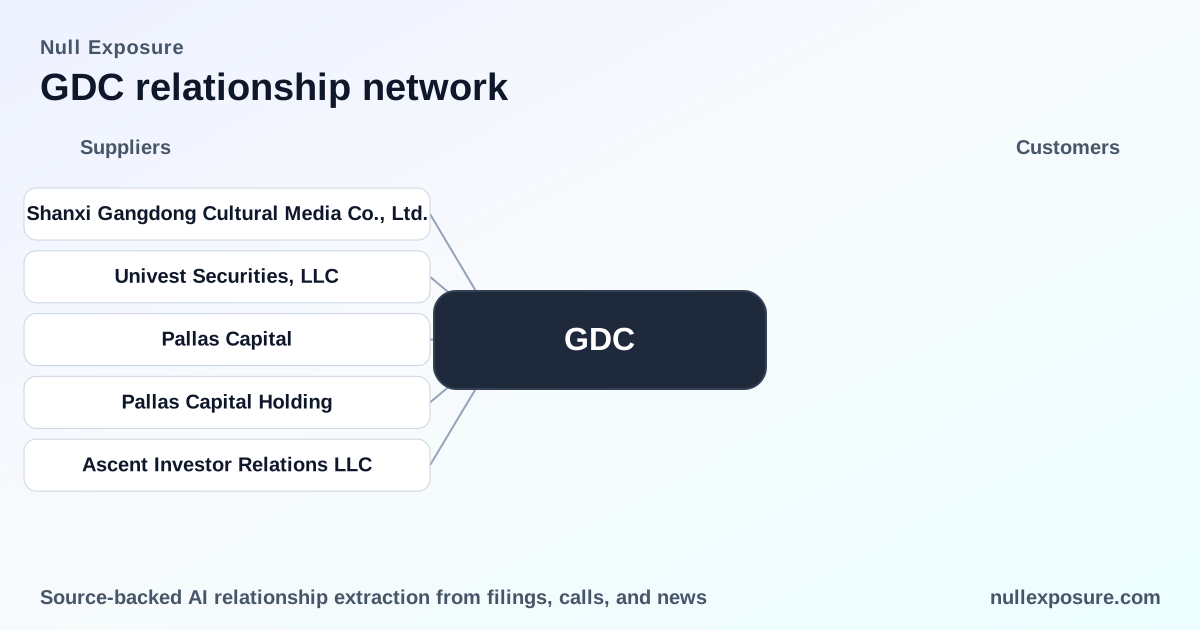
GDC supplier map: what investors need to know about counterparties and recent deals
GD Culture Group Limited (GDC) operates as a Nevada-based holding company that monetizes through AI-driven digital human technology, live-streaming e-commerce operations, and occasional corporate financings and asset acquisitions. Revenue drivers are a mix of platform-driven commerce, licensing of digital-persona technologies, and balance-sheet management tied to strategic asset swaps and capital raises. GDC’s counterparty activity over FY2024–FY2026 shows a hybrid operating posture: targeted technology purchases, dependence on capital markets intermediaries, and a material, high-profile crypto treasury acquisition that reshapes both capital structure and liquidity strategy. For a concise entry point to this supplier and counterparty analysis, visit https://nullexposure.com/.
Why this matters for investors: counterparties reveal where cash flows, operational risk, and strategic optionality live—software sellers that enable core products, placement agents that access capital, and non-operating asset sellers that effectively rebuilt GDC’s balance sheet with Bitcoin.
How to read these relationships: operating constraints and business-model signals
GDC’s disclosed supplier relationships and corporate filings convey several actionable firm-level signals:
- Contracting posture: GDC executes one-off purchase agreements (e.g., software buys) alongside placement agency and investor-relations retainers, indicating a mix of transactional and retained-service contracts rather than long-term strategic supply exclusivity.
- Concentration and criticality: The company signals material reliance on third-party platforms for core functions; downtime or service disruption to these platforms would be consequential for operations and revenue continuity.
- Counterparty complexity: The company does business with a mix of domestic U.S. intermediaries and China-linked suppliers; GDC flags that some suppliers are PRC government‑owned, introducing regulatory and compliance risk in cross-border engagements.
- Maturity and spend posture: Contract exposure suggests modest operating spend with larger episodic capital commitments (software purchase and major asset acquisitions), while corporate overhead (executive lease at ~$31k/month) indicates a lean head office footprint consistent with a capital-intensive, asset-management tilt.
For granular sourcing and to explore supplier relationships in depth, see https://nullexposure.com/.
Relationship-by-relationship: what filings and press releases reveal
Shanxi Gangdong Cultural Media Co., Ltd.
GDC executed a software purchase agreement on May 31, 2024, acquiring the seller’s rights in a software product called Tribal Light; the transaction is recorded in GDC’s FY2024 10‑K filing. This is a direct technology acquisition that positions GDC as the buyer of proprietary software tied to its AI/digital-human ambitions. (Source: FY2024 10‑K, filed 2024-12-31.)
Univest Securities, LLC
Univest acted as a placement agent for GDC’s financing activity, serving as the sole placement agent on a private placement that closed in October 2025. Univest’s role indicates GDC’s reliance on third-party brokers to access PIPE/private placements rather than underwriting on-balance-sheet, which preserves dilution control but concentrates execution risk in placement agents. (Source: GlobeNewswire press release, Oct 28, 2025.)
Pallas Capital
Press coverage indicates that GDC acquired Pallas Capital’s assets via a share exchange that included a large Bitcoin reserve—reported as 7,500 BTC—transacted in December 2025. Pallas Capital is the source of the Bitcoin reserve that materially expanded GDC’s treasury exposure and triggered subsequent volatility in the company’s market valuation. (Source: CoinCentral and CryptoNews reporting, Q4 2025–Q1 2026.)
Pallas Capital Holding
Multiple media outlets reported that GDC agreed to issue approximately 39.2 million shares in exchange for the assets of Pallas Capital Holding, a deal widely reported as valuing the Bitcoin component at roughly $875.4 million. This counterparty transaction converted external crypto holdings into equity and shares, creating immediate dilution risk while giving GDC substantive liquid-asset optionality. (Sources: TradingView/Cointelegraph coverage and CoinCentral analysis, reported Q4 2025.)
Ascent Investor Relations LLC
Ascent Investor Relations (contact: Tina Xiao) is listed as GDC’s retained investor‑relations contact in press releases around the company’s private placement and later board-authorized Bitcoin sales. Ascent functions as GDC’s public-investor communications vehicle, a critical amplifier for market narrative management around both capital raises and treasury monetization. (Sources: GlobeNewswire releases, Oct 28, 2025 and Feb 25, 2026.)
Operational implications and risk profile
- Strategic pivot to balance-sheet assets: The Pallas/Pallas Holding transactions represent a deliberate pivot—GDC transformed an operational profile toward balance-sheet management by acquiring a large BTC reserve in exchange for equity. This amplifies market sensitivity to crypto prices and creates an explicit link between investor sentiment and treasury composition.
- Capital markets execution dependence: Use of placement agents (Univest) and retained IR (Ascent) shows GDC outsources capital formation and narrative control. This reduces in-house execution burden but concentrates risk—poor placement execution or messaging missteps materially affect dilution outcomes and secondary liquidity.
- Operational supply risk and jurisdictional nuance: Company disclosures note some suppliers are PRC government-owned and the firm relies heavily on third‑party streaming platforms for inventory management and live commerce; these are non-financial but operationally critical exposures that can translate into revenue disruption or regulatory complications.
What investors should watch next
- Monitor statements and filings about Bitcoin disposition: board-authorized sales to fund share repurchases will materially affect liquidity and float; the company issued guidance via IR in Feb 2026. (Source: GlobeNewswire, Feb 25, 2026.)
- Track placement-agent activity and any further equity issuances or PIPEs: follow Univest engagement and any subsequent placement agreements for dilution signals. (Source: GlobeNewswire, Oct 28, 2025.)
- Assess operational vendor contracts and platform reliance: investor diligence should include how GDC mitigates downtime risks from third‑party live-streaming platforms and the governance controls around PRC-linked suppliers.
For a full supplier and counterparty intelligence brief tailored to investment due diligence, visit https://nullexposure.com/ to see how these relationships map to valuation and operational risk.
Final assessment and recommended next steps
GDC’s recent supplier and counterparty set paints the picture of a company shifting from technology operations into larger, opportunistic balance-sheet plays. Key takeaways: the software acquisition path shows targeted capability build; placement agents and IR retainers reveal capital-dependence; and the Pallas transactions introduce substantial treasury-level crypto exposure and dilution risk. Investors should evaluate GDC with a two-track lens: operational revenue durability and balance-sheet volatility driven by crypto holdings.
To commission a deeper counterparty-risk report or to integrate this supplier mapping into your model, start at https://nullexposure.com/ and request the supplier intelligence package.