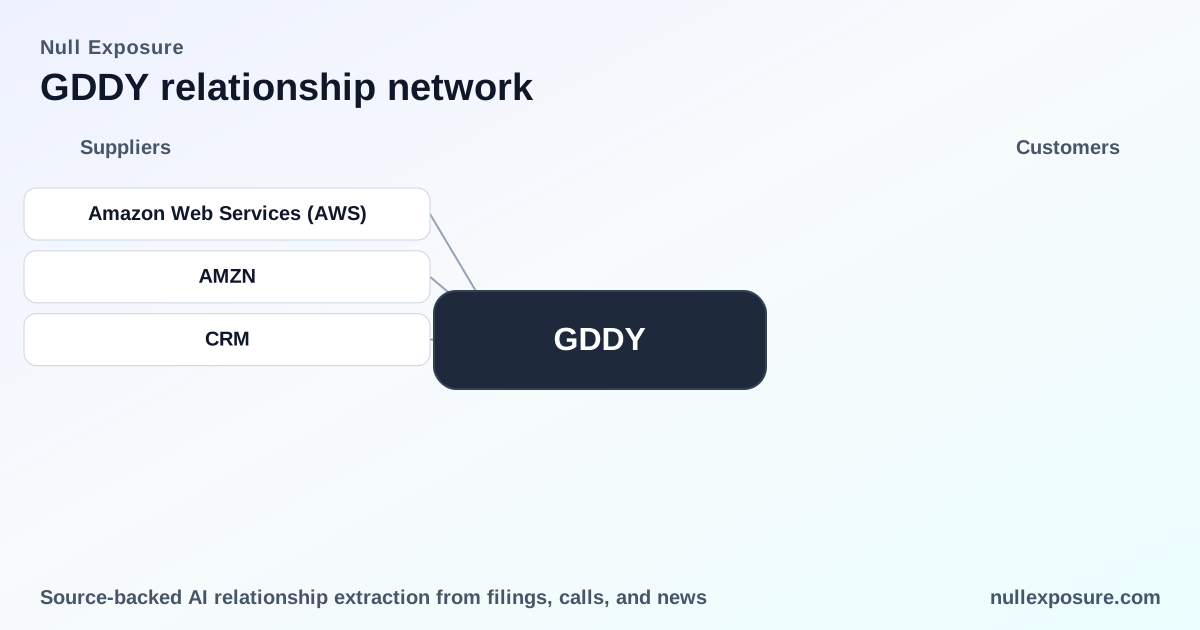
GoDaddy (GDDY) — Supplier Map and Operational Implications for Investors
GoDaddy operates a hybrid infrastructure and platform business that monetizes through subscription services (domains, hosting, site-building and web presence tools), professional services and platform integrations that drive upsells and recurring revenue. The company runs a mix of company-owned data center assets and co-located facilities while integrating third-party cloud and enterprise middleware providers to scale product delivery and accelerate feature development — a structure that concentrates operational risk in a handful of external suppliers even as it preserves control over core hosting capacity.
If you evaluate supplier risk or vendor concentration in technology-heavy SMB platforms, this profile clarifies the relationships that matter and where to focus diligence. For deeper supplier visibility and continuous monitoring, visit https://nullexposure.com/ for analyst-grade supplier intelligence.
How GoDaddy structures its supplier footprint — what the filings signal about operating posture
GoDaddy’s disclosures reveal a hybrid contracting posture: a company-owned data center in Phoenix complemented by co-location arrangements across the U.S. and international markets. Those arrangements enable geographic reach while keeping critical hosting control internal. The company also engages third parties for customer support roles, which externalizes labor and service delivery risk.
- Contracting posture: Hybrid — owned infrastructure plus co-location providers and third-party service vendors.
- Geographic footprint: North America is core (owned Phoenix data center; significant Virginia co-location presence), with international co-locations concentrated in France, Germany, the Netherlands and Singapore.
- Outsourced service model: Parts of customer support (GoDaddy Guides) are engaged through third parties, creating potential reputational and replacement-cost risk if third-party performance fails.
- Operational maturity: The company is intentionally optimizing between owned infrastructure and public-cloud use to balance cost, control and scale.
These signals imply concentrated operational exposure across a small set of physical and managed-service partners, and they shape where investors should probe contract SLAs, redundancy plans and run-rate costs.
Supplier relationships you need to know
Below I cover every supplier relationship surfaced in the available records and explain what each partner contributes to GoDaddy’s operating model.
Amazon Web Services (AWS)
GoDaddy continues to migrate many non-hosting products and internal systems to AWS while maintaining an optimized company-owned cloud infrastructure, reflecting a deliberate split between internal hosting and third-party cloud scale. According to GoDaddy’s FY2024 disclosure, the move is part of ongoing migration efforts to AWS and company-owned infrastructure. A TradingView summary of GoDaddy’s FY2026 operational risk commentary explicitly called out reliance on third-party cloud services like AWS as a potential source of system disruption. (Sources: GoDaddy FY2024 Form 10‑K; TradingView report summarizing FY2026 commentary.)
MuleSoft (Salesforce)
GoDaddy has integrated Salesforce’s MuleSoft as part of an AI agent-identification integration, positioning MuleSoft as the enterprise middleware enabling identity workflows between customer-facing agents and GoDaddy systems. A March 2026 market note documented the MuleSoft integration in the context of GoDaddy’s AI initiatives and broader earnings commentary. (Source: Sahm Capital coverage, March 2026.)
What these relationships mean for operations and risk
The relationships above deliver scale and integration velocity but also concentrate criticality in a small number of external platforms and in outsourced service providers. Investors and operators should focus on four practical implications:
- Concentration and resilience: The mix of company-owned Phoenix infrastructure and co-located facilities in Virginia and selected EMEA/APAC hubs reduces single-point failure at the physical level, but the shift of non-hosting workloads to third-party cloud providers concentrates logical dependencies. Review disaster recovery and cross-provider failover plans.
- Vendor lock and switching costs: Integrations like MuleSoft can accelerate product velocity but create coupling between internal systems and external middleware. Ask for estimated time and cost to replace middleware or to re-architect integrations if commercial terms become unfavorable.
- Service delivery and reputation: The company’s use of third-party providers for GoDaddy Guides introduces operational reputational risk if third parties fail to meet service expectations. The filing notes the potential for increased cost and service delays should those relationships terminate or underperform.
- Geographic exposure: The disclosures show an explicit North American bias with important EMEA and APAC co-location points (France, Germany, the Netherlands, Singapore). That footprint supports international latency and compliance needs but requires attention to cross-border data governance and regional redundancy.
Midway checkpoint — for investors wanting vendor-level insights and contract risk scoring, explore subscription options at https://nullexposure.com/ to incorporate supplier signals into diligence and portfolio risk management.
Practical questions for management and diligence
When engaging management or underwriting exposure to GoDaddy, prioritize these queries:
- What percentage of non-hosting workloads run on third-party cloud providers versus company-owned infrastructure, and how is that split trending?
- What SLAs and financial remedies exist with core third-party cloud and middleware suppliers? Are there capabilities to fail over to owned infrastructure within defined RTOs/RPOs?
- How are third-party GoDaddy Guide contracts structured (term, termination rights, performance metrics, indemnities) and what contingency plans exist for replacement?
- How does the company handle cross-border data residency and incident response across its co-location footprint in EMEA and APAC?
Conclusion — investment implications and recommended next steps
GoDaddy’s supplier strategy is a balance of control and speed: company-owned capacity for predictable hosting and third-party cloud and middleware for flexibility and rapid delivery. That architecture optimizes product velocity, but it concentrates operational dependence on a small set of external vendors and third-party service providers — a material governance and operational risk for investors assessing continuity and margin sensitivity.
Recommended next steps for investors:
- Review contract-level protections and SLAs for core cloud and middleware suppliers.
- Stress-test recovery timelines between owned and third-party infrastructure.
- Monitor third-party customer support performance and replacement costs tied to GoDaddy Guides.
For continuous supplier monitoring and to convert these signals into portfolio actions, visit https://nullexposure.com/ and subscribe to supplier intelligence tailored to technology-heavy SMB platforms.
Bold takeaway: GoDaddy’s hybrid infrastructure reduces some physical concentration but increases logical dependence on external cloud and middleware partners — an essential dynamic for any investor or operator assessing operational continuity and vendor risk.