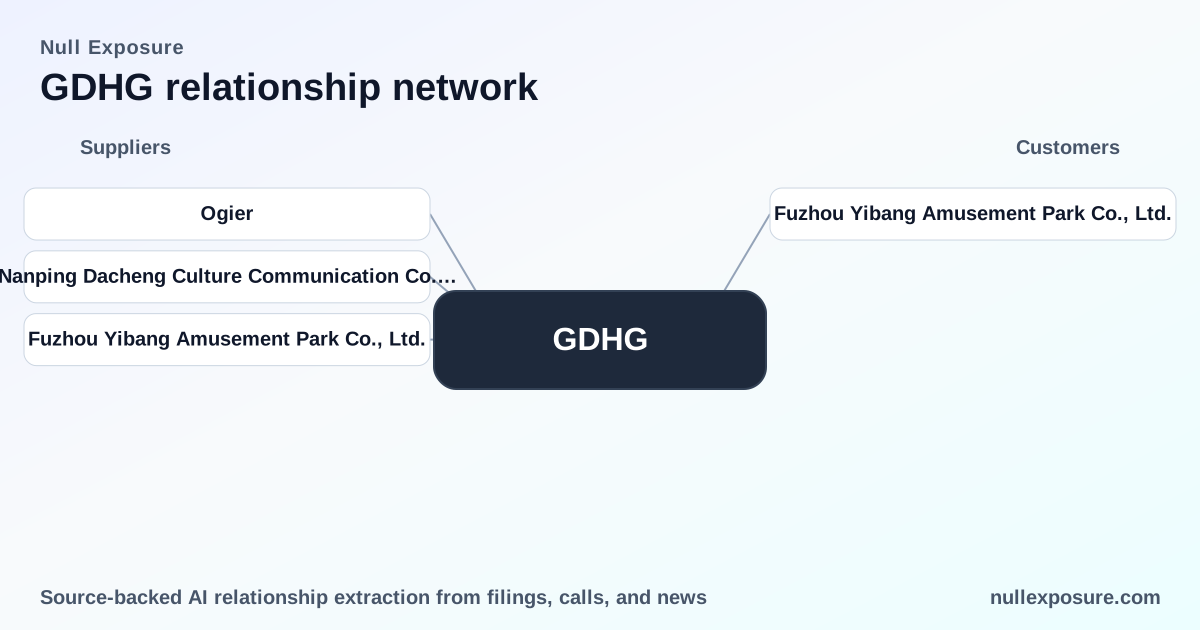
GDHG: Supplier map and capital-market partnerships that drive short-cycle monetization
Golden Heaven (ticker GDHG) operates as an entertainment and cultural-project operator that monetizes through two parallel channels: project-level revenue sharing with local operators and active capital-market transactions to manage investor liquidity and funding. The company executes short-term cooperative development agreements to deploy experiences (wedding photography, light shows and related venue services) while using U.S. registration and shelf arrangements to enable share resales that support funding and secondary-market liquidity. For more structured supplier intelligence and model-backed monitoring, visit https://nullexposure.com/.
How GDHG runs projects and turns partnerships into cash
GDHG structures near-term cash generation by acting as coordinator and operational supervisor on localized entertainment projects while outsourcing specialized execution to third parties. The company signs cooperation agreements that allocate roles—GDHG supervises and shares in profits, while local partners provide venues and technical services—creating low-capex, high-turnover revenue streams. Concurrently, GDHG maintains an active capital-markets posture: legal opinions from offshore counsel support resale mechanics under an existing U.S. registration, which improves share liquidity and expands financing flexibility.
This hybrid model produces two practical investor implications: operational risk is concentrated in execution partners, and financial flexibility is supported by formal securities registrations and legal opinions that facilitate resale. If you want ongoing monitoring and supplier-facing intelligence on GDHG, go to https://nullexposure.com/ for setup and alerts.
What the public record shows about each supplier and advisor
Below are the supplier/advisor relationships identified in public releases. Each entry includes a concise plain-English summary and the source.
-
Ogier — Cayman legal opinion supporting resale of Class A shares. Ogier delivered a Cayman Islands legal opinion confirming the legality of up to 14.5 million Class A ordinary shares offered pursuant to a December 4, 2025 purchase agreement, enabling resale under GDHG’s U.S. registration and supporting capital-markets activity. This was disclosed in a company press release reported on March 9, 2026 by The Globe and Mail (FY2026). Source: press release reported by The Globe and Mail on March 9, 2026 — https://www.theglobeandmail.com/investing/markets/stocks/GDHG/pressreleases/37283969/golden-heaven-files-legal-opinion-supporting-resale-of-145-million-shares-under-f-3-shelf/
-
Ogier (duplicate filing entry). The second listing repeats the Cayman legal opinion confirming resale mechanics for the same block of Class A shares under GDHG’s U.S. registration, reinforcing the firm’s compliance documentation supporting liquidity. This duplicate was also recorded on March 9, 2026 in a related press release entry tracked by The Globe and Mail (FY2026). Source: related Globe and Mail press release on March 9, 2026 — https://www.theglobeandmail.com/investing/markets/stocks/GDHG-Q/pressreleases/37283969/golden-heaven-files-legal-opinion-supporting-resale-of-14-5-million-shares-under-f-3-shelf/
-
Nanping Dacheng Culture Communication Co., Ltd. — local creative services partner. GDHG announced a cooperation agreement where Nanping Dacheng will provide professional photography services and collaborate on wedding-photography and light-show projects in Tongling and Changde; GDHG will coordinate operations and take a share of project profits over the stated cooperation period. This cooperation was described in an OpenPR release in March 2026 (FY2025). Source: OpenPR release, March 2026 — https://www.openpr.com/news/3877261/promising-new-investments-and-joint-venture-agreements
-
Fuzhou Yibang Amusement Park Co., Ltd. — venue and operations partner. Under the same cooperation agreement, Fuzhou Yibang will supply venues and support light-show activities while GDHG supervises and participates in profit sharing, making Fuzhou Yibang an operationally critical venue provider for these projects. This arrangement was disclosed in the March 2026 OpenPR announcement. Source: OpenPR release, March 2026 — https://www.openpr.com/news/3877261/promising-new-investments-and-joint-venture-agreements
What these relationships collectively reveal about GDHG’s operating model
- Contracting posture: GDHG favors short, targeted cooperation agreements where the company coordinates and supervises while outsourcing execution, which accelerates time-to-revenue and avoids heavy fixed-asset commitments.
- Concentration: The supplier base shown is localized and specialized—creative services and venue providers—indicating low supplier concentration at the advisory/legal level but potential operational concentration on a few local partners for each project.
- Criticality: Local partners supply the core experiential components (photography, light shows, venues); these partners are operationally critical for project delivery but not strategically unique from a replication perspective, which allows GDHG to redeploy the model across different cities.
- Maturity and governance: Use of a Cayman legal opinion to enable share resale under a U.S. registration demonstrates mature capital-markets governance and an intention to keep funding and liquidity channels open for investors.
Key takeaway: The business model combines light-asset project rollouts with formal capital-market mechanisms, producing rapid revenue cycles while controlling financial flexibility through documented legal support.
If you need ongoing supplier risk scores or alerts tied to these relationships, start monitoring at https://nullexposure.com/.
Risk considerations investors should track
- Execution risk: Profitability hinges on partner execution quality and local marketing; short-term cooperation limits long-tail control over outcomes.
- Counterparty performance: Single-city projects concentrate operational delivery risk in individual partners; verify contract terms, performance guarantees and dispute-resolution mechanisms where available.
- Capital-market dependency: Resale mechanics backed by offshore legal opinions reduce legal friction but increase reliance on continued registration compliance and market receptivity; track shelf status, filings and trading liquidity.
- Disclosure and transparency: Public disclosures are sparse on long-term supplier commitments and escalation clauses; investors should press for standardized reporting on partner contracts and revenue attribution.
Bottom line and recommended next steps
GDHG generates revenue through asset-light, partner-driven entertainment projects while preserving financing optionality via structured resale of equity under U.S. registration—a model that accelerates cash conversion but concentrates delivery risk at the partner level. For investors and operators, prioritize verification of counterparty performance metrics, contractual terms for profit sharing, and ongoing proof of registration and legal cover for share resales.
For continuous tracking and supplier-specific alerts on GDHG and comparable issuers, visit https://nullexposure.com/. To commission a focused supplier due-diligence brief or set up monitoring for these counterparties, engage our team at https://nullexposure.com/.
Major relationship takeaways: Ogier provides capital-markets legal cover that enhances liquidity; Nanping Dacheng and Fuzhou Yibang deliver the operational muscle for GDHG’s short-cycle projects—together they form a funding-plus-execution architecture that investors must monitor across execution, disclosure and market-liquidity vectors.