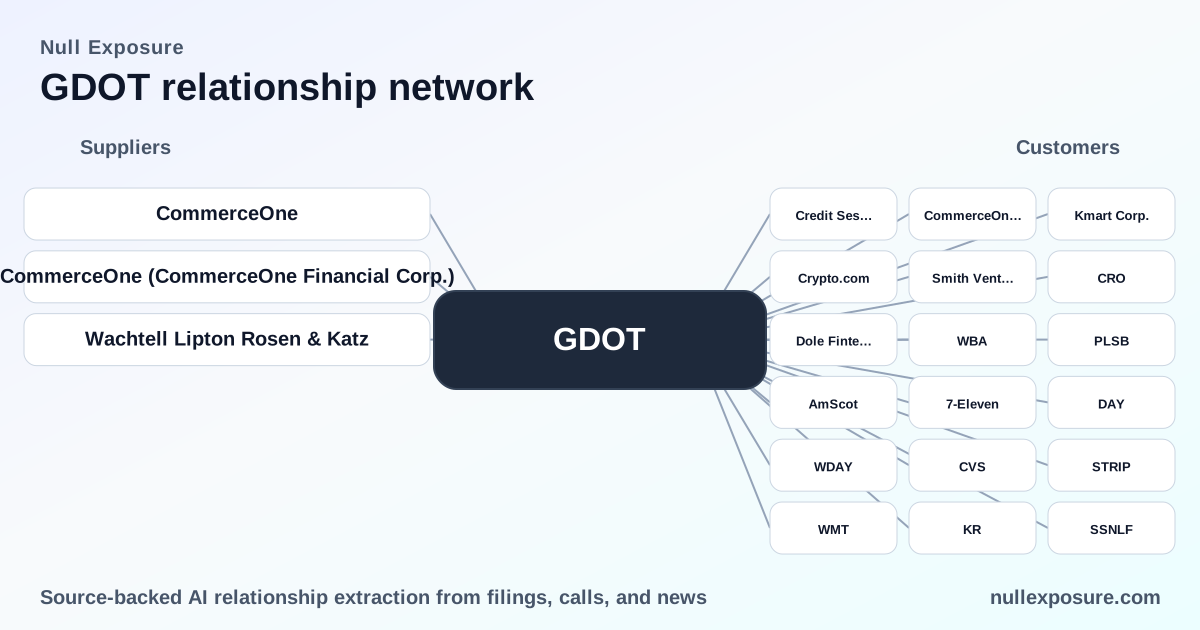
Green Dot (GDOT) supplier relationships: what the CommerceOne deal and advisor roster mean for investors
Green Dot operates as a fintech platform that issues consumer accounts and provides bank-as-a-service (BaaS) to partners, monetizing through account fees, interchange economics and B2B services tied to gross dollar volume and processing scale. Recent announcements and public disclosures show a deliberate reconfiguration of the company’s issuing relationships and legal posture—moves that directly affect cost structure, counterparty concentration, and the firm's operational leverage. For investors and operators evaluating supplier risk, the implications are concrete: contracting posture is shifting toward a single, exclusive issuing partner while processing spend remains a material, high-dollar line item.
Explore a supplier-focused view of GDOT on the NullExposure homepage: https://nullexposure.com/
Recent headlines that matter to counterparties and creditors
CommerceOne — acquisition of Green Dot Bank reported (BhamNow, Nov 24, 2025)
A BhamNow article reported that CommerceOne will acquire Green Dot Bank and its associated assets and operations, and together they will become a new publicly traded bank holding company that serves as the fintech’s exclusive issuing bank. This transaction reassigns the critical issuing function to CommerceOne and consolidates issuing control under a single partner (BhamNow, Nov 24, 2025).
CommerceOne — cross-sector megadeal described (USA Herald, FY2025)
A USA Herald report covering the same transaction framed CommerceOne (CommerceOne Financial Corp.) as becoming Green Dot’s exclusive issuing bank, a change that management said supports trust, growth, and client service objectives, signaling a strategic move to lock in issuer capacity and brand continuity (USA Herald, FY2025).
Wachtell Lipton Rosen & Katz — legal counsel on the deal (USA Herald, FY2025)
The USA Herald coverage notes that Wachtell Lipton Rosen & Katz advised Green Dot on the transaction, indicating the company engaged top-tier legal advisory for the cross-sector acquisition and the associated re-organization of issuing services (USA Herald, FY2025).
How every reported relationship reads for supplier risk and opportunity
- CommerceOne (BhamNow): CommerceOne will acquire Green Dot Bank and become Green Dot’s exclusive issuing bank, which concentrates issuing risk and streamlines issuer integration under a single partner (BhamNow, Nov 24, 2025).
- CommerceOne — CommerceOne Financial Corp. (USA Herald): The same CommerceOne transaction is described as a $1.1 billion cross-sector deal that formally establishes CommerceOne as Green Dot’s exclusive issuing bank, a move management frames as supporting growth and service objectives (USA Herald, FY2025).
- Wachtell Lipton Rosen & Katz (USA Herald): Wachtell Lipton served as legal counsel to Green Dot in the transaction, reflecting the company’s use of elite outside counsel for major strategic and regulatory work (USA Herald, FY2025).
Company-level constraints and what they tell investors about how Green Dot operates
The public excerpts and filings generate several consistent signals about Green Dot’s supplier posture that are material to counterparty evaluation:
-
Distributor-heavy go-to-market and outsourcing of physical fulfilment. Filing language highlights commission payments to retail distributors and the costs to manufacture and distribute card packages and promotional materials, indicating ongoing dependence on third-party retail partners to reach customers. This is a recurring operating cost that drives working capital and distribution risk.
-
Third-party processing is strategic and large-scale. Processing expenses are called out as fees to payment networks, third-party card processors and issuing banks; filings show processing spend grew materially in 2024, driven by BaaS account volume and migrations to in-licensed systems. This is a high-dollar, operationally critical spend category that scales directly with volume and can create supplier concentration and pricing leverage points.
-
Spend magnitude consistent with a $100m+ processing posture. Public excerpts describe an increase in processing expense measured in the hundreds of millions for the year ended December 31, 2024, reflecting both growth in BaaS volume and the importance of processor relationships to gross margin.
-
Mature legal and transaction posture. Engagement of a premier law firm for a transformational issuer transaction signals that Green Dot is operating at a corporate maturity level where complex M&A, regulatory approvals and contract renegotiations are routine and handled with specialist advisors.
These constraints collectively portray an operating model that is outsourced in distribution and processing, concentrated in critical issuing relationships, and managed with top-tier external advisory when executing structural changes.
Investment implications: concentration, cost control, and transition risk
- Concentration risk rises with an exclusive issuer. Making CommerceOne the exclusive issuing bank centralizes a mission-critical function. That reduces integration complexity but increases single-counterparty dependence—important for lenders and counterparties who stress-test continuity plans.
- Large, variable processing spend challenges margin predictability. The jump in processing expenses tied to BaaS volume means margins will remain sensitive to processor pricing and volume trends; efficient migration to in-licensed systems reduces unit cost but requires execution discipline.
- Deal execution is supported by high-end advisors. Engagement of Wachtell Lipton signals that the company treats such transitions as structurally important and is prepared to absorb legal and transaction costs to mitigate regulatory and contractual friction.
Key takeaway: Green Dot is deliberately consolidating issuer relationships while retaining large, externalized processing and distribution roles—this reduces technical fragmentation but concentrates counterparty risk and keeps processing spend a major financial lever.
If you want a supplier-risk scorecard or a deeper counterparty map for GDOT, begin your analysis here: https://nullexposure.com/
What investors should watch next
- Monitor integration milestones and timelines for the CommerceOne issuing transition, including contractual length, termination rights, and SLA commitments.
- Track processor spend trends and any disclosure of unit economics after migrations to in-licensed systems.
- Watch legal filings and regulatory notices associated with the acquisition for covenants that affect liquidity, collateral, or third-party access.
Final read: positioning your portfolio and operations for the new supplier structure
Green Dot’s shift to a single exclusive issuing partner coupled with large, externally provided processing capacity makes supplier diligence essential for credit analysts and operations managers. Concentration of issuing increases systemic counterparty exposure; processing spend remains a lever that will drive near-term margin volatility. Engage counterparties on SLAs, termination mechanics, and contingency planning, and model scenarios where processor pricing or issuer availability changes.
For a practical guide to mapping supplier exposures and stress-testing GDOT’s counterparty network, visit NullExposure for supplier-focused analytics and benchmarks: https://nullexposure.com/