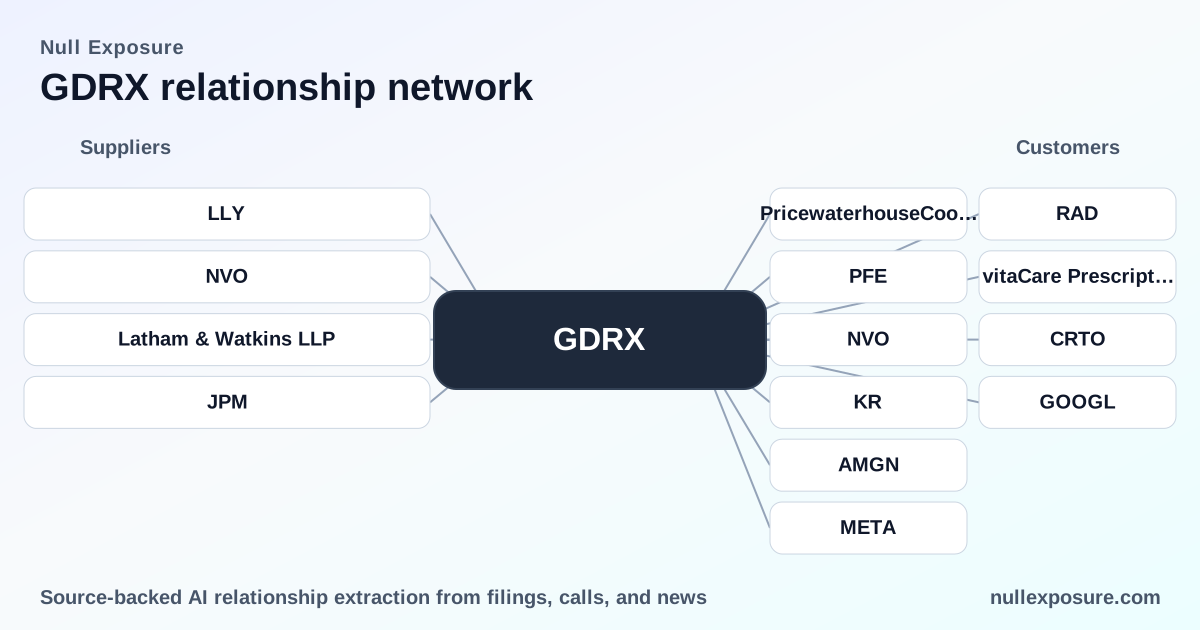
GoodRx (GDRX) as a Supplier: Who matters to the platform and why
GoodRx operates a consumer-facing prescription pricing and distribution platform that monetizes through pharmacy transactions, cash-pricing programs and partner integrations with drug manufacturers and health-service providers. Recent partnerships to offer GLP‑1 therapies at cash prices and ongoing legal, real‑estate and advisory relationships reveal a company balancing rapid commercial expansion with operational dependencies on third‑party platforms and cloud infrastructure. For a deeper view of supplier relationships and the implications for diligence, see https://nullexposure.com/.
How GoodRx makes money and what that means for suppliers
GoodRx drives revenue by connecting consumers to lower prescription prices and by facilitating transactions and access to medications through pharmacy partners and direct retail pricing programs. Revenue is sensitive to the company’s ability to maintain distribution channels (apps and app stores), pharmaceutical partner agreements, and the underlying cloud and platform services that host its consumer experiences.
- The company’s commercial moves — notably adding GLP‑1 therapies to its cash-pricing offers — are direct revenue drivers because they expand addressable consumer spend through GoodRx’s checkout flows.
- Operationally, GoodRx is heavily dependent on third‑party cloud hosting and app marketplaces for data processing and distribution, which makes supplier continuity and contract terms critical to uptime and customer acquisition.
Act now: if you evaluate supplier risk or seek to map counterparty exposure for GoodRx, start from the company homepage analysis at https://nullexposure.com/.
Key operating constraints and what they tell investors
The sourced constraint excerpts paint a clear operational profile:
- Critical cloud dependency. GoodRx processes “nearly all” data storage and analytics on third‑party servers, with Amazon Web Services explicitly named and some uses of Google Cloud Platform cited; if those vendors fail or commercial terms change, the company’s operations can be materially disrupted.
- Service‑provider posture. The company relies on external providers for core infrastructure rather than vertically integrating hosting or analytics capability, which concentrates operational risk with a small set of suppliers.
- Active distribution reliance. GoodRx’s apps are distributed through Apple App Store and Google Play, making continued access to those marketplaces a business‑critical contract and an ongoing point of negotiation and operational dependency.
These constraints are company‑level signals of concentration and criticality rather than isolated, transient vendor links; they imply high operational leverage to a few platform partners and therefore warrant prioritized contract review and contingency planning.
Midway action: review GoodRx supplier mappings and risk ratings at https://nullexposure.com/ to prioritize vendor diligence.
The full set of supplier‑side relationships surfaced
Below I enumerate every relationship pulled from the source results with a short investor‑oriented read and the original reporting reference.
Eli Lilly — GoodRx sells Lilly products through pharmacy channels
GoodRx lists Eli Lilly drugs such as Mounjaro and Zepbound in its standard pharmacy channels, supporting consumer access to Lilly’s GLP‑1 products at regular pharmacy pricing (reported March 9, 2026). (Source: Yahoo Finance, Mar 9, 2026)
Novo Nordisk — GoodRx offering Ozempic and Wegovy at a flat cash price
GoodRx announced it will sell Novo Nordisk’s Ozempic and Wegovy for a cash price of $499 per month, a move that directly expands GoodRx’s retail offering into high‑demand GLP‑1 therapies (reported March 9, 2026). (Source: Yahoo Finance, Mar 9, 2026)
Novo Nordisk (local coverage) — Market reaction to the GLP‑1 deal
Local business reporting linked the Novo Nordisk deal to a sharp share re‑rating for GoodRx after the company made Wegovy and Ozempic available to self‑pay customers at the $499 monthly price point (coverage referenced Aug 18; cited in March 2026 aggregation). (Source: Los Angeles Business Journal, coverage referenced 2025–2026)
Latham & Watkins LLP — capital markets counsel for the IPO
Latham & Watkins advised GoodRx on its public offering, providing capital‑markets legal representation that established the company’s initial public‑market and regulatory posture (documented in the IPO announcement, FY2020). (Source: Latham & Watkins, 2020)
Eli Lilly and Company — product expansion and subscription initiatives
GoodRx expanded access to Eli Lilly’s Zepbound KwikPen and other Lilly offerings, including subscription-style price programs, which deepen GoodRx’s commercial relationship with Lilly product lines (market announcement flagged in FY2025 reporting). (Source: MarketScreener, FY2025)
Latham & Watkins LLP — successful defense in securities litigation
A Latham & Watkins securities litigation team secured dismissal of a shareholder class action against GoodRx, underlining the firm’s ongoing role in GoodRx’s legal defense and corporate governance matters (reported FY2022). (Source: Latham & Watkins, 2022)
JPMorgan Chase & Co. — real‑estate transaction involving GoodRx premises
JPMorgan purchased the Santa Monica property that housed GoodRx for approximately $166 million, a commercial real‑estate transaction with implications for corporate real‑estate strategy and landlord/capital relationships (reported FY2023). (Source: Los Angeles Business Journal, FY2023)
Novo Nordisk A/S — Wegovy availability through GoodRx and other retail channels
Novo Nordisk’s Wegovy distribution notes include GoodRx as one of the avenues for U.S. access, placing GoodRx alongside pharmacies, telehealth providers and specialty dispensaries as a commercial channel for high‑value product distribution (reported FY2026). (Source: SAHM Capital report, Jan 5, 2026)
Investment implications and a risk checklist
GoodRx’s supplier map reveals three practical implications for investors and operators:
- Concentration risk is high. Cloud hosting and app‑store distribution are single points of failure; contract terms with AWS, Google Cloud and the app marketplaces determine operational continuity — treat these as first‑order risks.
- Commercial expansion is product‑driven. Partnerships to distribute GLP‑1 drugs are material revenue levers but also heighten regulatory and supply‑chain scrutiny; pharma partner agreements are commercially critical.
- Legal and capital service partners are established. Ongoing engagements with top‑tier counsel and transactions with major financial institutions point to maturation of corporate governance and financing but also higher visibility to investors and litigants.
Actionable checklist:
- Confirm contract terms and SLAs with cloud and marketplace providers; stress‑test continuity plans.
- Review commercial agreements for GLP‑1 distribution for exclusivity, pricing commitments, and inventory controls.
- Monitor legal exposures and property‑level obligations in light of prior litigation wins and real‑estate transactions.
Final step: for targeted due diligence on GoodRx suppliers or to model counterparty exposure, start with an organized supplier map available at https://nullexposure.com/.
GoodRx’s supplier relationships are both growth enablers and concentration risks — underwrite them accordingly.