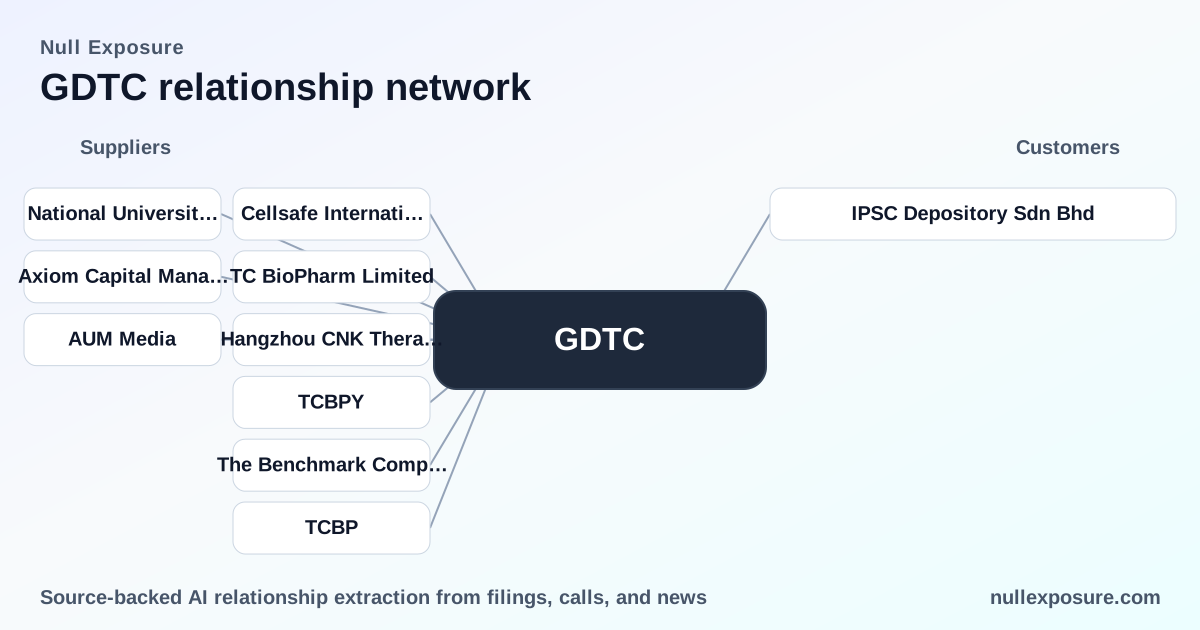
CytoMed Therapeutics (GDTC): Partner map and supplier signals investors need now
Thesis — CytoMed Therapeutics (GDTC) advances an allogeneic cell-therapy platform built on gamma delta (γδ) T‑cell and non‑viral CAR engineering technologies, and it monetizes by acquiring and licensing immune‑cell IP, progressing clinical programs through hospital and R&D partnerships, and financing development via public capital raises. Investors should value CGTC as a development‑stage biotech where near‑term value drivers are technology acquisitions and clinical collaborations that de‑risk programs ahead of later commercial optionality. For further supplier and counterparty diligence, start with the firm’s relationship map at https://nullexposure.com/.
How the partner footprint defines the company’s operating posture
CytoMed runs a build-and-integrate model: the company acquires external technology and capabilities, stitches them into in‑house programs, then uses clinical partnerships and capital markets to advance trials. From the relationship set below, several company-level signals are visible:
- Contracting posture — acquisitive and collaborative. CytoMed executes asset acquisitions (paid purchases) and research collaborations rather than long-term supply contracts, indicating control of key IP through purchase and targeted R&D agreements.
- Concentration — focused on a small number of strategic partners. The partner list shows targeted relationships in cell‑therapy IP, research tools and clinical trial sites rather than a broad vendor base; supplier concentration creates single‑node execution risk if a partner underdelivers.
- Criticality — high for a few partners. Partners that supply gene‑editing platforms or proprietary cell lines are mission‑critical to product execution; clinical sites and underwriters are strategically important to program progression and financing cadence.
- Maturity — mixed. Relationships span established financial intermediaries and clinical institutions alongside early‑stage technology vendors and acquired assets, indicating a hybrid maturity profile that raises integration and regulatory execution demands.
For a consolidated view of counterparties and how they affect program timing and financing, see https://nullexposure.com/.
Key supplier and partner relationships investors must know
Below are every relationship referenced in public coverage of GDTC’s supplier/partner activity. Each entry is a plain‑English 1–2 sentence synopsis with a source reference.
Cellsafe International Sdn Bhd
CytoMed, through subsidiary IPSC Depository Sdn Bhd, acquired the licence and certain assets of Cellsafe International Sdn Bhd (In Liquidation), securing a Malaysian cord‑blood banking licence as part of its cell sourcing and storage capabilities (reported FY2024). This purchase expands CytoMed’s control over upstream cell custody infrastructure. Source: BioInformant report (first reported March 2026).
TC BioPharm Limited (first mention)
CytoMed completed a paid acquisition of TC BioPharm Limited’s allogeneic gamma delta T‑cell technology (TCB‑002), transferring development rights into the CytoMed program roster (announced FY2025). The deal is a clear example of GDTC’s strategy to buy clinical‑stage IP rather than develop every platform internally. Source: Yahoo Finance coverage of the company announcement (FY2025).
Hangzhou CNK Therapeutics Co., Ltd (CNK)
CytoMed entered a research collaboration to use CNK’s PiggyBac non‑viral gene‑integration technology to permanently graft CAR constructs into γδ T cells, positioning non‑viral engineering as a manufacturing and durability lever for CytoMed’s allogeneic products (reported FY2023). This partnership reduces reliance on viral vector supply for certain constructs and speeds gene integration workflows. Source: PR Newswire press release (FY2023).
TC BioPharm (Holdings) PLC (TCBPY)
The TC BioPharm (Holdings) PLC parent was disclosed as the seller of TCB‑002 technology to CytoMed, highlighting a cross‑border technology transfer from a UK group into CytoMed’s development pipeline (announced FY2025). The acquisition included full payment and transfers of rights, indicating a cash‑based IP consolidation. Source: Yahoo Finance and Globenewswire coverage tied to the November 2025 transaction (FY2025).
TC BioPharm (alternate listing)
Market intelligence services similarly reported completion of the TCB‑002 acquisition, reinforcing that TC BioPharm’s gamma delta T‑cell platform is now under CytoMed’s control (reported FY2026 in some summaries). Multiple news outlets repeated the transaction details, emphasizing the strategic importance of the TCB‑002 asset. Source: Intellectia.ai news aggregation (FY2026).
The Benchmark Company, LLC
The Benchmark Company acted as the bookrunning manager on CytoMed’s underwritten public offering, demonstrating the company’s reliance on established boutique underwriters to access equity capital in FY2023. This indicates an ongoing relationship with capital markets intermediaries for funding growth. Source: PR Newswire closing notice for the IPO (FY2023).
National University Hospital (NUH), Singapore
CytoMed signed a clinical study agreement with NUH to recruit patients for the first‑in‑human ANGELICA trial evaluating CTM‑N2D, confirming that NUH is a named clinical partner for early human safety assessment (agreement dated September 23, 2024; reported FY2024). Access to an academic medical center supports trial conduct and patient enrollment credibility. Source: Company interim financial statements quoted on MarketScreener (FY2024).
Axiom Capital Management, Inc.
Axiom Capital served as a co‑managing underwriter alongside Benchmark on CytoMed’s public offering, indicating a second‑tier banking relationship used to syndicate equity issuance in FY2023. This pairing shows a typical mid‑market underwriting footprint for a clinical‑stage issuer. Source: PR Newswire closing notice for the IPO (FY2023).
AUM Media
AUM Media is listed as the investor relations contact (Crocker Coulson, CEO) on the IPO closing release, signaling the external communications vendor or IR contact used during CytoMed’s capital raise in FY2023. Maintaining a professional IR channel supports market visibility during program milestones. Source: PR Newswire investor relations information (FY2023).
Risk implications and what to watch next
- Integration risk: The TCB‑002 acquisition and the Cellsafe licence are positive steps to control IP and upstream supply, but integration of technology and regulatory alignment will determine timing to clinical readouts.
- Single‑node execution risk: Dependence on CNK’s PiggyBac for non‑viral engineering and on NUH for early‑stage trials creates concentrated operational nodes that are critical to program timelines.
- Funding cadence: Underwriter relationships with Benchmark and Axiom show the company’s path to public capital; market access is essential for continued R&D funding until commercialization.
For a deeper read on counterparties and potential supplier concentration risk across GDTC’s partner map, visit https://nullexposure.com/.
Bottom line for investors
CytoMed’s supplier and partner architecture is strategic, acquisitive and clinically focused: acquisitions buy IP, non‑viral technology partnerships accelerate product design, and hospital and underwriting relationships enable trials and financing. Primary near‑term investor levers are successful clinical execution with NUH and technical integration of the TCB‑002 and PiggyBac platforms; deficiencies in either area would compress expected upside.
For tailored diligence on supplier exposure and counterparty risk for GDTC and comparable development‑stage biotechs, see our analysis hub at https://nullexposure.com/.