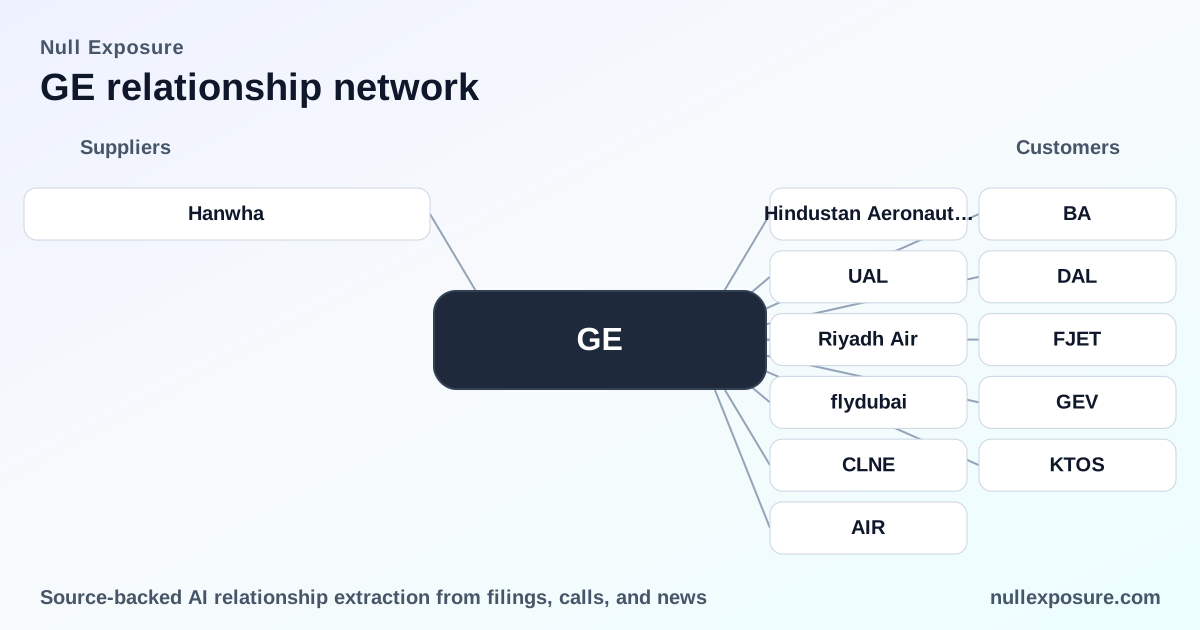
GE Aerospace: Supplier Spotlight — Hanwha, global constraints and what operators should price in
Thesis: GE Aerospace sells and services jet engines and related systems while monetizing a high-margin aftermarket of long-term service agreements, spare parts and MRO; its commercial success depends as much on engine OEM sales as on a resilient, global supply chain and localized assembly partnerships that shorten delivery timelines and protect service revenue. Investors should treat supplier relationships as strategic operational levers that directly influence production cadence, aftermarket capture and geopolitical exposure. Learn more at https://nullexposure.com/.
Hanwha’s role: localized assembly for T700 and F404 platforms
A recent industry report documents that Hanwha will assemble additional GE Aerospace T700 and F404 engines in Korea, reflecting deeper manufacturing cooperation and regionalization of GE’s supply base. According to a Forecast International news item dated February 25, 2026, the coverage identifies Hanwha as a local assembler for these GE powerplants in Korea, which supports both military and commercial customers in the region. https://dsm.forecastinternational.com/2026/02/25/usaf-selects-honeywell-to-prototype-engine-for-new-cca-fleet/
How that relationship reads for operators and investors
- Operationally, localized assembly reduces lead times and import friction for Asia-Pacific customers, improving GE’s ability to fulfill long-term service agreements and parts demand in that region.
- Strategically, the partnership diversifies manufacturing footprint and shifts some production and MRO-related economic activity closer to end-markets, which supports aftermarket margin stability.
These outcomes are direct consequences of having regional partners perform assembly and qualification tasks rather than relying solely on U.S.-based production lines.
Company-level supply constraints you must factor in
GE’s supplier posture is defined by a few consistent, company-level signals that inform investment and operational risk assessments:
- Global sourcing is core to the model. GE states it relies on a global supply chain for raw materials, components and MRO services, which increases exposure to multi-jurisdictional logistics, trade shifts and supplier country risk. This is a structural attribute, not a temporary condition, and it amplifies the importance of relationships like Hanwha that localize production.
- Certain suppliers are critical or sole-source. GE discloses reliance on limited- or sole-source suppliers where product quality and continued availability are mission-critical. That makes supplier continuity a determinative factor for revenue delivery on major engine programs.
- Material disruptions are consequential. The company documents that prolonged disruptions at significant suppliers, or loss of access to important parts, can force lengthy requalification, regulatory cycles and production delays — all of which carry direct revenue and reputation costs.
- GE acts as a large-scale buyer with concentrated exposure. The firm’s procurement posture creates market power but also concentration risk: the buyer role reduces cost flexibility but increases the consequences of single-supplier failure for production timelines.
These excerpts originate from GE’s public risk disclosures and should be treated as firm-level operating constraints that inform supplier strategies and contingency planning.
All supplier relationships identified in the review (compact, source-linked)
Hanwha — Hanwha will assemble more GE Aerospace T700 and F404 engines in Korea, supporting regional manufacturing and service operations; the arrangement was reported by Forecast International in February 2026. https://dsm.forecastinternational.com/2026/02/25/usaf-selects-honeywell-to-prototype-engine-for-new-cca-fleet/
(There were no other supplier relationships flagged in the reviewed results.)
What this implies for revenue, margins and risk
- Aftermarket resilience: Local assembly partners like Hanwha strengthen GE’s proximity to fleet operators in Asia, improving spare-parts availability and supporting long-term service contracts that generate annuity-like margins. That directly supports GE’s strong profitability in aviation services.
- Concentration and certification risk: The company-level disclosure that some suppliers are sole-source creates asymmetric downside if a supplier disruption affects a major engine family; investors should price a non-linear risk premium into programs with single-source components.
- Geopolitical and regulatory exposure: Regional assembly reduces tariff and logistics friction but introduces dependence on partner-country industrial policy and export-control regimes. Korea-based assembly improves commercial access in Asia while creating a bilateral policy dependency that requires active contract and export-control management.
- Procurement leverage vs. supply fragility: GE’s scale gives it bargaining power, but the same scale concentrates operational exposure; supplier failures can lead to protracted qualification cycles and production delays that hit revenue recognition and aftermarket capture.
Practical watchlist for analysts and operators
- Track regional assembly rollouts and how many engine lines move to partners like Hanwha; an expanding footprint signals faster aftermarket capture in local markets.
- Monitor supplier concentration metrics for critical parts and any shifts from single-source to dual-source arrangements; moves toward qualification of alternative suppliers reduce tail risk.
- Watch regulatory filings and GE risk disclosures for updates to supply-chain language and any newly reported supplier disruptions that could foreshadow production delays.
- Evaluate geopolitical developments involving partner countries (Korea in this case) that could affect export controls, licensing timelines or component flows.
If you want continuous visibility into these supplier relationships and operational exposures, visit https://nullexposure.com/.
Final takeaways and investor action
Hanwha’s assembly work is a direct operational hedge that improves GE Aerospace’s service delivery in Asia and supports aftermarket revenue — a critical value driver for the company. Simultaneously, GE’s public disclosures make clear that dependence on global, sometimes sole-source suppliers is a material operational constraint that investors must price into production and earnings scenarios.
For portfolio managers and operational leaders, the practical response is to combine contract-level diligence on partner qualifications with top-down monitoring of supplier concentration and geopolitical vectors. Stay informed on partner expansions and supplier risk disclosures at https://nullexposure.com/ to align valuation and operational planning with the underlying supply realities.