Great Elm Capital Corp (GECC): Supplier relationships and what they tell investors
Great Elm Capital Corporation is a business development company that earns returns by originating and holding middle‑market secured and mezzanine debt and selective equity positions, while outsourcing portfolio management to an external adviser that is paid a base management fee plus incentive fees. The firm monetizes through interest and fee income on its credit holdings and distributes a large share as dividends; its economics are therefore tightly coupled to the performance and contractual posture of its external service providers and capital facilities. For investors evaluating counterparty and operational risk, the supplier relationships and contract constraints around Great Elm are the primary lenses to assess continuity of management, cost structure, and capital flexibility.
Explore supplier risk profiles and operational signals at the NullExposure homepage: https://nullexposure.com/
How Great Elm runs the business — the operating model in plain English
Great Elm operates as a traditional externally‑managed BDC: it sources mid‑market loans (enterprises with EV roughly $100M–$2B), takes secured positions in credit and some equity, and delegates day‑to‑day investment decisions to Great Elm Capital Management (GECM) under a fee-bearing investment management agreement. That outsourcing creates a concentrated operational dependency: portfolio performance and the firm’s cost structure are materially driven by the terms and incentives embedded in the management agreement.
Key operating signals:
- Contracting posture is mixed: the company holds long‑dated debt instruments (notes maturing through 2029) and a revolver extended to 2027, while its management and administrative agreements are renewable annually but can be terminated on short notice (60 days). This combination produces stability in capital but flexibility — and potential governance risk — around the advisory relationship.
- Concentration and criticality: investments skew to the United States and middle‑market borrowers, and the external manager (GECM) is an essential service provider responsible for strategy and execution; high insider ownership (≈47%) implies governance concentrated among insiders.
- Scale and spend profile: the portfolio comprises hundreds of millions of dollars of invested capital (aggregate fair value north of $300M in debt/equity lines cited) with a $25M secured revolver — a structure consistent with BDCs that manage large, concentrated credit positions rather than broad retail lending.
The supplier relationship you must read first: Great Elm Capital Management
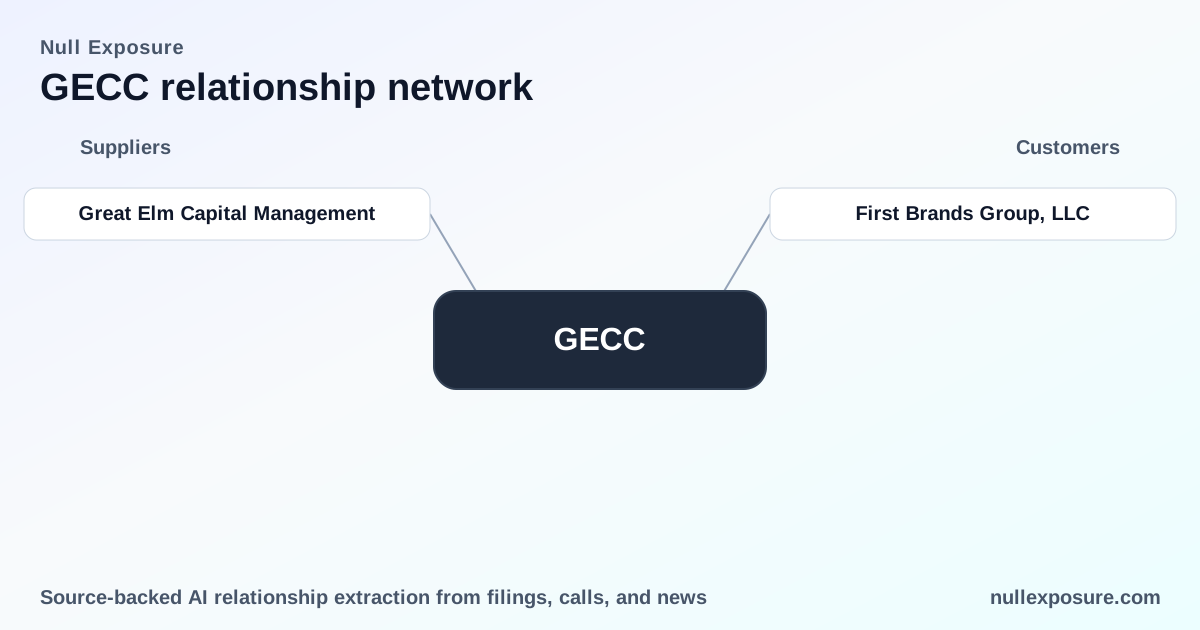
Great Elm Capital Management (GECM) is the external investment manager charged with sourcing, underwriting and managing the portfolio under an Investment Management Agreement; the manager is compensated through a base management fee tied to assets and a performance incentive fee, making it the single most consequential supplier relationship for GECC’s economics and governance. A CityBiz report highlighted leadership changes at GECM in March 2026, noting portfolio management continuity under Mr. Kaplan (portfolio manager since October 2020). (CityBiz, March 9, 2026: https://www.citybiz.co/article/226533/great-elm-capital-corp-announces-new-board-leadership/). Company filings further document that GECM was engaged under agreements executed in 2016 and remains the operational manager as of the December 31, 2024 filing.
All supplier and contract signals that matter (company‑level constraints)
Below are the material contractual and structural signals extracted from company disclosures that frame counterparty risk and strategic optionality:
- Long‑term capital maturities provide runway but impose refinancing risk — multiple note series mature across 2026–2029, giving the firm multi‑year visibility on funding but creating concentration around those refinancing windows (company filing, Dec 31, 2024).
- Revolver extended to 2027 — the senior secured revolving line of credit was amended to extend the maturity to May 5, 2027, improving near‑term liquidity flexibility (company filing).
- Management agreement renewal cadence creates annual governance checkpoints — the Investment Management Agreement renews annually but requires Board or security‑holder approval, and a majority of disinterested directors must approve; this structure yields recurring decision points for investors to assess fees and performance (company filing).
- Short‑notice termination exists — both the Investment Management Agreement and the Administration Agreement can be terminated by either party with 60 days’ written notice, introducing counterparty optionality and potential swift operational change (company filing).
- Geographic concentration is U.S.‑heavy with global optionality — the portfolio is reported predominantly in the United States as of Dec 31, 2024, while the investment policy contemplates foreign credit exposures that carry additional political and FX risk (company filing).
- Spend scale is meaningful — the firm manages high‑value positions with aggregate portfolio fair value in the low hundreds of millions, and individual financing capacity (revolver) up to $25M; this is consistent with a mid‑market credit platform rather than smaller, fee‑for‑service asset managers (company filing).
- Certain instruments have been retired — the company redeemed a noted series (GECCM Notes) in October 2024, demonstrating active liability management and the ability to eliminate legacy instruments when advantageous (company filing).
Relationship checklist — the one explicit supplier result in our set
Great Elm Capital Management: GECM continues as the external investment adviser; recent reporting noted a portfolio manager with a credit investing background and leadership changes announced in March 2026. (CityBiz, March 9, 2026: https://www.citybiz.co/article/226533/great-elm-capital-corp-announces-new-board-leadership/). Company filings dated through December 31, 2024 document the management agreement, fee mechanics, and governance conditions.
Midway insight — if you track counterparty risk, track governance and fee resets. For direct access to supplier risk dashboards and comparative supplier analytics, visit NullExposure: https://nullexposure.com/
Investment implications — what investors should act on
- Operational dependency is concentrated: GECM is critical; any abrupt termination or leadership change has direct performance and fee implications. Monitor Board votes and any 60‑day termination notices closely.
- Capital structure is manageable but clustered: multi‑year note maturities and a revolver through 2027 give breathing room, but investors should stress test scenarios around the 2026–2029 refinancing window.
- U.S. mid‑market focus shapes credit risk: portfolio composition and the manager’s underwriting standards will directly determine NAV volatility — underperformance in a few large credits would materially affect distributions.
For a fast, investor‑grade view of supplier contract terms and their balance sheet impact, return to NullExposure and review the supplier scoring: https://nullexposure.com/
Final takeaways
Great Elm is a classic externally‑managed BDC where the external manager's incentives and contractual terms are the primary operational lever investors must monitor. Long‑dated debt maturities and a mid‑market credit focus define the company’s financial runway, while the annual renewal and short‑notice termination options create governance levers that can quickly change the cost and control environment. For asset allocators and operators, the combination of concentrated counterparty risk, meaningful invested capital, and concentrated governance warrants continuous monitoring rather than a passive hold. Explore supplier analytics and governance flags at NullExposure: https://nullexposure.com/