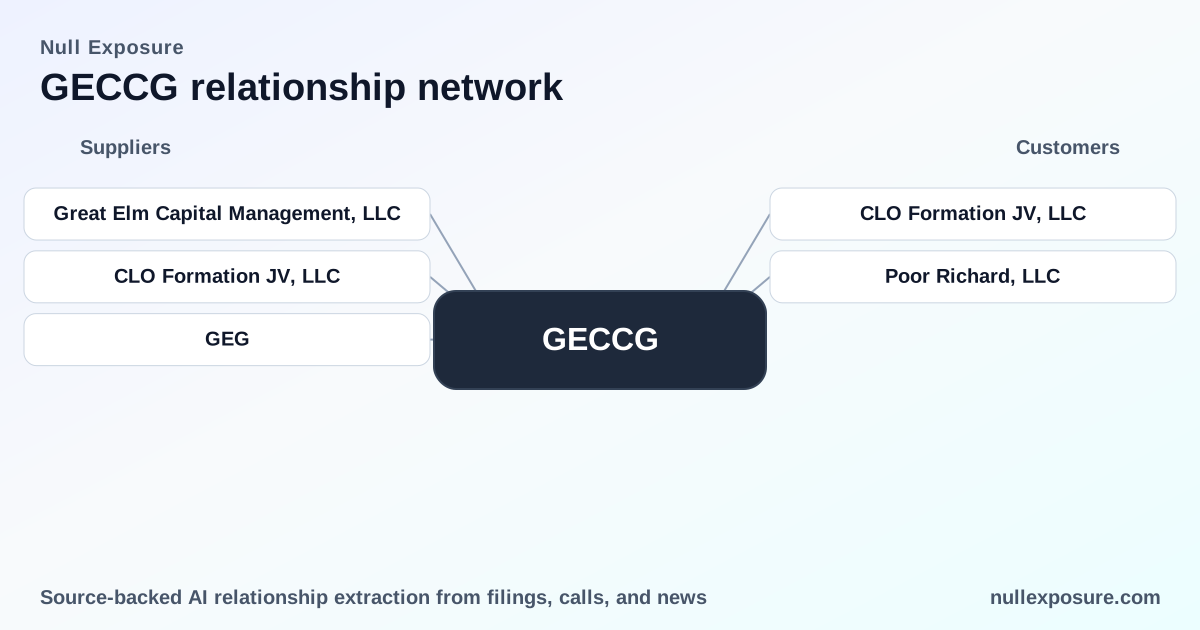
Great Elm Capital Corp. (GECCG) — supplier map and what investors need to know
Great Elm Capital Corp. 7.75% Notes Due 2030 (GECCG) is a fixed‑income exposure vehicle that monetizes through interest paid on the notes and cash distributions generated by an actively managed middle‑market credit and private investment portfolio; it is externally managed and levered via multiple unsecured note series. Investors should view GECCG as a yield instrument underpinned by a concentrated, actively traded private credit book and a fee relationship with an external manager that directly influences net income and alignment. For more detailed supplier analytics, visit https://nullexposure.com/.
How GECCG makes money and where the cash flows come from
GECCG receives cash flow from two primary sources: interest paid to noteholders from portfolio income and periodic cash distributions from structured investments and portfolio exits. The company holds a portfolio of both debt and equity stakes in middle‑market companies — $236.7 million in debt and $87.5 million in equity at fair value as of December 31, 2024 — and carries material unsecured notes on the liabilities side (about $195.4 million outstanding across four series as of that date). These balance‑sheet items drive coupon payments to noteholders and determine asset coverage and refinancing sensitivity.
Key operational fact: the vehicle is externally managed under an Investment Management Agreement, which governs base fees and incentive fees; the adviser has recently executed fee concessions that directly affect distributable cash. Early investor diligence should focus on manager economics, asset coverage, and upcoming note maturities.
The supplier relationships you must evaluate
Below are the counterparties and supplier relationships disclosed in recent communications, with concise takeaways and source citations.
Great Elm Capital Management, LLC — the external investment adviser
Great Elm Capital Management (GECM) serves as GECCG’s external investment adviser and administrator, providing investment management as well as CFO and CCO services under formal agreements; the manager waived accrued incentive fees through March 31, 2026, a material alignment action for the period. According to a GlobeNewswire release on March 2, 2026, and corroborated by reporting on March 9, 2026, GECM is the operational fulcrum for GECC’s portfolio and fee economics.
Source: GlobeNewswire press release (March 2, 2026) and QuiverQuant reporting (March 9, 2026).
CLO Formation JV, LLC — a cash‑producing structured investment
GECCG received $4.3 million of cash distributions from the CLO Formation JV in the quarter ended December 31, 2025, up from $1.5 million in the prior quarter, indicating near‑term distribution volatility and contribution to quarterly cash available for the note. This distribution was reported in the company’s Q4 2025 financial commentary.
Source: QuiverQuant report summarizing Q4 2025 results (first seen March 9, 2026).
Great Elm Group, Inc. (NASDAQ: GEG) — corporate parent linkage
Great Elm Group, Inc. is the parent of the adviser; senior leadership overlaps exist—Mr. Reese serves as Chairman and CEO of Great Elm Group and is named in GECC communications—creating direct corporate linkage between the adviser and its listed parent. This relationship is disclosed in GECC’s recent press releases and financial announcements.
Source: GlobeNewswire press release (March 2, 2026) and QuiverQuant reporting (March 9, 2026).
(Each of the above relationships was explicitly named in company filings and press releases; investors should treat them as primary supplier and income counterparties.)
Contracting posture, concentration and operational constraints — what the evidence signals
The company’s public disclosures and filing excerpts present the following operating model characteristics as firm signals for investors:
- Contracting posture: mixed but bias to long‑term fixed income. Portfolio investments show an expected maturity window of roughly three to five years with several unsecured note series maturing between 2026 and 2029, supporting a long‑dated liability profile that creates refinancing timing risk around those dates. Company text also discloses seasonal short‑term liquidity management in cash and money market instruments, giving the firm tactical short‑term flexibility.
- Balance‑sheet scale and leverage are material. As of December 31, 2024 the company reported approximately $195.4 million of outstanding indebtedness across four note series and a reported asset coverage ratio of 169.7%, establishing a >$100m spend/investment band and meaningful leverage that governs downside sensitivity.
- Geographic concentration is North America‑centric. Portfolio fair value is heavily weighted to the United States (per the company’s geography table), making performance and credit cycles in the U.S. primary drivers of portfolio returns.
- Dual relationship roles: buyer and service provider. GECC conducts direct purchases of middle‑market debt instruments and is externally managed; disclosures include both the company’s position as an active buyer and the formal Investment Management and Administration Agreements with its adviser.
- Active portfolio stage. The firm reported active investments in 53 debt instruments across 44 companies and 18 equity stakes across 14 companies as of year‑end 2024, indicating ongoing portfolio management and deal activity.
Where constraints explicitly name a counterparty, attribution follows the naming: the Investment Management Agreement and the Administration Agreement explicitly connect GECM to fee and administrative roles and therefore should be treated as primary operational dependencies.
For a deeper supplier risk map and vendor analytics, visit https://nullexposure.com/.
What this means for investors and operators — risks and opportunities
- Income visibility is strong but dependent on manager effectiveness and structured distributions. Regular CLO JV distributions and portfolio coupon income support the note coupon, but both are dependent on credit performance and the adviser’s asset management decisions.
- Refinancing and maturity calendar is the principal timing risk. Multiple series of unsecured notes mature between 2026 and 2029; investors must model refinancing capacity and asset coverage under stress scenarios.
- Manager alignment is currently improved by fee waivers. The adviser’s decision to waive accrued incentive fees through March 31, 2026 is a near‑term positive for distributable cash and indicates a willingness to preserve distributions in the short run.
- Concentration to U.S. middle market increases credit-cycle sensitivity. Portfolio concentration amplifies macro and sector exposures versus a broad diversified credit fund.
Practical next steps for due diligence
- Confirm the timing and permanence of the incentive fee waiver and understand the reinstatement mechanics in subsequent quarters.
- Map the note maturity schedule against expected cash generation and potential refinancing options; stress test the asset coverage ratio under downside scenarios.
- Review CLO JV performance drivers and the stability of future distributions, including structural protections in the JV.
- Validate management continuity and governance given the parent/adviser linkage to Great Elm Group, Inc.
For a complete supplier assessment and custom exposure reports, start here: https://nullexposure.com/.
Closing note: GECCG is a yield vehicle whose risk‑reward is governed as much by its asset composition and leverage as by the economics of its external manager. Active monitoring of manager actions, structured investment distributions, and the maturity calendar is essential for investors and operators managing exposure to this issuer. For ongoing monitoring and deeper supplier analytics, visit https://nullexposure.com/.