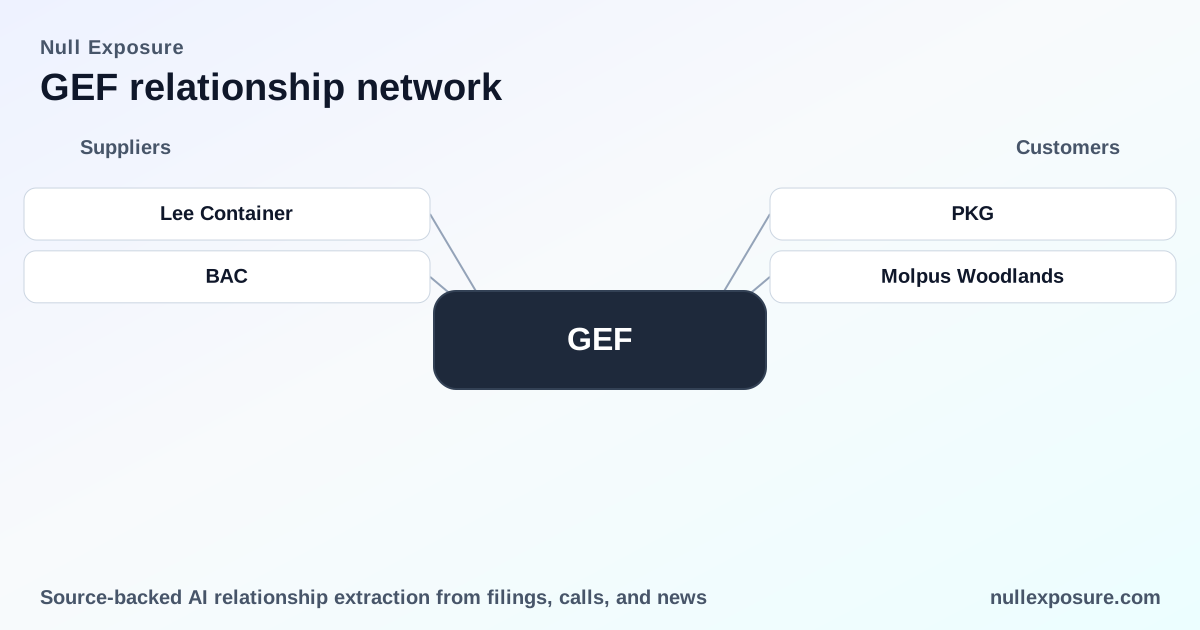
Greif (GEF): Supplier relationships, capital allocation, and the implications for investors
Greif is a global industrial packaging company that manufactures and distributes containers, packaging systems and related services to industrial and consumer markets; it monetizes through product sales, value-added services and targeted M&A that expand capability and channel coverage. With roughly $4.27 billion in trailing revenue, an EV/EBITDA of 6.9 and a market capitalization near $3.8 billion, Greif runs a capital-intensive, scale-driven business where supplier access and cost control directly affect gross margins and cash generation. Explore detailed supplier mappings and counterparties at https://nullexposure.com/ to benchmark exposures and counterpart dynamics.
Short, pragmatic thesis for active investors
Greif converts raw materials and manufacturing capacity into durable cash flow by selling packaging products and services across diversified end-markets. The business leans on a hybrid procurement posture — buying on the open market while maintaining both short- and long-term supply agreements — and uses acquisitions and buybacks as levers to reallocate capital. Given a forward P/E of 9.3 and an analyst target near $80.2, valuation upside is linked to margin expansion and successful integration of strategic buys.
Recent deal activity that reshapes the supplier map
Greif’s M&A is tactical: it buys targeted suppliers to secure product capability and distribution reach. A notable transaction was the December 2022 acquisition of Lee Container, a blow-moulded containers supplier, for $300 million — a deal that strengthens Greif’s position in molded rigid packaging and brings manufacturing and design capabilities in-house. The acquisition was reported in Greif’s filings and summarized by Packaging Gateway in a FY2023 write-up on Greif’s filings.
Capital allocation and financial counterparties matter
Greif balances strategic investment with shareholder returns. As part of a broader $150 million repurchase program, the company entered a $75 million accelerated share repurchase agreement with Bank of America to buy back Class A stock, signaling management’s preference for buybacks as a use of excess cash in FY2022. That repurchase arrangement was disclosed in a PR Newswire release covering the program.
All supplier and counterparty relationships surfaced in this review
Below are the supplier and counterparty relationships surfaced in recent public reporting and coverage. Each entry is a concise, plain-English summary with the source noted.
Lee Container — acquisition expands in-house blow-moulding capability
Greif acquired Lee Container in December 2022 for $300 million, bringing blow-moulded container manufacturing and related customer relationships into Greif’s packaging portfolio to reduce dependence on third-party suppliers and capture incremental margin. This transaction is described in Greif filings and covered by Packaging Gateway in a FY2023 recap.
Bank of America, N.A. — financial counterparty for accelerated repurchase
Greif entered a $75 million accelerated share repurchase with Bank of America as part of a $150 million repurchase program, using the bank as a liquidity and execution partner to retire equity and return capital to shareholders in FY2022. The repurchase agreement was announced in a PR Newswire release.
What the constraints and disclosures reveal about Greif’s operating model
Greif’s public excerpts and filings indicate three company-level procurement signals that inform supplier risk and operational posture:
- Greif purchases raw materials both on the open market and under short-term and long-term supply agreements. This mixed approach gives flexibility to exploit market swings while preserving predictability where necessary. The company expressly states that it uses open-market purchases alongside short- and long-term agreements in its filings.
- The company’s role is largely that of a buyer for raw materials and components, which makes supplier stability and raw material price volatility direct drivers of gross margin. The buyer role is declared in the same disclosures describing procurement methods.
- These procurement characteristics are company-level signals — they do not assign specific contract types to any single supplier in the record unless the disclosure explicitly named that supplier.
From those signals, investors should draw these operating-model conclusions:
- Contracting posture: Greif maintains a balanced procurement strategy. Long-term contracts reduce earnings volatility for critical inputs; short-term purchasing preserves upside capture when commodity prices fall.
- Concentration and criticality: Public disclosures do not list a high concentration of any single supplier, but the company’s buyer position means disruptions in raw-material supply or large supplier failures would be directly critical to manufacturing continuity and margins.
- Maturity and integration: Greif’s M&A (e.g., Lee Container) shows an integration strategy that reduces external supplier reliance by internalizing capabilities — a sign of a mature operator shifting toward vertical control where it yields margin benefit.
Investment implications and risk factors
- Margin sensitivity: Operating margin is modest relative to gross profit (operating margin ~5.68%, gross profit ~$954M on $4.27B revenue). Procurement effectiveness and the mix of contracted vs. spot purchases will materially influence margin recovery or compression.
- Capital allocation trade-offs: The use of accelerated repurchases with Bank of America signals a shareholder-return orientation that competes with capital for M&A and capacity investments; investors should watch free cash flow versus buyback cadence.
- Execution risk on M&A: Acquisitions like Lee Container are designed to secure capabilities, but integration execution will determine whether expected synergies and supplier-risk reduction are realized.
If you assess supplier counterparty networks as part of diligence, review upstream raw-material contracts and integration plans for recent acquisitions. For a deeper look at supplier exposures and counterparty dynamics, visit https://nullexposure.com/ to see our broader supplier mapping and analytics.
Bottom line and next steps for investors
Greif is a mature packaging operator monetizing scale, in-house manufacturing and targeted M&A to control costs and expand capabilities. Supplier strategy combines market purchases with contractual hedges, and recent M&A plus buybacks indicate management is actively optimizing both growth and capital returns. Monitor raw-material contract composition, integration outcomes from Lee Container, and the company’s cash deployment choices as primary drivers of future returns.
For ongoing monitoring of supplier links, counterparties, and the implications for credit and equity investors, consult the project hub at https://nullexposure.com/. If you want a tailored report on how Greif’s supplier relationships interact with your portfolio exposures, start at https://nullexposure.com/ and request a bespoke analysis.