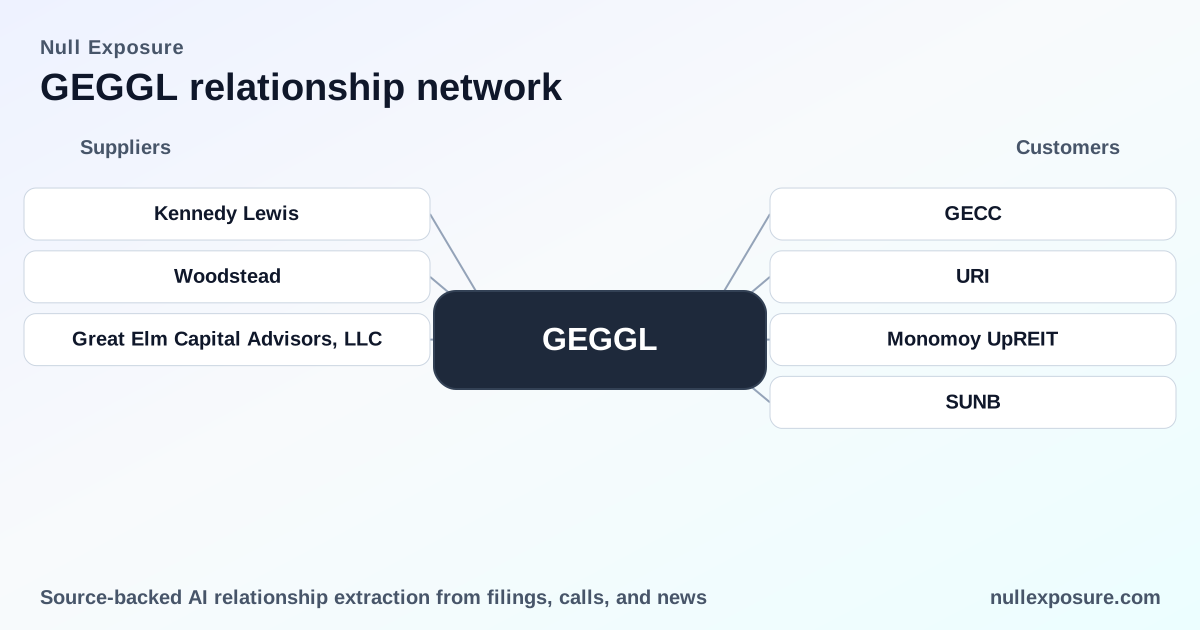
Great Elm Group (GEGGL) — Supplier relationships and what they mean for creditors and partners
Great Elm Group Inc. operates as a diversified holding company that monetizes through equity and debt investments across healthcare, media and technology, while funding growth and capital structure needs with public debt — notably the 7.25% Notes due 2027. Recent transaction-level disclosures show the company is actively managing liquidity with committed credit and partner injections, while relying on third-party providers for selected operational functions. For investors and counterparties, the focus should be on counterparty exposure, the duration of commercial commitments, and the scale of recurring outsourcing spend. Explore deeper supplier mapping at https://nullexposure.com/.
How Great Elm funds growth and where suppliers fit in
Great Elm issues publicly traded notes and runs an external advisory model through Great Elm Capital Advisors, LLC to execute investment commitments. The company balances direct capital deployments with external funding (credit drawdowns and equity injections) when needed, and outsources specialized functions such as cybersecurity and back‑office services to third parties. Market price bands and moving averages show a relatively tight trading range (52‑week high 24.77, low 19.33, 50‑/200‑day moving averages at 24.7/24.3), while public disclosure of operating economics remains sparse. The 7.25% coupon on the 2027 notes signals yield compensation for leverage and liquidity horizon.
Explore supplier risk and counterparty intelligence at https://nullexposure.com/.
Direct supplier and capital partner relationships you need to know
Below are every relationship flagged in the sourced coverage, with concise, plain‑English summaries and the source for each.
- Kennedy Lewis — Great Elm secured a $100 million drawdown from Kennedy Lewis in FY2025 as part of a broader liquidity package to strengthen its financial position; this was reported in market commentary covering the company’s strategic growth initiatives (ValueTheMarkets, March 9, 2026: https://www.valuethemarkets.com/analysis/great-elm-group-stock-geg-strategic-growth-initiatives).
- Woodstead — The company received a $9 million equity investment from Woodstead in FY2025, representing minority external capital deployed to support balance‑sheet needs and transaction activity (ValueTheMarkets, March 9, 2026: https://www.valuethemarkets.com/analysis/great-elm-group-stock-geg-strategic-growth-initiatives).
- Great Elm Capital Advisors, LLC — As the firm’s external adviser, Great Elm Capital Advisors typically makes equity and debt commitments in the $10 million–$40 million range, defining the scale and cadence of deal activity executed on behalf of the group (MarketBeat reporting citing company commentary, January 8, 2026: https://www.marketbeat.com/instant-alerts/great-elm-capital-group-nasdaqgecc-stock-rating-upgraded-by-zacks-research-2026-01-08/).
Company-level constraints and what they imply about supplier posture
The disclosure evidence raises three firm-level signals about how Great Elm engages suppliers:
- Contracting posture: longer-duration commitments. Lease disclosures record a weighted‑average remaining life of 4.3 years, which signals a preference for multiyear operating commitments rather than purely transactional engagements. This creates moderate persistence in supplier demand.
- Role of suppliers: service providers for specialized functions. Public excerpts highlight third‑party engagement for cybersecurity assessments and annual penetration testing, alongside shared personnel and reimbursement agreements for back‑office services with related entities; these are service relationships rather than product-only vendor arrangements.
- Spend scale: mid‑single‑digit hundreds of thousands annually. Operating lease costs and related third‑party expenses are reported in the $0.5 million range for the year, which places recurring supplier spend in the $100k–$1m band — material to service providers but not at enterprise‑scale contract levels.
Taken together, these constraints describe a supplier model that is service-centric, moderately durable, and concentrated at mid-level spend bands — a profile that raises counterparty diligence priorities around performance SLAs, vendor continuity, and cybersecurity assurance.
Investment implications — priorities for investors and operators
- Counterparty concentration and liquidity risk are immediate considerations. A $100M drawdown from Kennedy Lewis is a meaningful funding event that reallocates credit exposure and creates dependency on that relationship for near‑term liquidity. Scrutinize drawdown terms and repayment triggers in creditor agreements.
- Minority equity injections signal partner alignment but limited capital cushion. The $9M from Woodstead provides incremental capital without substantially changing leverage ratios; treat it as a supportive but non-transformational capital event.
- Advisory and deal scale define growth tempo. With the external adviser executing $10M–$40M commitments, pipeline and deal cadence are predictable within that band — useful for modeling near‑term capital deployment and counterpart supplier needs.
- Operational outsourcing is critical for control and compliance. Third‑party cybersecurity assessments and shared back‑office arrangements are functionally critical; their continuity and testing cadence should be part of any counterparty risk evaluation.
Practical due diligence checklist for counterparties and credit investors
- Obtain the terms of the $100M drawdown (maturity, covenants, intercreditor mechanics).
- Validate the nature of the Woodstead equity (preferred/common, conversion features).
- Confirm service levels and audit rights for cybersecurity vendors and any shared‑services agreements.
- Stress‑test liquidity under a scenario where the notes are refinanced or where drawdown availability is curtailed.
For a deeper, structured supplier map and to monitor these counterparties over time, visit https://nullexposure.com/.
Bottom line and actionable next steps
Great Elm’s current profile is that of a debt-funded, externally‑advised investor with mid‑sized recurring supplier relationships and reliance on a handful of counterparties for capital support. The $100M Kennedy Lewis facility stands out as the most consequential counterparty event for creditors; the Woodstead equity and the adviser’s $10M–$40M deal scale set the company’s operating tempo. Investors and operators should prioritize covenant analysis, counterparty diligence, and vendor continuity checks.
To convert this analysis into operational oversight or an investment decision, run a targeted counterparty review via NullExposure and maintain a calendar for covenant and vendor testing events: https://nullexposure.com/.