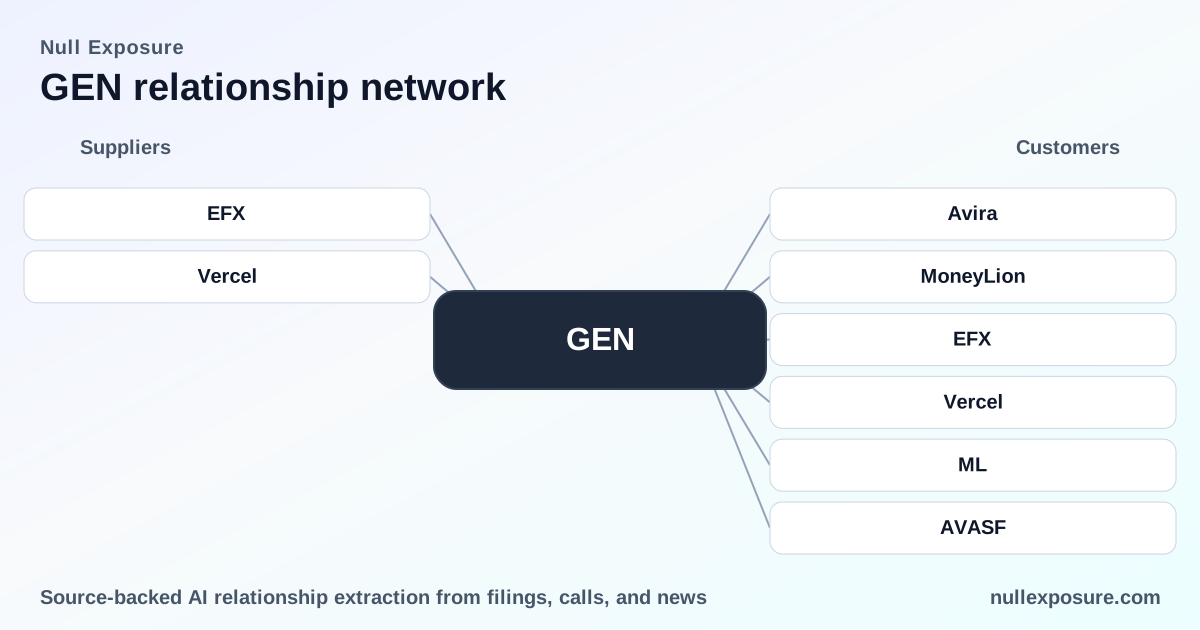
Gen Digital (GEN): Supplier relationships that shape the product moat and operational risk
Gen Digital sells consumer cybersecurity and identity protection products (Norton, Avast, LifeLock, plus MoneyLion after the acquisition) and monetizes through subscription fees, cross-sell across brands, and embedded services that surface premium upgrades. Partnerships that supply identity, fraud and safety data or add developer-facing safety checks are therefore direct inputs to product differentiation and retention economics. If you evaluate GEN as an investor or operator, view these supplier ties as determinants of feature velocity, data quality and service continuity — and not ancillary marketing relationships.
Explore how these relationships change the competitive picture at https://nullexposure.com/.
Why supplier ties matter to revenue and margins
Gen’s software-driven consumer business converts product improvements into recurring revenue and lower churn; partner-sourced data and safety tooling are operational levers that change lifetime value and marginal cost. The company’s FY2025 revenue of roughly $4.7B and strong gross margins imply a scalable SaaS-like model where the quality and exclusivity of third-party inputs (data, security checks, identity signals) directly influence conversion and retention. Partnerships that feed AI-powered alerts, fraud signals and agent-security checks accelerate new feature rollouts without equal internal data mining investment, but they also increase dependency on external suppliers and contractual terms.
Visit https://nullexposure.com/ to benchmark supplier exposures across peers.
The supplier map you need to know
Equifax — deeper financial and identity data woven into GEN’s AI stack
GEN expanded a partnership with Equifax to ingest Equifax’s financial health and fraud datasets into GEN’s AI-driven portfolio, enabling enhanced alerts and insights across Norton, Avast, LifeLock and MoneyLion. According to Finviz coverage (March 9, 2026) and contemporaneous reports from Crowdfund Insider and earnings call transcripts in March 2026, the deal is presented as an expansion that feeds richer identity and credit-related signals into GEN’s consumer-facing services. (Finviz, Mar 9, 2026; Crowdfund Insider, Feb 2026; GEN earnings call, Mar 2026.)
Vercel — developer-focused safety checks for Skills.sh
Gen announced a partnership with Vercel to add safety checks to Skills.sh, integrating runtime or build-time safety verification into developer workflows. InsiderMonkey reported the collaboration on February 17, 2026, describing it as a tactical move to harden GEN’s agent/skill ecosystem and reduce malicious or unsafe behaviors at the point developers deploy skills. (InsiderMonkey, Feb 17, 2026.)
What these relationships imply about GEN’s operating model
These supplier ties reveal a deliberate operating posture: GEN is sourcing specialized external inputs to accelerate features rather than distilling all signals in-house. That approach produces distinct characteristics investors should weigh.
- Contracting posture: GEN behaves as a buyer of specialized data and as an integrator of third-party safety tooling; the company relies on external data vendors to supply critical signals for fraud and identity products rather than owning end-to-end data collection.
- Concentration and criticality: Partnerships with large credit bureaus and developer platform vendors are high-impact because the supplied data and checks are central to core product functionality (alerts, identity protection, agent safety). Loss or degradation of these inputs would be material to product performance.
- Maturity and replaceability: These relationships are with established suppliers (e.g., Equifax, Vercel) and therefore convey mature, enterprise-grade inputs, but replacing them quickly would be expensive and would likely slow feature velocity and erode short-term retention economics.
- Operational exposure: GEN also reports hosting many products in third‑party data centers and not controlling their operations, which signals additional service-provider reliance for infrastructure and continuity.
These company-level signals are consistent with a strategy that leverages best-of-breed external partners to scale product capabilities rapidly.
Constraints, recent M&A and what they change
GEN’s public disclosures include two operational constraints that clarify risk and integration posture. First, GEN acknowledges it hosts many products in third-party data centers and does not control facility operations, highlighting infrastructure dependency as an ongoing operational risk. Second, GEN completed the acquisition of MoneyLion in April 2025, and the December 2024 definitive agreement shows GEN acting as an active buyer expanding into adjacent financial services; this increases product scope and the need to integrate third-party financial data streams (an objective advanced by the Equifax expansion). Both signals underline that GEN’s supplier network is strategic: data and uptime are critical inputs to revenue generation.
Investment implications — what to watch and why it matters
- Positive: Faster feature rollouts and improved monetization. The Equifax tie and Vercel safety checks accelerate higher-value alerts and safer agent ecosystems, which should lift conversion and reduce churn when properly executed. These relationships are revenue-accretive levers.
- Negative: Dependency risk and contractual leverage. The company’s reliance on a small number of high-value suppliers increases bargaining and operational risk; contract renewal terms, pricing, and exclusivity will materially affect margins and product competitiveness. Supplier concentration is a key risk factor.
- Integration risk from M&A. The MoneyLion acquisition expands GEN’s addressable product set but requires melding fintech data flows and compliance controls; supplier relationships will be central to realizing cross-sell synergies.
For investors and operators, the focal questions are contract length and exclusivity with data providers, SLAs for hosted infrastructure, and the road map for internalizing critical signals versus continuing to buy them.
Learn how to translate supplier intelligence into investment decisions at https://nullexposure.com/.
Bottom line and next steps
Gen Digital’s supplier relationships—most notably the expanded Equifax data tie and the Vercel developer-safety integration—are strategic inputs that materially affect product differentiation, retention economics, and operating risk. As an investor, monitor contract terms, renewal timing, and any public performance indicators that reflect improved conversions or reduced fraud-related churn. As an operator, prioritize redundancy planning and clear integration playbooks for any supplier that feeds identity or fraud signals.
If you evaluate technology suppliers and need a comparative lens on supplier concentration and contractual exposure, start your analysis at https://nullexposure.com/.