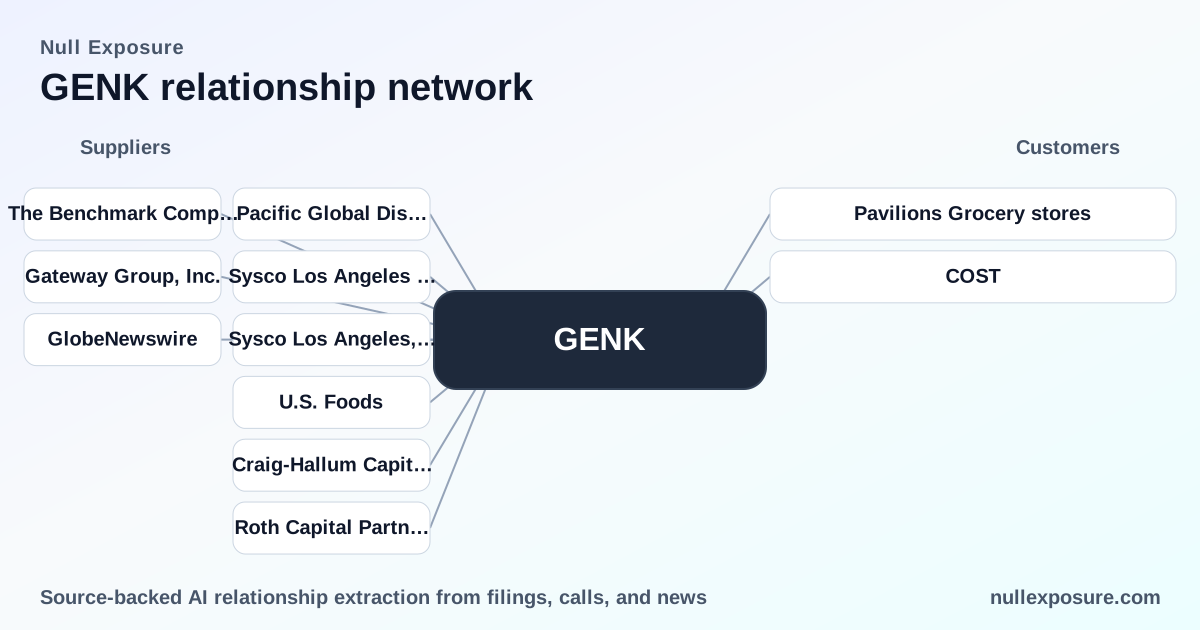
GENK Supplier Map: Concentration, Contracts and Where Operational Risk Lives
GEN Restaurant Group (GENK) operates a network of Korean BBQ restaurants across several U.S. states and converts foot traffic, takeout and beverage sales into revenue through company-operated locations. The company’s economics are driven by same-store sales, new store openings under long-term leases, and tight vendor procurement for food, supplies, and services—making supplier relationships a direct lever on margins and continuity of operations. For investors evaluating counterparty risk and supplier concentration, the supplier roster and contract terms in GENK’s filings and press releases are essential inputs to underwriting operating leverage and downside scenarios.
Explore deeper supplier intelligence at https://nullexposure.com/.
Executive summary: the single-sentence takeaways investors need
- Sysco is the dominant food supplier and a single-point operational risk after GENK signed a multi-year purchasing agreement; Sysco accounted for a very large share of food costs in 2024.
- U.S. Foods and Pacific Global Distribution are meaningful complements—U.S. Foods supplied a material slice of 2023 food and beverage costs, while Pacific Global (PGD) supplies non-food items and represents a related-party source of goods.
- Capital markets and IR relationships reflect GENK’s post-IPO posture with boutique underwriters and a retained IR firm handling communications.
Read GENK’s supplier footprint and contract signals in detail at https://nullexposure.com/.
How the supplier roster is composed and why it matters
GENK’s procurement mix is a classic restaurant split: a dominant national food distributor plus regional distributors and in-house related-party suppliers for specialty items and non-food supplies. A three-year purchase agreement with Sysco combined with short payment terms and cash collection dynamics concentrates procurement risk, while related-party purchases and modest spend with specialty service providers create governance and operational considerations. The company also runs cloud software and hosted services as part of its operations, which introduces subscription-style vendor relationships alongside traditional goods procurement.
The relationships (each one from the public record)
- Pacific Global Distribution, Inc. — GENK buys tableware, napkins, soda and sauces from PGD; the company purchased approximately $678 thousand in 2024 and $2.8 million in 2023 from PGD. PGD is 100% owned by a board member’s family, creating a related‑party sourcing dynamic that investors should monitor. According to GENK’s FY2024 Form 10‑K, PGD is a recurring supplier for non-food restaurant supplies.
- Sysco Los Angeles Inc. — GENK entered an agreement during Q4 2023 with Sysco to purchase certain food products under a three‑year arrangement; Sysco accounted for approximately 76.3% of total food costs in 2024, making it a critical supplier. This is disclosed in GENK’s FY2024 Form 10‑K.
- Sysco Los Angeles, Inc. — The filing references Sysco Los Angeles, Inc. in a near‑identical disclosure of the three‑year purchase agreement; the duplicate entries in the record reflect the same material long‑term purchasing relationship with Sysco reported in the 2024 10‑K.
- U.S. Foods — U.S. Foods provided certain food products that represented approximately 36.0% of total food and beverage costs in 2023, per GENK’s FY2024 Form 10‑K, marking it as a historically important supplier even as Sysco’s share rose.
- Craig‑Hallum Capital Group — Craig‑Hallum acted as a co‑manager for GENK’s initial public offering; coverage from the July 2023 transaction announcement lists Craig‑Hallum among the underwriters that managed the offering. This underwriting role is cited in post‑IPO press coverage.
- Roth Capital Partners — Roth served as the sole book‑running manager and representative of the underwriters for GENK’s IPO, according to the July 2023 offering release. The bank executed the underwriting responsibilities described in the transaction announcement.
- The Benchmark Company — The Benchmark Company participated as a co‑manager on the IPO alongside Craig‑Hallum, as noted in the same July 2023 offering disclosure.
- Gateway Group, Inc. — Gateway Group is listed as GENK’s investor relations contact in GENK’s May 13, 2025 press release, indicating an outsourced IR relationship for financial communications.
- GlobeNewswire — GlobeNewswire is the distributor of multiple GENK press releases; an AI‑generated disclaimer appeared in an aggregated November 2025 summary hosted on QuiverQuant, but original press materials are distributed via GlobeNewswire.
(Each relationship summary above is drawn from GENK’s FY2024 10‑K and subsequent public press releases and transaction announcements.)
Constraints that change how you underwrite GENK (company‑level signals)
- Concentration risk is high. GENK reported that Sysco accounted for ~76.3% of total food costs in 2024, a company‑level materiality signal that concentrates supply chain risk and bargaining leverage. GENK’s disclosures treat this as critical to operations.
- Contracting posture is mixed but tilted toward duration. GENK has a three‑year purchase agreement with Sysco (long‑term supplier contract) while many vendor relationships operate on short payment cycles (company collects cash the same day and typically pays vendors within ~30 days). GENK also discloses long real‑estate lease commitments (10 to 25 years), which create a long‑dated fixed‑cost structure for store openings.
- Related‑party sourcing is active and measurable. GENK purchased material supplies from Pacific Global Distribution (PGD), which is family‑owned by a board member, producing spend in the $100k–$1m band in 2024 and higher in 2023. That related‑party dynamic warrants governance scrutiny.
- Service and software spending is present but smaller. GENK operates cloud applications on SaaS/hosted services and uses third parties for construction and cybersecurity; those service relationships are smaller in spend and more tactical in nature.
- Spend profile is lumpy across bands. Public excerpts show spend tranches from sub‑$100k for interior construction services up to the $10m–$100m band historically for other affiliated purchases, signaling variability across supplier categories.
For a deeper profiling of GENK’s supplier concentration and contractual exposures, see our supplier analytics hub at https://nullexposure.com/.
Investment implications and risk checklist
- Operational continuity depends on Sysco maintaining service and pricing discipline; any disruption or price shock at Sysco would transmit directly to gross margins.
- Related‑party purchases from PGD introduce governance risk that could influence supply terms and cost visibility.
- Lease commitments lock fixed costs into the P&L and increase sensitivity to revenue declines, amplifying supplier payment urgency.
- Capital markets relationships are boutique, reflecting a recent IPO path that leaves institutional ownership modest and retail/insider concentration relatively high.
If you are modeling downside scenarios for GENK, stress Sysco pricing, related‑party procurement terms and lease occupancy costs simultaneously—these are the primary levers to the company’s margin and liquidity profile.
For tailored supplier risk reports and counterparty monitoring on GENK, visit https://nullexposure.com/ or contact our research desk.
Final takeaway
GENK runs a high‑concentration procurement model anchored to Sysco, supplemented by regionals and related‑party suppliers; that structure delivers purchasing scale but creates a single‑counterparty vulnerability. Investors should prioritize vendor continuity, contract renewal terms, and governance around related‑party purchases when evaluating GENK’s operating leverage and downside risk.