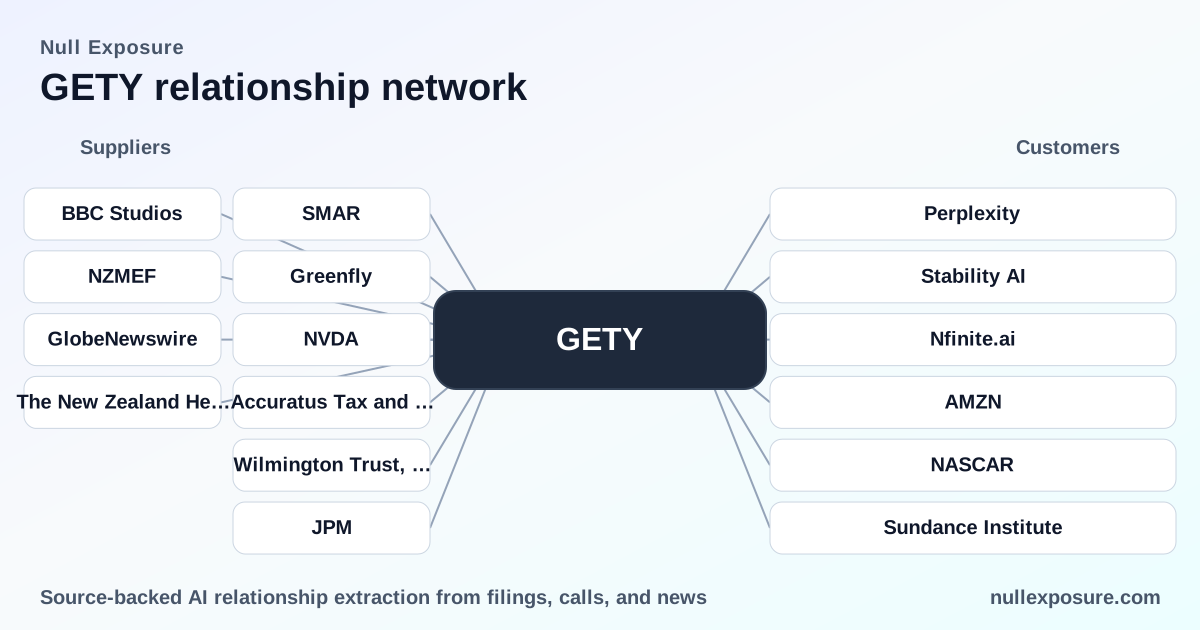
Getty Images (GETY): supplier relationships, contracts and what investors should price in
Getty Images operates a two-sided visual content marketplace and enterprise services business that monetizes by licensing imagery, video and music to media, brands and platforms while paying royalties to a broad supplier base; revenue comes from transactional licenses, subscriptions and enterprise agreements, and margins are shaped by royalty economics and minimum-royalty obligations. For investors evaluating supplier risk, the core takeaway is simple: Getty controls distribution and pricing but is materially exposed to guaranteed royalty commitments and third‑party service dependencies that affect cash flow and execution. For deeper coverage and relationship maps, visit NullExposure.
The quick financial and structural snapshot investors need
Getty reported roughly $946 million in trailing revenue with gross profit of $690.6 million and a negative EPS of -$0.23 TTM, reflecting heavy royalty and content cost structures. The company disclosed paying nearly $220 million in royalties to content contributors in 2024 and records minimum royalty guarantee payments as a recurring contract cost, indicating a high fixed-cost base tied to supplier economics. These obligations sit alongside refinancing activity and a mixed mix of enterprise partnerships that both diversify content and create counterparty dependencies.
Relationship map — who Getty is working with, and why it matters
Below I cover every supplier/partner mention in the public results and what each relationship contributes to Getty’s operating model.
Smartsheet (SMAR)
Getty expanded deployment of Brandfolder by Smartsheet to run Media Manager for Getty Images, indicating an enterprise procurement of digital-asset management tooling that supports Getty’s content operations and client-facing workflows. This is documented in a Smartsheet announcement circulated via FT Markets in FY2026. (FT Markets press release, FY2026.)
Greenfly
Getty launched "Access by Getty Images" in partnership with Greenfly to provide talent and creators with real-time licensed access to entertainment imagery for social use, with a nominal convenience fee—this speaks to Getty’s strategy to monetize short‑form, immediate-use licensing. (Getty/Greenfly announcement via SahmCapital, FY2026.)
NVIDIA (NVDA)
Getty partnered with NVIDIA to launch "Generative AI by Getty Images," a service addressing customer demand for AI-enabled content capabilities, showing Getty’s move to integrate AI tooling with content licensing and product differentiation. (Getty press release describing the NVIDIA partnership, FY2023.)
Accuratus Tax and CA Services LLC (Bondholder Communications Group / BondCom)
Accuratus, acting as information and exchange agent, published early results of Getty’s exchange offer for senior notes; this is a creditor-communications role during Getty’s debt restructuring exercises. The disclosure was summarized on QuiverQuant in FY2025. (QuiverQuant reporting on Accuratus/BondCom activity, FY2025.)
Wilmington Trust, National Association
Wilmington Trust appears as trustee under the old notes indenture and is named in the supplemental indenture process connected to Getty’s proposed indenture amendments—this confirms trustee-level counterparties are active in the company’s debt restructuring. (QuiverQuant reporting on trustee actions, FY2025.)
JP Morgan Chase Bank, N.A. (JPM)
Getty completed a comprehensive refinancing that included a $580 million 5‑year U.S. dollar term facility and a €440 million 5‑year euro term facility led by a JP Morgan‑led syndicate, which materially reshaped Getty’s capital structure and liquidity profile. (GlobeNewswire disclosure covering the refinancing, FY2025.)
BBC Studios
Getty partnered with BBC Studios to accelerate archive supply chain access, adding 57,000 programs to Getty’s customer offerings—this is a content‑supply partnership that increases catalog depth and licensing inventory. (Getty newsroom release referencing the BBC Studios collaboration, FY2023.)
NZME (and The New Zealand Herald)
Getty entered a global partnership with NZME to add over 10,000 images from The New Zealand Herald to GettyImages.com, expanding Getty’s regional content footprint and syndication reach. The partnership was announced repeatedly across Getty press releases in FY2025–FY2026 and covered by NZME channels and The New Zealand Herald. (Getty newsroom releases and NZME/New Zealand Herald coverage, FY2025–FY2026.)
GlobeNewswire
A QuiverQuant entry flagged an AI‑generated summary of a press release distributed by GlobeNewswire related to Getty’s exchange offer; GlobeNewswire functions here as a press distribution channel used in corporate debt and refinancing communications. (QuiverQuant note identifying an AI‑generated summary of a GlobeNewswire release, FY2025.)
What the public constraints tell investors about Getty’s operating posture
The company disclosures and constraint excerpts reveal clear, actionable characteristics of Getty’s supplier and operating model:
- Contracting posture — licensing heavy and obligation‑oriented. Getty runs contractual licensing relationships that include unconditional purchase obligations and minimum royalty guarantees, which convert supplier relationships into predictable cost lines that compress upside if revenue softens.
- Counterparty mix — broad individual contributors plus large enterprises. Getty sources content from independent creators who retain copyright but license distribution rights (typical royalty splits of 20–50%), while also striking commercial deals with large content partners and platforms.
- Materiality and criticality — royalties and infrastructure are critical. Royalties are a material recurring cash outflow (nearly $220 million in 2024) and the business depends on third‑party internet and payment infrastructures; loss of payment processing or degraded network delivery could directly impede revenue collection and customer experience.
- Spend and guarantees — concentrated cash commitments. Minimum royalty guarantees recorded in company disclosures (a figure reported as 105,603 in the cited schedule) show committed cash outflows across supplier contracts that survive near‑term revenue volatility.
- Relationship roles — buyer, seller and service‑provider layers. Getty acts as both buyer (paying royalties and guarantees) and seller (licensing content), and simultaneously relies on third‑party service providers for systems and distribution.
These signals collectively define a supplier model that is mature and high‑fixed‑cost, with clear operational leverage to content demand but also meaningful downside if licensing volumes or payment channels deteriorate.
For investors tracking counterparty and supplier risk, Getty’s refinancing and its partnerships to expand catalog (BBC Studios, NZME) and product capabilities (NVIDIA, Greenfly, Smartsheet) are positive strategic moves that do not eliminate the core royalty and guarantee exposure. Learn more about mapping supplier risk at NullExposure.
Investment implications and action points
- Price in royalty rigidity. Minimum guarantees and sizeable annual royalty outflows require that underperformance in licensing revenue will hit cash flow before substantial cost relief is achievable.
- Monitor debt cadence and trustee actions. The refinancing with JP Morgan and the exchange offer mechanics involving Wilmington Trust and Accuratus are central to short‑term liquidity risk and covenant dynamics.
- Watch product integrations for margin recovery. Partnerships with NVIDIA (AI productization) and workflow vendors like Smartsheet could lift monetization per asset if adoption scales.
If you are evaluating Getty for portfolio exposure or vendor risk, focus due diligence on licensing revenue trends, minimum guarantee schedules, and payment/infrastructure contingencies; the business is asset-rich but contractually committed.
For a concise supplier-risk brief and live relationship mapping, visit NullExposure and request the Getty Images supplier dossier.
Summary call-to-action: Getty’s content moat is real, but the company’s economics are fundamentally driven by contractual royalty obligations, third‑party infrastructure, and the success of product partnerships—those are the levers investors should monitor before increasing exposure. For tailored diligence and model inputs, go to NullExposure.