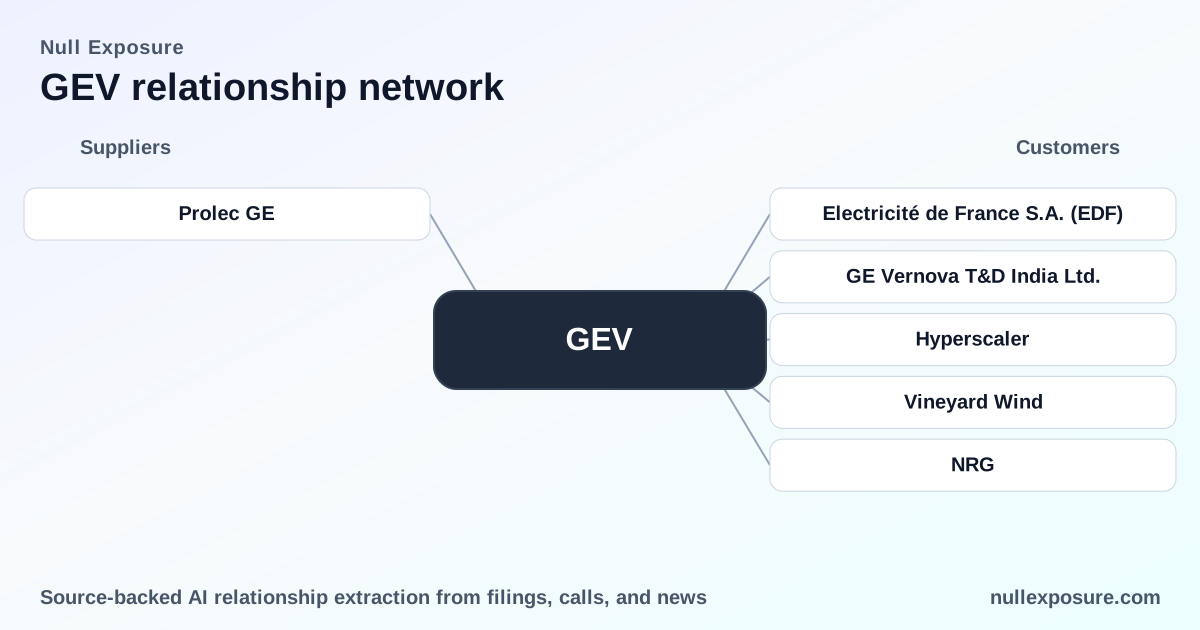
GE Vernova (GEV): supplier footprints, procurement posture, and the Prolec GE tie-in
GE Vernova operates large-scale electricity-generation assets and related industrial services and monetizes primarily through the sale of power, asset-level service contracts, and the procurement-driven execution of capital projects that support its generation fleet. The business sits at the intersection of utility economics and heavy industrial supply chains: material procurement and equipment partnerships directly affect margins and project delivery timelines. GE Vernova reported roughly $38.1 billion in trailing revenue and $3.0 billion in EBITDA for the trailing twelve months, underscoring the economic materiality of its supplier relationships to investors and operators. According to the company’s FY2025 filings, annual procurement runs at scale — a structural factor for counterparty selection and risk management.
If you evaluate counterparty exposure for energy producers, examine GE Vernova’s supplier network and procurement constraints to understand where operational and financial concentration live. For detailed supplier mapping and relationship analytics, visit https://nullexposure.com/.
One clear supplier relationship: Prolec GE, described in filings
-
Prolec GE is referenced directly in GE Vernova’s FY2025 Form 10‑K as “a leading grid equipment supplier, producing transformers across most ratings and voltages” with extensive global manufacturing capacity, signaling a traditional supplier role for critical grid hardware. According to the FY2025 10‑K filing, Prolec GE has roughly 10,000 employees across seven manufacturing sites globally, which positions it as a strategic industrial supplier to power generators and utilities.
Source: GE Vernova FY2025 Form 10‑K (company filing, FY2025). -
On the Q4 2025 earnings call management confirmed that the Prolec GE acquisition received rapid approval from required jurisdictions, converting what had been a supplier relationship into an owned asset (or formally integrated affiliate) in regulatory terms and altering the commercial posture between the parties. This transaction changes counterparty dynamics because an acquired supplier shifts from external vendor risk to internal operational integration and potential synergies.
Source: GE Vernova Q4 2025 earnings call (2025Q4).
How the documented constraints frame GE Vernova’s operating model
The company-level constraints drawn from filings and disclosures create a coherent picture of GE Vernova’s procurement and financial posture:
-
Mixed contracting maturity: The company uses both short‑term instruments (one- to 13‑month foreign currency contracts) and contracts with maximum remaining maturities up to 14 years, indicating a hybrid contracting strategy that balances near-term cash-flow management and long-term project commitments. This signals disciplined hedging for working capital while locking terms on capital equipment and turnkey projects where long horizons matter.
Evidence: FY2025 disclosure on contract maturities. -
Large‑counterparty focus: GE Vernova limits credit exposure to major financial institutions with investment‑grade ratings and actively monitors counterparties, which shows a deliberate preference for large-enterprise counterparties and formal credit controls rather than dispersed, unsecured vendor relationships. This lowers credit risk but concentrates counterparty exposure to a smaller set of counterparties.
Evidence: FY2025 risk management disclosure. -
Global sourcing at scale: Annual purchases total roughly $20 billion sourced from over 100 countries, creating a global, diversified supplier base but also exposing GE Vernova to geopolitically driven supply disruption and logistics complexity. The breadth of sourcing is a liquidity and negotiating strength but imposes operational coordination and compliance costs.
Evidence: FY2025 procurement disclosure. -
High absolute spend band: The procurement scale places GE Vernova well into the >$100 million vendor spend band for many key suppliers, which elevates vendor criticality and gives the company bargaining leverage, but also concentrates operational risk where a supplier failure is financially meaningful.
Evidence: FY2025 procurement disclosure.
These constraints are company-level signals; they describe procurement posture, concentration, criticality, and contractual maturity across GE Vernova’s supplier population rather than any single vendor unless the filing explicitly names that vendor.
Commercial implications for investors and operators
-
Acquisition changes risk profile. The Prolec GE approval moves an important transformer supplier from external counterparty to an acquired asset, altering credit, operational and integration risk — and potentially reducing external supplier concentration in the transformer category while increasing integration and execution risk on the company books. Management’s rapid regulatory approvals reduce execution uncertainty and accelerate the capture of vertical synergies.
Source: Q4 2025 earnings call. -
Procurement strategy is a lever on margin and delivery. With $20 billion of annual purchases and a mix of long and short contracts, procurement decisions are a primary driver of working capital and project gross margin. Investors should treat supplier risk and contract tenure as first‑order items when modeling margin sensitivity and capex delivery timelines.
Source: FY2025 Form 10‑K. -
Counterparty concentration and credit management are explicit controls. The explicit limit to investment‑grade financial counterparties reduces the probability of liquidity shocks through hedging counterparties, but it also means exposures are concentrated among a handful of large financial institutions — a tradeoff that requires monitoring in stressed market scenarios.
Source: FY2025 risk disclosures.
If you need a deeper mapping of how supplier concentration translates into operational risk for energy assets, explore our relationship analytics at https://nullexposure.com/.
Actionable takeaways for evaluation and monitoring
- Treat Prolec GE as strategically material. The acquisition and the supplier’s scale in transformer manufacturing mean integration effectiveness and capex rationalization will be meaningful to project delivery and asset performance.
- Monitor contract maturity skew. Long-tailed supplier contracts (up to 14 years) are positive for supply certainty but require active oversight of inflation pass-throughs and changing technology risk.
- Quantify counterparty concentration. Institutional counterparty limits lower credit risk but concentrate exposures; scenario-test hedging counterparty failure and liquidity runs.
- Watch global sourcing vulnerabilities. Sourcing from 100+ countries diversifies suppliers but raises geopolitical and logistics conditionality — build contingency assumptions into asset outage and capex schedules.
For practical next steps — supplier scorecards, concentration heat maps, and integration risk checklists — visit https://nullexposure.com/ for tools and tailored briefings.
Conclusion: risk-adjusted view
GE Vernova runs a procurement model that is simultaneously global, high‑value, and credit‑conservative. The Prolec GE relationship — now formalized through acquisition approvals — illustrates how GE Vernova converts critical supplier relationships into strategic assets, reducing external dependency while increasing integration demands. For investors, the core questions are execution on integration, the effect on project delivery and margins, and the resilience of long-term supplier contracts in an inflationary and geopolitically noisy environment. Operational diligence against the procurement constraints outlined in filings will be decisive to the company’s near- to medium-term earnings stability and project pipeline realization.