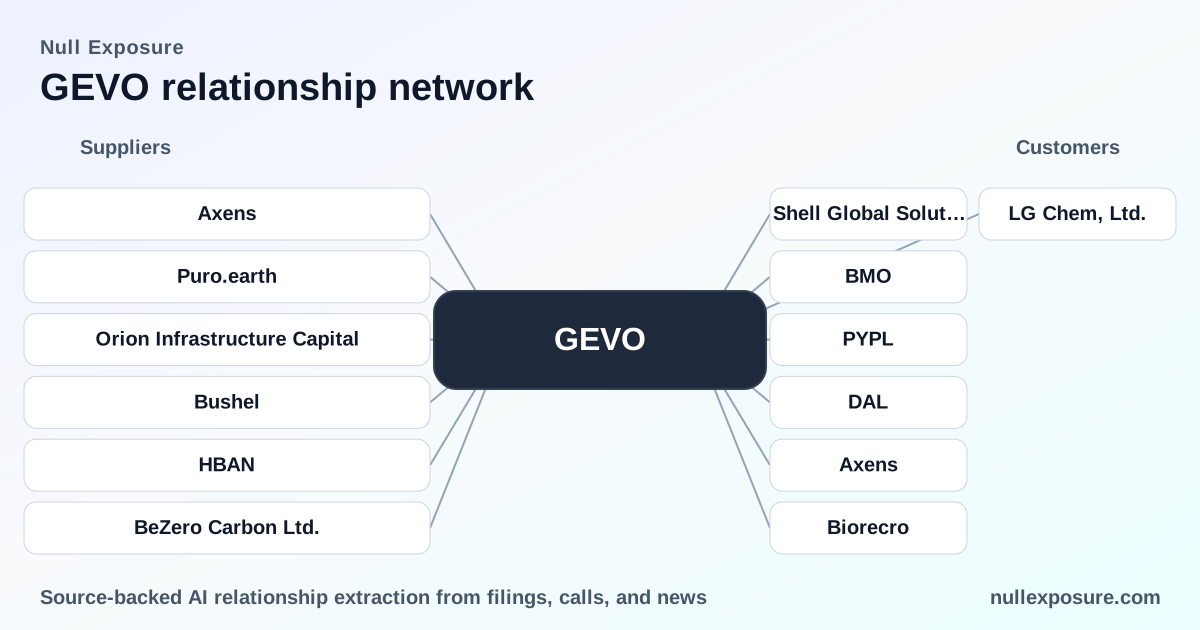
Gevo (GEVO) — supplier relationships that shape a capital‑intensive renewable fuels play
Gevo operates as a renewable fuels and chemicals company that monetizes through the sale of low‑carbon fuels (notably sustainable aviation fuel and ethanol derivatives), licensing its conversion technology, and selling high‑quality carbon removal or avoidance credits. Revenue comes from product sales and increasingly from validated carbon credit issuance and technology licensing, while financing comes from a mix of project debt and corporate facilities that reflect the capital intensity of its plant network. For a concise supplier risk and partner profile, see NullExposure’s platform: https://nullexposure.com/.
How Gevo makes money and why suppliers matter
Gevo’s commercial model combines industrial manufacturing with sustainability credentials. The company generates cash from fuel sales (Revenue TTM ~$160.6M) and extracts additional margin through carbon removal credits and technology licensing pathways that expand product optionality. The business is capital intensive: large project-level financing and long-term supply or off‑take arrangements are integral to converting patents and process know‑how into scalable cash flow. That requires a supplier network that can deliver engineering, equipment, feedstock traceability, and credit verification at scale — and partners that can provide or underwrite large tranches of debt.
Gevo’s balance of operational suppliers and financial counterparties determines near‑term execution risk and the runway for iterative plant expansion. If you evaluate GEVO as a supplier customer or counterparty, focus on the interplay between long‑dated contracts, capital structure, and credit validation for carbon products. Learn more about supplier exposures and counterparty mapping at NullExposure: https://nullexposure.com/.
Who Gevo is working with — the partnership map and takeaways
-
Axens — Gevo is leveraging Axens for licensing, equipment supply, and engineering services to scale its ethanol‑to‑olefins (ETO) pathway and renewable jet fuel production following a new U.S. patent. According to press coverage tied to GEVO’s patent announcement in January 2026, Axens is positioned to support global deployment through licensing and equipment provision (GlobeNewswire, Jan 14, 2026).
Source: GlobeNewswire, Jan 14, 2026. -
Puro.earth — Gevo’s North Dakota carbon capture and storage project has issued Puro.earth‑certified removal certificates, described as having thousand‑year permanence and contributing to Gevo’s carbon revenue stream (GlobeNewswire, Jan 21, 2026). This partnership underpins the commercial saleability of Gevo’s carbon credits.
Source: GlobeNewswire, Jan 21, 2026. -
BeZero Carbon Ltd. — Gevo’s North Dakota facility received an “A” rating from BeZero Carbon Ltd., giving independent, market‑recognized validation to its capture and storage performance and enhancing the marketability of credits derived from that site (GlobeNewswire, Jan 21, 2026).
Source: GlobeNewswire, Jan 21, 2026. -
Orion Infrastructure Capital — Gevo consolidated project and RNG subsidiary debt into a new $175 million loan facility with Orion Infrastructure Capital, simplifying its debt structure and moving project obligations under a single consolidated facility (Gevo release via GlobeNewswire, Feb 11, 2026). This transaction materially alters project finance counterparty exposure.
Source: GlobeNewswire, Feb 11, 2026. -
Huntington National Bank (HBAN) — Gevo established a $20 million revolving credit facility with Huntington National Bank to bolster working capital for its North Dakota ethanol plant, improving near‑term liquidity and operational stability (company disclosure reported Feb 2026).
Source: GlobeNewswire / company release via Feb 11, 2026; secondary reporting Mar 2026. -
Bushel (through Verity Holdings, LLC) — Verity, a wholly owned Gevo subsidiary, integrated Bushel’s on‑farm data platform to feed sustainability modeling and carbon scoring, enabling traceability of agricultural feedstock and strengthening the provenance behind carbon claims (press release reported in March 2026). This data linkage supports compliance and crediting workflows.
Source: The Globe and Mail (press release), Mar 2026.
What the relationship map says about Gevo’s operating constraints
Gevo’s partner roster and disclosed filings produce company‑level signals about how it contracts and operates:
-
Long‑term contracting posture is baked into the model. Evidence includes a funded $105 million senior secured term loan with a maturity in 2030 and the existence of multiple long‑term feedstock supply contracts for RNG projects; this reflects multi‑year capital recovery horizons and embedded counterparties across financing and feedstock. (Company filings cited in constraints evidence.)
Implication: expect contractual rigidity that protects lenders and project economics but limits short‑term flexibility. -
Capital intensity and large ticket spend are structural. A disclosed $210 million purchase price for an asset acquisition and consolidated $175 million project loan indicate project‑level spend bands in the hundreds of millions, meaning suppliers and lenders play outsized roles in Gevo’s success.
Implication: supplier selection and contract terms materially affect ROI; procurement and finance must align on long duration commitments. -
Buyer posture and acquisition behavior shape counterparty risk. Gevo has acted as an acquiring buyer in strategic purchases, which signals active portfolio consolidation and appetite to internalize assets rather than relying solely on third‑party operators.
Implication: counterparties face a sophisticated buyer that integrates vertically to capture margin and control feedstock or project performance.
Investment implications — what to watch for
- Execution and scale risk: licensing relationships (Axens) and engineering suppliers determine how quickly patented processes translate into commercial fuel volumes; operational delays compress cash flow relative to debt amortization. Axens’ role is a positive enabler, but delivery timelines will drive near‑term returns.
- Credit and pricing for carbon products: third‑party validation (Puro.earth; BeZero) materially improves the price realization for removals and legitimizes ESG revenues; maintain vigilance on evolving certification standards and market demand.
- Refinancing and liquidity: consolidation of project debt with Orion and a $20M revolver with Huntington materially reduced structural complexity, but continued capital raises or refinancing are likely as Gevo scales new plants. Evaluate covenant terms and amortization schedules before underwriting exposure.
For a deeper counterparty and supplier risk profile tailored to institutional needs, visit NullExposure: https://nullexposure.com/.
Actionable checklist for investors and operators
- Validate the timing and scope of Axens deliverables relative to Gevo’s deployment schedule. Engineering milestones equal revenue timing.
- Confirm the persistence and market acceptance of Puro.earth‑issued credits and BeZero ratings when modeling carbon revenue streams.
- Review loan terms under the Orion facility and Huntington revolver for covenant sensitivity in downside scenarios.
Bottom line
Gevo’s model is capital‑intensive, contractually anchored, and increasingly diversified across fuel sales, carbon credits, and licensing. Supplier and finance relationships—from engineering partners like Axens to certifiers like Puro.earth and BeZero, and financiers such as Orion and Huntington—are not peripheral: they are core value drivers that determine whether patents and plant capacity convert into predictable cash flow. For detailed counterparty scoring and supplier exposure reports, explore NullExposure’s research hub: https://nullexposure.com/.
Bold, informed supplier due diligence is essential when underwriting or partnering with Gevo: the company’s trajectory hinges on successful delivery of engineered pathways, validated carbon credits, and stable project finance.