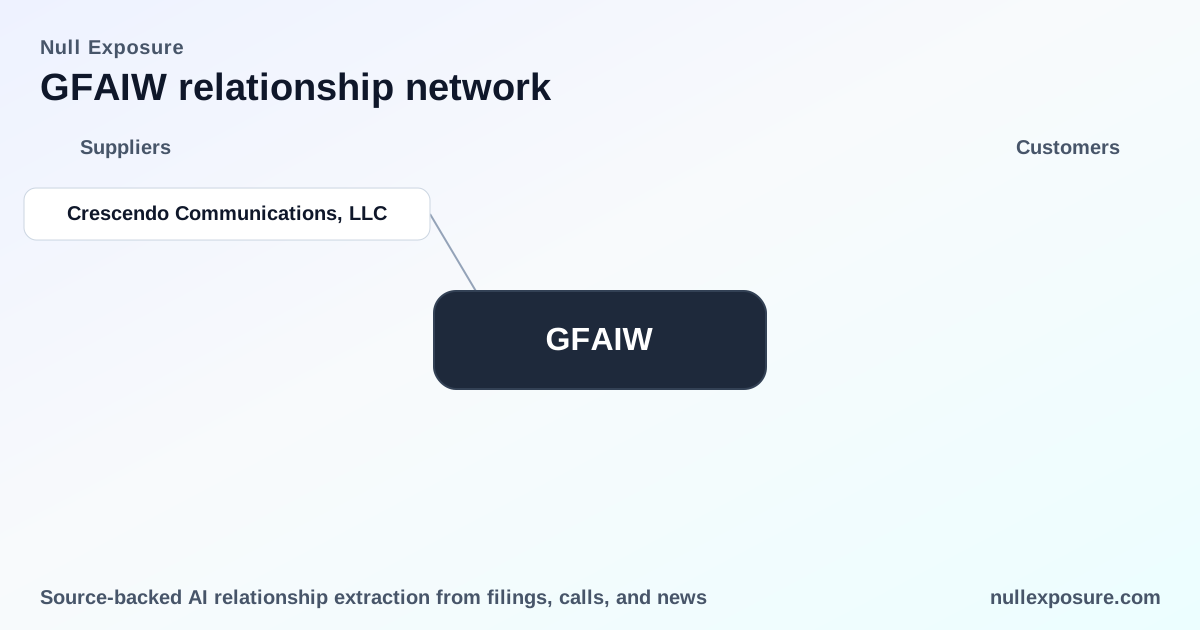
Guardforce AI (GFAIW) — supplier relationships and what investors should know
Guardforce AI Co. Limited operates as a B2B security-technology supplier that monetizes through the sale and deployment of AI-driven security hardware and software, recurring service and maintenance contracts, and related integration services across banking, retail, and logistics customers. The company’s public instrument here is a warrant listed as GFAIW, and the underlying operating entity runs a capital-intensive, contract-oriented business with recurring revenue attributes and negative profitability today. For a quick gateway to additional supplier intelligence and relationship mapping, visit https://nullexposure.com/.
Executive snapshot: how Guardforce AI makes money and why relationships matter
Guardforce AI sells integrated security solutions — physical devices, AI analytics and managed services — to enterprise customers that require continuous availability and high regulatory reliability. Revenue TTM of about $37.0M with a gross profit of $5.97M signals commercial traction, but negative operating and net margins (operating margin -13.4%, profit margin -16.9%, diluted EPS -0.181) show the business is still in investment mode. The company carries a high beta (2.63) and limited institutional ownership, which increases sensitivity to news flow and counterparty perceptions.
Because Guardforce’s product suite is embedded in customer security stacks, supplier and partner relationships are operationally critical: uptime guarantees, software update cadences, and integration capabilities materially affect contract renewals and revenue visibility. At the same time, the instrument tracked here is a warrant, which changes the investor payoff profile and elevates capital structure considerations relative to equity investors.
What is documented about Guardforce AI’s supplier/partner relationships
The available relationship record for GFAIW in public monitoring is concise but relevant for diligence.
Crescendo Communications, LLC — investor relations partner
Crescendo Communications is listed as Guardforce AI’s investor relations contact, with named contacts David Waldman and Natalya Rudman and the email gfai@crescendo-ir.com and telephone 212-671-1020. This contact information appears in a public notice related to a Nasdaq compliance communication reported on December 18, 2025, by Sahm Capital. (Sahm Capital, December 18, 2025).
This relationship is a communications/IR engagement rather than a product supplier, but it is material to market messaging, regulatory notices, and investor access during periods of elevated scrutiny.
How the relationships and public signals shape operating constraints and contracting posture
Guardforce’s supplier and partner posture should be viewed through these company-level signals:
- Contracting posture: Enterprise-facing commercial model with recurring service components implies standard master services agreements and service-level obligations; counterparty performance and indemnities are economically and operationally meaningful.
- Concentration and criticality: Security services are mission-critical for end customers, so any supplier disruption has high customer impact and renewal risk. The public record does not enumerate vendor concentration metrics, but the business model inherently makes third-party integrations and hardware supply chains consequential.
- Maturity: Financial metrics show a company in growth and investment mode — negative EBITDA and net loss coupled with positive revenue growth year-over-year — which translates into higher dependency on capital markets and external communications (explaining the IR relationship).
- Disclosure and market posture: The company disclosed receipt of a Nasdaq minimum bid price deficiency notification in December 2025 (reported by Sahm Capital), which elevates governance and investor-relations activity as a near-term operational constraint.
No supplier-specific contractual constraints are documented in the monitored relationship feed; the constraints inventory returned empty results, which is a company-level signal that no public supplier constraints were captured in the monitored scope.
For teams evaluating procurement or counterparty risk, these attributes imply that procurement diligence should focus on SLA robustness, diversification of hardware and cloud vendors, and the company’s ability to fund warranty and service obligations if capital access tightens.
For more structured supplier mappings and to track incremental disclosures, consult https://nullexposure.com/ for updated relationship feeds and alerts.
Risk checklist for operators and investors
- Financial sustainability risk: Negative EBITDA and operating losses require monitoring of cash runway and financing options; warrant holders have different recovery mechanics than equity holders.
- Market access and liquidity risk: Warrant structure, thin institutional ownership, and limited market capitalization disclosures increase price and liquidity volatility.
- Reputational and regulatory risk: The Nasdaq deficiency notice raises governance and disclosure obligations; investor relations activity becomes operationally significant.
- Operational dependency: Security solutions are mission-critical to clients; any supplier interruption or failure in software updates could accelerate churn.
Practical next steps for diligence teams
- Request copies of material supplier contracts, SLAs, and warranty terms to measure real economic exposure.
- Validate uptime histories, patch cadence, and incident response commitments for deployed customers.
- Confirm supply-chain diversification for hardware components and third-party AI tooling.
- Engage the company’s IR contacts (Crescendo Communications) for clarifications on Nasdaq matters and investor communications; those contacts are publicly listed in the December 2025 notice (Sahm Capital, December 18, 2025).
Dive deeper into supplier relationships and monitoring tools at https://nullexposure.com/ to ensure ongoing coverage and to surface new partner disclosures as they are reported.
Bottom line: what this means for investors and operators
Guardforce AI is a commercially active security-technology supplier with real revenue but not yet profitable, operating under capital-market pressure and governance scrutiny following a Nasdaq deficiency notice. The sole supplier-scope relationship captured here is an investor-relations engagement with Crescendo Communications, which is important for transparency and market communications but does not substitute for supply-chain diligence. Investors and procurement teams should prioritize contract-level review, operational resilience, and funding pathway analysis before increasing exposure to the warrant or the underlying business.
For ongoing relationship monitoring and prioritized supplier signals, visit https://nullexposure.com/ — it's the fastest route to publishable supplier intelligence and alerting for counterparty risk.