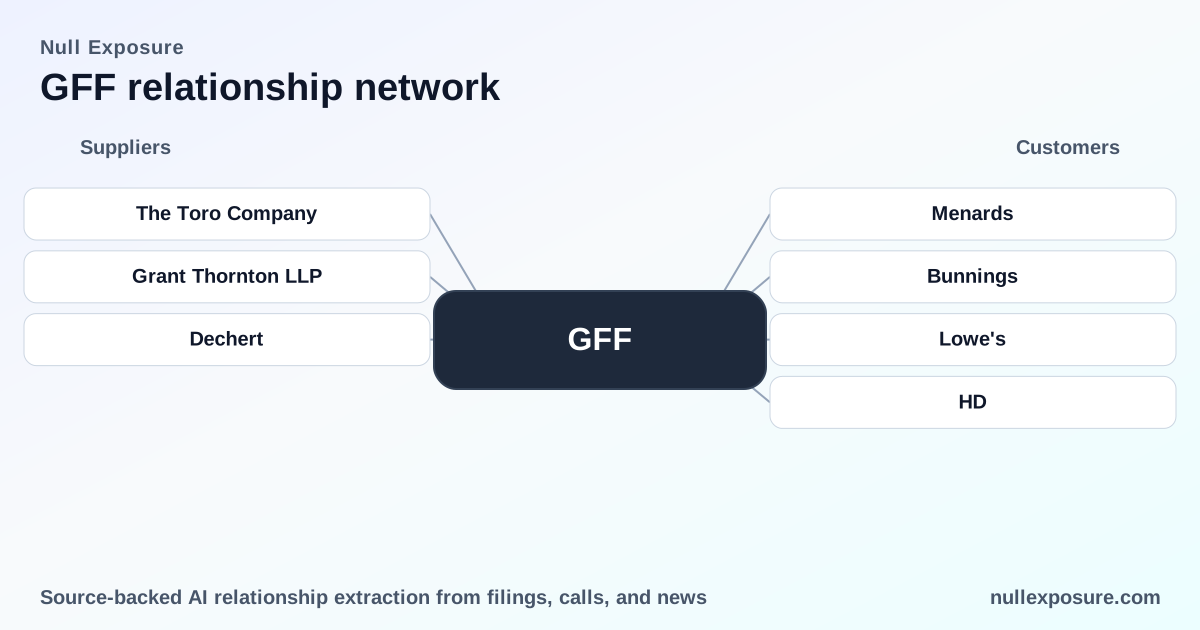
Griffon Corporation (GFF): Supplier relationships that matter for investors
Griffon Corporation is a diversified industrial holding company that monetizes through product sales, strategic acquisitions, and selective joint ventures across consumer & professional products, home & construction products, and defense electronics. Revenue in the trailing twelve months stands near $2.54 billion with EBITDA of roughly $519.5 million, reflecting a portfolio that combines recurring manufacturing/procurement flows with periodic M&A-driven growth and capital deployment. This supplier-focused brief isolates the external relationships disclosed in recent filings and press coverage to illuminate procurement concentration, contractual posture, and governance signals that affect operational resilience and financial predictability. For a deeper supplier-risk scan, visit https://nullexposure.com/.
What the disclosed supplier signals tell investors about Griffon's operating model
Griffon runs a mixed sourcing model that combines internal manufacturing with external suppliers under framework supply arrangements, particularly for its Consumer & Professional Products (CPP) segment. According to company disclosures, CPP sources finished goods, components and raw materials from China under supply agreements, indicating contractual frameworks rather than ad-hoc purchases. Those China-based sources are material to CPP: Griffon reports sourced finished goods represented approximately 38% of CPP revenue in 2025, while HBP sourced goods were about 6% of revenue—a structural supplier exposure rather than an incidental one.
Contractual and spending signals extracted from Griffon’s disclosures present a pragmatic risk profile:
- Framework contracts and long-term supply agreements point to predictable vendor commitments and negotiated terms, reducing spot-price volatility but increasing dependency on incumbent suppliers.
- APAC concentration—notably China—creates geographic supply risk for CPP lines that is operationally significant given the 38% revenue share.
- Manufacturer role: CPP’s sourcing mix combines internal production and external manufacturing partners, so supplier disruptions can be mitigated by internal capacity but not eliminated.
- Near-term purchase obligations and lease commitments—reported at roughly $218,344 and $41,883 respectively—signal manageable contractual cash flow commitments over the coming twelve months relative to Griffon’s scale, but they are non-trivial when evaluating working capital and liquidity under supply shock scenarios.
These constraints collectively describe a company that contracts for scale, concentrates procurement in APAC for cost and capacity reasons, and retains partial vertical integration as a buffer. For an executive-level supplier-risk dashboard, explore https://nullexposure.com/.
Relationships you need to know (documented interactions)
The Toro Company — a small, targeted asset purchase in Australia
On July 1, 2024, Griffon’s subsidiary The AMES Companies acquired substantially all the assets of Pope, an Australian residential watering-products provider, from The Toro Company for approximately AUD 21,800 (about $14,500) in cash, expanding AMES’s Australian footprint and product set. This was disclosed in Griffon’s FY2025 public filing. (Source: Griffon 2025 Form 10‑K, FY2025)
Grant Thornton LLP — continuity in external audit oversight
Griffon’s shareholders ratified the appointment of Grant Thornton LLP as the company’s independent registered public accounting firm for fiscal 2026, reinforcing continuity in financial oversight and audit processes during a period of active M&A and JV activity. This was reported in shareholder materials and press coverage in early 2026. (Source: Globe and Mail press release, FY2026)
Dechert — external legal counsel on joint-venture execution
Philadelphia-headquartered law firm Dechert advised Griffon on a joint venture transaction with ONCAP (a subsidiary of Onex Corporation), a deal guided publicly in connection with a roughly $100 million JV arrangement; Dechert’s role reflects Griffon’s use of specialized external legal expertise for structuring and executing material partnerships. (Source: ICLG news report, FY2026)
Commercial implications and risk framing for investors
Griffon’s supplier relationships and disclosed constraints combine into clear investment-relevant themes:
- Concentration risk is material for CPP. With roughly 38% of CPP revenue sourced from externally manufactured finished goods (including China-only suppliers for some SKUs), procurement disruptions in APAC will have a direct earnings impact. The company’s framework contracts provide contractual continuity, but geography still matters for lead times and geopolitical risk.
- Contracting posture is pragmatic and mature. The use of framework agreements and long-term sourcing arrangements signals negotiated terms, potential volume discounts, and supply predictability—advantages for margin stability. At the same time, those frameworks raise switching costs if Griffon needs to re-source quickly.
- Strategic M&A and JV activity is part of the supply expansion strategy. The small Pope acquisition from Toro strengthened AMES’s regional product offering; the Oncap JV executed with legal counsel from Dechert signals a willingness to use partnerships to access distribution, scale, or capabilities rather than sole reliance on internal build-outs.
- Governance continuity reduces execution risk. Retaining Grant Thornton as auditor for fiscal 2026 signals stable financial controls and audit continuity during periods of operational change, which supports investor confidence in reported performance and disclosure reliability.
- Contractual cash flow commitments are visible and bounded. Griffon reports purchase obligations and operating lease obligations in the near term—numbers that are significant for cash planning but do not indicate outsized fixed-cost leverage relative to the company’s revenue base.
Bold takeaway: Griffon’s operating model balances cost-effective APAC sourcing with internal manufacturing and targeted acquisitions/JVs; the structure reduces unit cost and accelerates scale but concentrates supplier geography and requires active governance and contingency planning.
(For supplier-relationship heat maps and counterparty scoring, see https://nullexposure.com/.)
What investors should monitor next
- Watch for disclosure on supplier diversification actions—any targeted re-shoring or supplier diversification in CPP would materially reduce APAC concentration risk.
- Track procurement terms and renewal cadence for major framework agreements; changes will affect gross margins and supply predictability.
- Monitor M&A and JV execution: additional tuck-ins similar to the Pope purchase or larger Oncap-style joint ventures will shape Griffon’s revenue mix and supplier dependency profile.
- Observe audit and governance developments after the Grant Thornton appointment to assess any changes in oversight intensity or reporting cadence.
Bottom line and next steps
Griffon manages a mixed sourcing model that delivers scale and margin upside while leaving material geographic concentration in CPP supply and routine contractual obligations that investors must price into valuation and downside scenarios. For investment teams building supply-adjusted valuations or counterparty risk assessments, Griffon’s public disclosures provide actionable lines of inquiry: contract terms, supplier concentration, and the cadence of M&A/JV activity. To commission a tailored supplier-risk brief for investors and operators, visit https://nullexposure.com/ and request a scoped review.