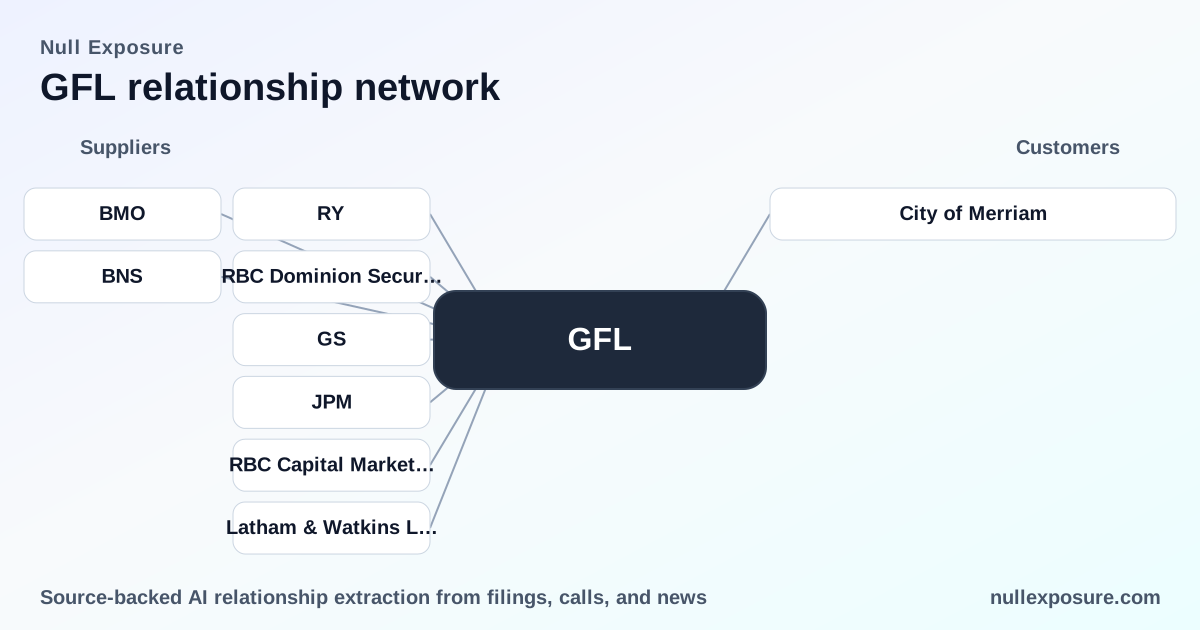
GFL Environmental: Capital partners, underwriters and counsel that shape access and liquidity
GFL Environmental is a large, diversified North American waste management operator that monetizes through fee-for-service collection, processing and disposal, plus ancillary environmental services and landfill assets; the company leverages public equity markets and periodic secondary offerings to provide liquidity to private-equity and institutional sellers while retaining operational control of its core business. Recent activity shows GFL uses established investment banks and global law firms to underwrite transactions, facilitate secondary liquidity and manage repurchases, which directly influences shareholder structure and short-term capital flexibility.
Learn how these supplier relationships affect exposure and decision-making at https://nullexposure.com/.
How GFL’s capital relationships translate into operational leverage
GFL’s commercial model is operationally stable—long-term municipal and commercial contracts generate recurring cash flows—yet corporate flexibility depends on capital-market partners who underwrite share sales, advise on documentation and occasionally transact with the company directly. That dynamic creates a mixed contracting posture: operational contracts are steady and critical, while capital markets relationships are transactional but strategically important for liquidity, founder/investor exits and balance-sheet management. Company-level signals from public filings and press releases point to:
- Concentration of capital-market counterparties: GFL repeatedly uses major banks (notably RBC) for underwriting and execution, signaling preferred counterparty status for equity transactions.
- Maturity of capital access: Roles filled by global banks and elite law firms indicate institutional-grade capital-market access rather than ad-hoc financing.
- Criticality for shareholder structure: Secondary offerings and repurchases directly alter ownership and voting dynamics; these relationships are material for governance and investor strategy.
The relationships that matter today — who did what, and where it matters
Below I cover every counterparty cited in recent public notices and press reporting. Each entry is a concise, plain-English summary with source attribution.
RBC Dominion Securities Inc.
RBC Dominion Securities acted as the Canadian underwriter for a March 2026 secondary offering and was also the selling shareholder from whom GFL agreed to repurchase 1,275,000 subordinate voting shares for cancellation, indicating a two-way commercial interaction between the bank and GFL (PR Newswire; Latham & Watkins, March 9, 2026).
RBC Capital Markets, LLC
RBC Capital Markets served as the U.S. underwriter on the same March 2026 secondary offering of subordinate voting shares, positioning RBC as a lead execution partner for transborder equity distribution (PR Newswire; Newswire.ca, March 9, 2026).
Latham & Watkins LLP
Latham & Watkins advised GFL and a selling shareholder (HPS Investment Partners) on the December 2025/early-2026 secondary offering and related repurchase, providing capital markets and transactional counsel that structured both the sale and the share repurchase agreement (Latham & Watkins press release; LegalDesire reporting, Dec 2025–Mar 2026).
Goldman Sachs
Goldman Sachs was named among the lead underwriters for GFL’s earlier IPO effort; that legacy relationship reflects the company’s reliance on global investment banks when launching public equity access (The Globe and Mail, coverage of the IPO, 2019).
J.P. Morgan Securities
J.P. Morgan Securities participated as a lead underwriter in GFL’s IPO process and represents a classically institutional bookrunner used by the company during its initial market entry (The Globe and Mail, 2019).
BMO Nesbitt Burns
BMO Nesbitt Burns is recorded as a lead underwriter on GFL’s IPO, signaling Canadian domestic-bank participation in GFL’s capital-market placements since the company’s public debut (The Globe and Mail, 2019).
Scotia Capital
Scotia Capital appeared as a lead underwriter in GFL’s IPO syndicate; inclusion of multiple Canadian banks in the syndicate underlines GFL’s Canadian financing footprint despite its substantial U.S. operations (The Globe and Mail, 2019).
What these relationships imply for investors and operators
The pattern in the record is clear: GFL relies on a small set of elite capital-market partners to manage shareholder liquidity events and to operationalize repurchase transactions. That reliance produces three operational implications:
- Execution concentration risk: Repeated use of RBC and other lead banks centralizes execution risk; a disruption to one key underwriter could slow future equity transactions.
- Governance and ownership mechanics: Share repurchases from selling shareholders reduce free float and can alter voting dynamics; these transactions require counsel like Latham & Watkins, which raises the bar on legal complexity and cost.
- Access to deep markets: Relationships with global banks (Goldman, J.P. Morgan) and major Canadian houses provide access to cross-border investor demand, supporting pricing and placement for large offerings.
Explore deeper counterparty exposure and governance impacts at https://nullexposure.com/.
Practical signals to track going forward
Investors and operators should watch a limited set of indicators that will change the profile of these relationships:
- Announcements of additional underwriting mandates or repurchase programs (frequency and size).
- Any shift in the bank syndicate composition—new lead banks or absence of long-standing partners.
- Legal counsel changes on capital transactions or material litigation tied to transactional work.
- Insider and institutional holdings trends after repurchases (voting share concentration).
Bottom line and next steps
GFL’s capital-market relationships are robust and institutionally anchored, but they concentrate execution and governance levers in a small group of banks and law firms. For investors, that translates to reliable access to liquidity, with the trade-off of counterparty concentration. For operators, expect detailed counsel and banker coordination on any structural equity moves.
For firms or researchers needing a concise mapping of counterparties and transaction history, visit https://nullexposure.com/ for tailored supplier-exposure analysis and alerts.