How GFR-R’s supplier footprint underpins a short, capital-raising rights offering
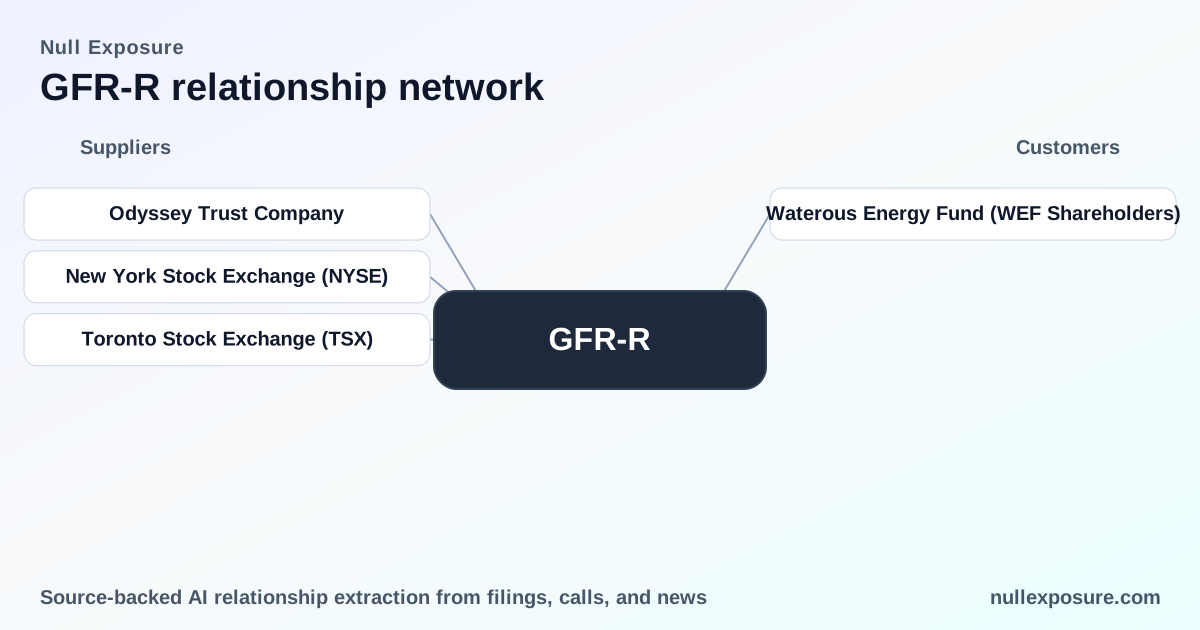
Greenfire Resources executed a narrowly scoped rights offering and related redemption notice in late 2025; the company monetizes through equity issuance to raise cash and through coordinated capital markets mechanics (rights trading and secured-notes redemption) that rely on a small set of external service providers. The economics are straightforward: the company sells subscription rights to existing holders, collects subscription proceeds via a depositary, and uses listed trading windows on two exchanges to deliver liquidity and price discovery. For active investors and operators evaluating counterparty risk, the supplier map highlights operational concentration around listings and transfer agent functions. Learn more about how supplier relationships affect capital events at NullExposure.
Why supplier relationships matter for a rights offering
A rights offering is a time-bound capital market operation that is operationally simple but execution-sensitive. Critical suppliers are not dozens of vendors but three functional counter-parties: the transfer/depositary agent and the listed exchanges handling the tradability of the rights. From a governance and operational-risk perspective that configuration creates obvious failure modes — missed filing or deposit deadlines, exchange delisting mechanics, or transfer-agent processing delays — all of which directly impair a successful raise and subsequent debt redemptions.
Operational constraints inferred from the filing history are consistent with a transactional, high-criticality posture: contracts are short-lived and tightly scheduled, counterparty concentration is moderate (two exchanges, one depositary), and maturity of the arrangements is procedural rather than strategic. No explicit supply constraints were disclosed in the filings, which is a company-level signal that the arrangement is standard for corporate capital raises rather than bespoke outsourcing.
The service relationships you need to know
Odyssey Trust Company — the depositary and subscription agent
Odyssey Trust Company is the rights depositary and subscription agent responsible for receiving completed DRS advice and subscription forms and for collecting subscription payments prior to the stated expiry time on December 16, 2025. According to the company press release published via Newsfile (November 2025), registered holders were instructed to mail subscription forms and payments to Odyssey Trust by the expiry time on the expiry date.
New York Stock Exchange (NYSE) — the U.S. trading venue for the rights
The company arranged for the rights to trade on a when‑issued basis on the NYSE beginning November 14, 2025, with regular-way trading under the symbol "GFR RT" to commence November 25, 2025. The same Newsfile release (November 2025) states the NYSE trading timetable for the rights, which is material for U.S.-market liquidity and price discovery during the offering period.
Toronto Stock Exchange (TSX) — the domestic trading venue for the rights
The rights were listed on the TSX at the opening of trading on the record date under the symbol "GFR.RT" and were scheduled to cease trading at 12:00 p.m. Toronto time on the expiry date. The Newsfile announcement (November 2025) sets the TSX timetable and confirms the transferability and trading window that Canadian holders would use to monetize or trade their rights.
What the relationships imply about concentration and criticality
- Concentration: The supplier footprint is compact — two exchanges plus a single depositary/agent. That configuration reduces vendor management overhead but raises single-point-of-failure risk for processing and market access during the offering window.
- Contracting posture: Agreements here are standard transactional arrangements tied to a capital raise, not long-term strategic supplier contracts; contractors are engaged to execute a defined timetable.
- Criticality: These suppliers are highly critical to the success of the rights offering; a failure at the depositary (missed payment processing) or at an exchange (trading suspension) would directly impair capital collection and secondary-market liquidity.
- Maturity: These relationships reflect routine capital markets plumbing rather than novel outsourcing; maturity in process reduces execution uncertainty if counterparties perform to standard.
No explicit constraints were disclosed in the company's filings or the referenced press release, which is a company-level signal that management relied on conventional capital-markets counterparties rather than specialized or constrained vendors.
Practical risk considerations for investors and operators
Operationally, the timeline is the biggest risk vector. Rights trading windows and a single subscription cut-off date create compressed operational windows for both management and service providers. Key risk factors are settlement timing, receipt of subscription funds at Odyssey Trust, and any market-structure events on the NYSE or TSX during the trading period. For operators executing similar raises, redundancy in communications, strict reconciliation protocols with the depositary, and real-time monitoring of exchange trading status are the most effective mitigants.
For investors, two related market considerations matter: liquidity and optionality. The when‑issued trading period on the NYSE and the TSX listing provide price discovery channels that allow holders to trade rights prior to exercise; conversely, low on‑exchange volumes can concentrate execution risk into the subscription window.
If you want a concise mapping of counterparties and execution timelines for capital events like this, see practical examples and supplier scoring at NullExposure.
Short takeaways and action items
- Execution hinges on a narrow supplier set: Odyssey Trust Company, NYSE, and TSX together deliver the entire operational stack for the rights offering.
- High operational criticality, low vendor diversity: That trade-off simplifies management but amplifies single-point-of-failure risk during the offering window.
- No disclosed supplier constraints: Company filings do not show constrained or bespoke vendor commitments, signaling a standard capital-markets workflow.
For portfolio managers and corporate operators preparing for similar raises, establish explicit verification steps with your depositary and set pre-specified contingency plans for exchange interruptions. If you want to benchmark supplier risk across capital events or compare counterparty configurations, visit NullExposure for supplier-centric intelligence and transaction playbooks.
Final assessment
The supplier map for GFR-R reflects a conventional, tightly scheduled capital-raising operation: rights issued, rights tradable on two exchanges, and deposits collected via a single trust agent. For investors, the primary diligence focus is operational: confirm depositary procedures, monitor exchange trading windows, and treat the subscription cut-off as the single most material operational date. These are the levers that determine whether the equity raise clears and related debt redemptions proceed as planned.