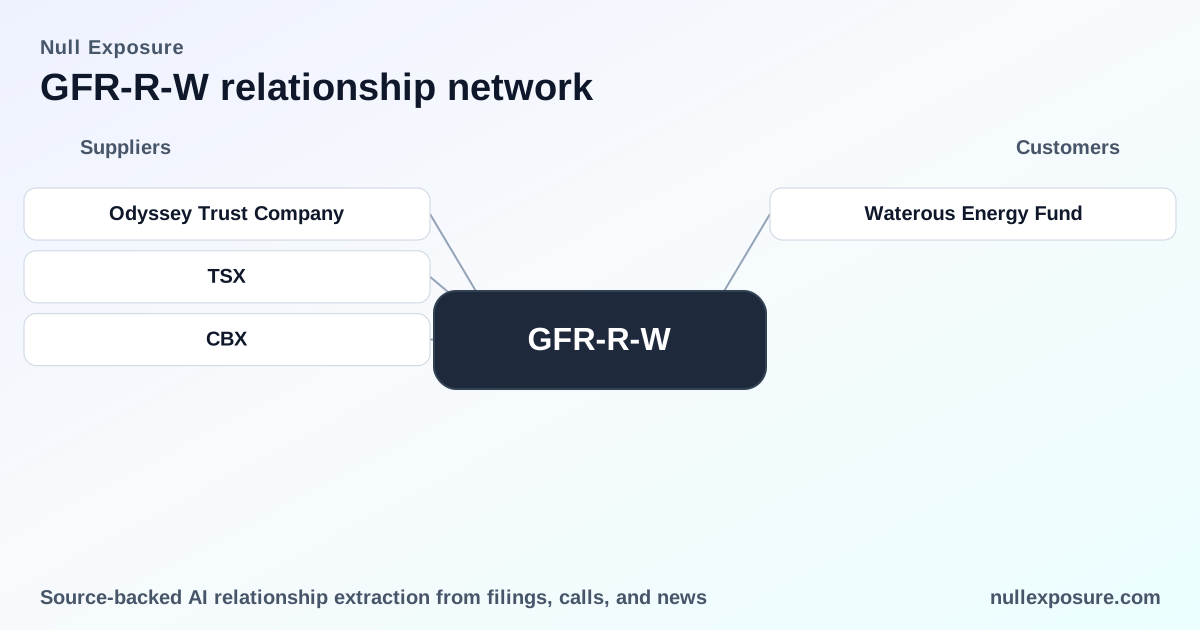
Greenfire Resources (GFR-R-W): What the Rights Offering and Service Relationships Signal to Investors
Greenfire Resources monetizes through traditional public equity and debt markets while executing capital structure adjustments via rights offerings and redemptions of secured notes. The company leverages exchange listings and third-party trust agents to execute short-term capital raises and investor communications, generating liquidity events that directly affect shareholder dilution, debt-equity mix, and near-term cash flow dynamics. Investors should view the recent rights offering as a financing lever intended to shore up balance-sheet flexibility while creating tradable instruments across multiple exchanges. Learn more about supplier relationship intelligence at https://nullexposure.com/.
What happened and why it matters to capital allocators
On November 6, 2025, Greenfire Resources announced a rights offering coupled with a conditional notice of redemption for its senior secured notes due 2028. The corporate mechanics rely on established market infrastructure: a rights agent to administer the offer and major exchanges to provide liquidity for the rights themselves. This structure converts a private financing decision into tradable instruments, concentrating short-term execution risk on the rights agent while distributing market risk across listed venues. The operation changes the timing and composition of available capital without immediately changing core operating cash flows.
Who Greenfire is contracting with — and the business consequences
Below I walk through each named counterparty uncovered in the public record and explain what their role implies for investors.
Odyssey Trust Company — rights agent and holder communications
Odyssey Trust Company is serving as the rights agent responsible for direct registration system notices and mailing Rights DRS Advice to eligible registered holders around the record date. This role is operationally critical because timely and accurate delivery of rights notifications determines investor participation and the ultimate success of the offering. (Chronicle Journal press release, November 6, 2025: https://markets.chroniclejournal.com/chroniclejournal/article/newsfile-2025-11-6-greenfire-resources-announces-launch-of-rights-offering-and-conditional-notice-of-redemption-for-its-senior-secured-notes-due-2028)
Toronto Stock Exchange (TSX) — primary listing venue for traded rights
The rights are transferable and scheduled to list for trading on the TSX under the symbol "GFR.RT" on the record date, with trading set to cease at midday on the expiry date. Listing on the TSX provides a Canadian trading venue that can absorb retail and institutional flows tied to the rights offering and helps set a market price for subscription rights. (Chronicle Journal press release, November 6, 2025: https://markets.chroniclejournal.com/chroniclejournal/article/newsfile-2025-11-6-greenfire-resources-announces-launch-of-rights-offering-and-conditional-notice-of-redemption-for-its-senior-secured-notes-due-2028)
New York Stock Exchange (NYSE) — U.S. when-issued and regular trading
The rights are slated to begin trading on a when-issued basis on the NYSE and then transition to regular-way trading under "GFR RT" later in November 2025. Access to the NYSE broadens investor reach and introduces U.S. ADR-style liquidity dynamics to the offering, which can affect pricing, arbitrage opportunities, and cross-listing flows. This dual-exchange strategy increases overall liquidity but introduces complexity in cross-listing governance. (Chronicle Journal press release, November 6, 2025: https://markets.chroniclejournal.com/chroniclejournal/article/newsfile-2025-11-6-greenfire-resources-announces-launch-of-rights-offering-and-conditional-notice-of-redemption-for-its-senior-secured-notes-due-2028)
What these relationships collectively reveal about Greenfire’s operating model
- Contracting posture: Greenfire uses third-party market infrastructure for execution, indicating a transactional contracting posture for capital markets activities; execution risk is outsourced to established agents and exchanges rather than handled in-house.
- Concentration and criticality: While the rights program involves multiple counterparties, the rights agent is uniquely critical to the offering’s operational success; exchanges are important but substitutable for trading liquidity. Operational failure at the agent level would have outsized impact on investor participation.
- Maturity of relationships: The named partners are legacy market participants (trust agent and major exchanges), signaling a reliance on mature, institutional service providers rather than ad hoc or boutique providers.
- Commercial leverage: By listing rights on two major exchanges, Greenfire reduces single-market concentration of liquidity and increases potential investor breadth, but increases regulatory and execution complexity.
These are company-level signals derived from the public rights offering mechanics and the named counterparties; no supplier-specific constraint disclosures were present in the record provided.
Investor implications — read the tradeoffs
Constructing a view on Greenfire from these supplier relationships highlights several concrete points for investors and operators:
- Dilution vs. deleveraging: The rights raise injects equity funding while simultaneously coupling to a conditional redemption of secured notes, shifting the balance sheet depending on uptake; monitor subscription rates closely for dilution outcomes.
- Execution risk localized to the agent: Odyssey Trust Company’s role is central to enrollment and transfer mechanics; operational issues there would create the most immediate friction.
- Liquidity and price discovery: Dual-listing of rights on TSX and NYSE improves market access and price discovery, which could reduce volatility in rights pricing but increases cross-market arbitrage dynamics.
- Regulatory and timing complexity: When-issued trading and staggered listing dates produce windows where price formation processes differ across venues; traders and risk desks must manage those windows actively.
A focused review of these points is essential before sizing positions in either the underlying equity or the tradable rights. For a wider review of how supplier relationships influence capital events, see https://nullexposure.com/.
Tactical takeaways for operators and risk teams
- Verify custody and communications workflows with the rights agent and ensure contingency plans for notice delivery failures.
- Model outcomes under a range of subscription rates and assume cross-market trade flows between TSX and NYSE affect realized proceeds.
- Track exchange timing closely: when-issued windows can create short-term liquidity vacuums followed by rapid repricing.
If you are assessing exposure to this financing event, prioritize agent performance metrics and subscription-rate disclosure as your next data points. Explore practical supplier intelligence and relationship analytics at https://nullexposure.com/ to supplement your diligence.
Final read — what to watch next
The rights offering transforms a corporate financing decision into tradable instruments whose success depends on administrative execution and market appetite across two major exchanges. Key near-term catalysts include the rights subscription rate disclosure, any updates from Odyssey Trust Company about mailing or DRS processing, and the timing of the secured-note redemption. These items will drive dilution, cash outcome, and the short-term direction of both the rights and underlying equity.
For continuous monitoring of supplier and market relationships tied to Greenfire and comparable issuers, visit https://nullexposure.com/ and incorporate supplier-criticality checks into your investment due diligence.