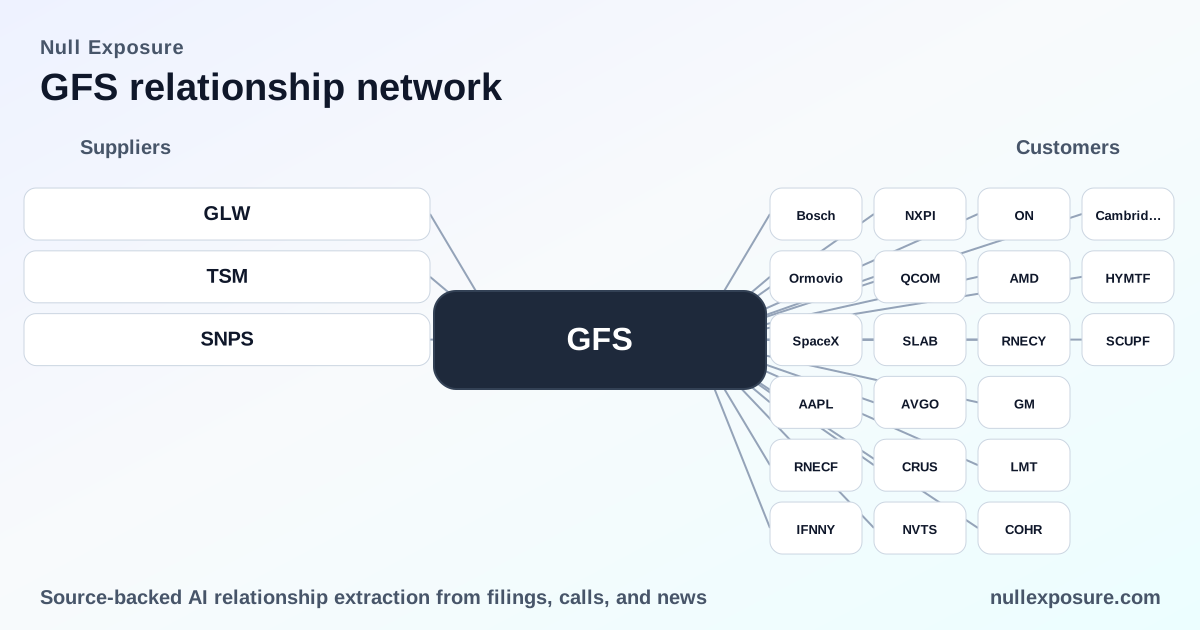
GlobalFoundries (GFS) supplier relationships: strategic partners that shape the foundry roadmap and addressable markets
GlobalFoundries operates as a pure-play semiconductor foundry, monetizing primarily through wafer fabrication services and capacity sales to fabless semiconductor companies and systems companies, while increasingly extending monetization through technology licensing and targeted M&A to broaden its IP and process portfolio. With trailing revenue of about $6.79B and an operating margin near 13.9%, GlobalFoundries is executing a hybrid growth model that couples capital-intensive manufacturing with selective intellectual-property and ecosystem plays to capture higher-value nodes and differentiated markets.
Explore partner intelligence and relationship risk for suppliers and customers at https://nullexposure.com/.
Why the partner ecosystem matters for valuation and risk
GlobalFoundries is no longer just a contract manufacturer; it is building an ecosystem that directly affects revenue mix, margin durability, and competitive positioning. The company’s recent partner moves fall into three operational patterns:
- Technology licensing and joint development, which accelerate process roadmaps without shouldering all R&D cost.
- Strategic acquisitions and IP inflows, which expand the company’s addressable market into processor IP and silicon photonics.
- Component and materials collaborations, which enable system-level integration (for example, photonics attach technologies) that raise switching costs for customers.
These patterns signal a contracting posture that is proactive and strategic—GlobalFoundries is converting supplier relationships into capability-building engines rather than purely transactional suppliers. Concentration risk is moderated by a varied partner set (TSMC, Synopsys, Corning), and the relationships are operationally critical where they address differentiated market niches such as gallium nitride (GaN) power devices and silicon photonics. The maturity profile is mixed: several agreements are recent, signalling execution and integration risk, while others augment established manufacturing lines.
Deal-by-deal: what each relationship contributes
Corning — building photonics assembly capability
GlobalFoundries disclosed a collaboration with Corning around detachable fiber attach for silicon photonics, positioning the foundry to deliver more integrated photonics solutions to hyperscale and networking customers. According to the 2025 Q4 earnings call, this collaboration is part of a strategy to create a differentiated silicon photonics ecosystem that couples fabrication with assembly-level technologies. (Source: GFS 2025 Q4 earnings call)
TSMC — licensing gallium nitride process technology
GlobalFoundries signed a technology licensing agreement with TSMC covering 650‑volt and 80‑volt GaN processes, accelerating its GaN roadmap and enabling the foundry to address higher-voltage power markets. The agreement was described in GFS commentary during its 2025 Q3 earnings call and reported in industry coverage noting the November 2025 licensing activity. This arrangement expands GlobalFoundries’ process toolbox without the company bearing the entire upfront development burden. (Sources: GFS 2025 Q3 earnings call; industry coverage referencing Nov 2025 licensing)
Synopsys — acquiring ARC processor IP to expand product scope
GlobalFoundries announced an agreement to acquire Synopsys’ ARC Processor IP Solutions business, a transaction intended to bring reusable processor IP blocks and related tooling into the company’s portfolio to accelerate offerings for physical AI, edge compute and other integrated solutions. Multiple market reports and coverage in early 2026 recorded the Jan. 14 announcement and subsequent commentary that the deal is part of a broader M&A push (which also included AMF, InfiniLink and other silicon photonics-related acquisitions). This is material because it moves GFS from pure silicon manufacturing toward embedding differentiated IP in its product stack. (Sources: TS2.Tech coverage; The Globe and Mail and other news reports from early 2026)
How these relationships change the operating model and investor calculus
GlobalFoundries is applying a mix of licensing, collaboration, and acquisition to transform its value proposition:
- Contracting posture: Proactive partnerships and licenses reduce time-to-market for new process nodes while preserving manufacturing scale. That posture decreases pure R&D exposure but increases integration and partner dependency risk.
- Concentration: Partner roster spans materials-to-IP firms; diversification is improving but integration of acquired IP increases execution concentration on successful assimilation.
- Criticality: Contracts with Corning and licensing from TSMC are functionally critical because they enable higher-margin, differentiated product offerings (silicon photonics and GaN power devices).
- Maturity: The relationships are recent and therefore carry near-term execution risk—investors should treat proof points (customer wins, joint product announcements) as catalysts.
Key investment implications: technology licensing accelerates addressable markets without the full R&D outlay, while IP acquisitions create cross-sell opportunities but heighten integration risk. Monitor revenue mix shifts and gross margin trajectory as leading indicators of whether these partnerships convert to sustainable higher-margin growth.
For deeper analysis of supplier risk and partner exposure across portfolios, visit https://nullexposure.com/.
Risk and opportunity checklist for analysts
- Monitor integration milestones for the Synopsys ARC assets: expect near-term costs and potential revenue uplift over multiple quarters if IP is commercialized with customers.
- Track tangible outcomes from the Corning collaboration: customer-facing photonics demos or qualified attach processes will be a clear revenue inflection.
- Watch GaN process qualification and customer adoption from the TSMC licensing deal; GaN addressable markets (EV chargers, data center power supplies) are growth vectors if GlobalFoundries secures design wins.
Concrete next steps for investors
- Reconcile reported revenue and margin trends against announced partner milestones each quarter; partnerships are turning points only when they produce customer wins and pricing power.
- Add supplier/partner diligence to models: allocate scenario assumptions for successful, delayed, or failed integrations of IP and licensing revenue.
- Track capital intensity relative to revenue growth—GlobalFoundries needs to balance fabs’ capex with returns from higher-value IP-driven offerings.
Act now to map partner exposures in your portfolio and get tailored supplier risk profiles at https://nullexposure.com/.
Final takeaway: GlobalFoundries is evolving from a capacity-centric foundry into a hybrid manufacturer-licensor with targeted IP acquisitions and strategic materials/assembly collaborations. These moves create upside through expanded addressable markets and higher-margin product sets, but they introduce execution and integration risk that investors must monitor through quarterly evidence of customer adoption and margin improvement.