Grupo Financiero Galicia (GGAL): Regulatory hit reframes supplier and counterparty risk
Grupo Financiero Galicia operates a full-service banking and financial holding franchise in Argentina, monetizing through interest income on loans and securities, fees from retail and corporate services, and trading and treasury operations tied to local markets. As an ADR listed on NASDAQ, Galicia combines a domestic Argentine footprint with access to international capital; investors should evaluate this blend of local regulatory exposure and global investor liquidity when sizing supplier and operational relationships.
For deeper supplier-risk intelligence and monitoring, visit https://nullexposure.com/.
A single payment that changes the playbook for counterparties
A March 2026 report from Bloomberg Línea documents a near-ARS 29,000 million payment by Grupo Financiero Galicia to the Banco Central de la República Argentina (BCRA) to repair alleged damages tied to manipulation of put instruments the central bank issued. This is not a routine fee but a discrete regulatory settlement that crystallizes direct legal and settlement exposure to the domestic monetary authority, altering the risk profile for counterparties and service providers that rely on Galicia’s stability and liquidity.
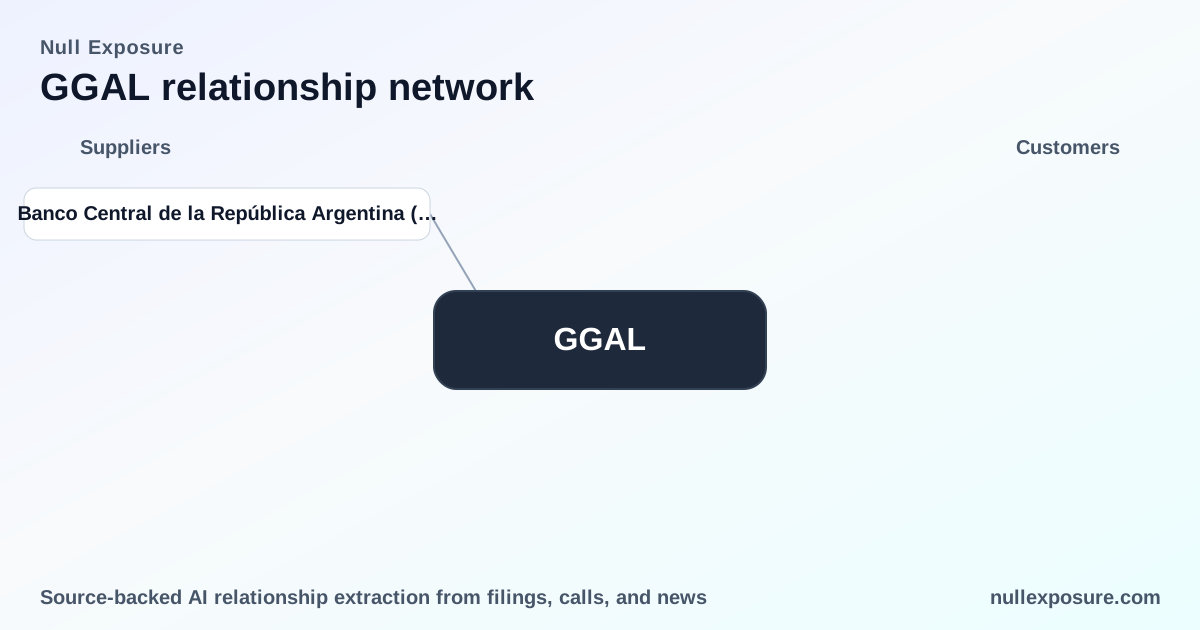
Relationship: Banco Central de la República Argentina (BCRA)
Grupo Financiero Galicia paid almost ARS 29,000 million to the BCRA in FY2026 in connection with a case alleging manipulation of financial puts that the central bank issued against government bond purchases by banks, according to Bloomberg Línea (March 2026). This transaction signals heightened regulatory enforcement risk and direct financial interaction with Argentina’s monetary authority. (Source: Bloomberg Línea, 2026-03-09)
What the lack of supplier constraints in the record reveals
The feed that produced this supplier relationship did not return any discrete supplier-constraint excerpts tied to specific vendors or contracts. That absence itself is informative: no external, catalogue-style supplier restrictions are flagged publicly in this dataset, so counterparty diligence must rely on company filings, regulatory disclosures, and news flow rather than a precompiled constraints registry.
Company-level signals that flow from that absence and from Galicia’s public profile:
- Contracting posture — regulator-dependent: As a regulated bank, Galicia operates under direct central-bank oversight; regulatory settlements and liquidity interventions are core strategic considerations rather than peripheral supplier issues.
- Concentration — country risk dominates: The business generates the bulk of activity in Argentina; supplier, funding and counterparty risk concentrate in a single jurisdiction with recurrent FX and regulatory volatility.
- Criticality — systemically relevant to local markets: Galicia is a major domestic player; shocks to its balance sheet or reputation have outsized local market implications for suppliers and correspondent banks.
- Maturity — established listed franchise: The company trades as an ADR on NASDAQ with market capitalization around USD 6.65 billion (latest public profile) and public analyst coverage, indicating institutional access and a mature capital-market profile.
These company-level signals should guide supplier negotiations and operational SLAs: price in regulatory friction, demand stronger liquidity covenants, and require clear dispute-resolution clauses tied to domestic legal outcomes. (Source: company public profile and market data; latest quarter 2025-12-31.)
For structured supplier-risk reports and continuous monitoring, see https://nullexposure.com/.
Financial and operational implications for investors and operators
The BCRA settlement is a clear example of a non-commercial counterparty event that has immediate balance-sheet and reputational effects:
- Capital and liquidity impact: A near-ARS 29,000 million outflow affects short-term liquidity and could force adjustments in treasury operations, funding tenor, or the use of central-bank instruments.
- Counterparty confidence: Suppliers, correspondent banks, and insurance partners will re-evaluate credit lines and settlement terms given increased regulatory scrutiny. Operational counterparties should require higher pre-funding, stricter netting, or shorter payment cycles.
- Valuation context: Public metrics show a trailing P/E of 55.22 and forward P/E of 3.31, a spread that reflects shifting earnings expectations and market pricing of near-term vs. longer-term profitability; such valuation dispersion matters for counterparties assessing credit exposure. (Source: company market data, latest quarter 2025-12-31.)
Practical steps for suppliers, vendors and operators
- Negotiate explicit remedies and liquidity covenants that trigger on regulatory settlements or sudden balance-sheet deterioration.
- Require operational transparency: more frequent covenant reporting, access to stress-test outputs, and notification windows for central-bank interactions.
- Re-assess concentration limits: reduce reliance on single-country clearing and consider multi-jurisdictional routing for critical services.
Bottom line and recommended next moves
The BCRA settlement is a structural signal that Grupo Financiero Galicia operates with elevated regulatory counterparty risk, and commercial counterparties must recalibrate contractual terms and liquidity controls accordingly. For investors and service operators, the practical response is simple: tighten credit and operational terms, demand better transparency, and price in Argentina-specific regulatory volatility.
For tailored supplier-risk assessments and to see how this payment reshapes counterparty exposure maps, visit https://nullexposure.com/.
Concluding thought: Galicia’s established franchise and NASDAQ listing provide avenues for capital and restructuring, but the BCRA interaction converts regulatory exposure into an immediate supplier- and counterparty-management problem — one that requires contractual discipline and active monitoring.