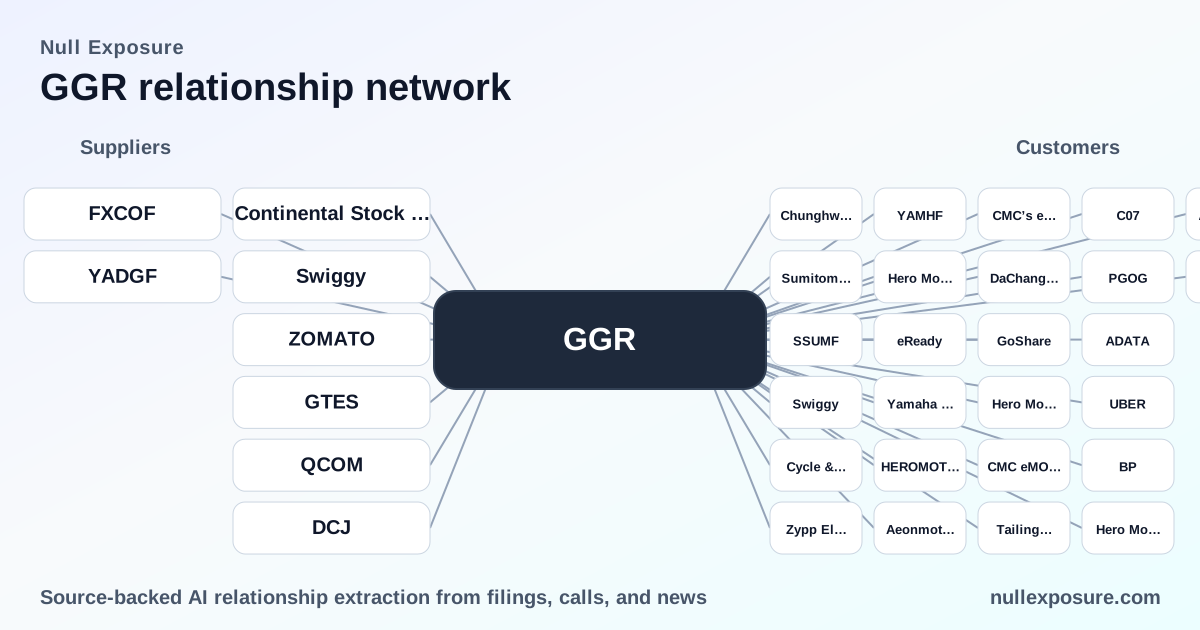
Gogoro (GGR): supplier relationships that shape platform reach and execution risk
Gogoro builds and monetizes a two-sided micromobility platform: it manufactures electric scooters and key components while operating a battery-swapping network and licensing platform technologies to OEMs and fleet operators. Revenue comes from unit sales of scooters and components, recurring access to battery-swapping services, and strategic partnerships that extend Gogoro’s platform into third‑party fleets and manufacturing arrangements. Investors evaluating supplier and partner counterparty risk should treat Gogoro as a platform company whose commercial progress depends as much on partner execution as on unit economics.
Explore more supplier intelligence at https://nullexposure.com/.
How Gogoro makes money and what that implies for partnerships
Gogoro’s operating model blends hardware sales with ongoing network services. The company sells scooters and parts, deploys battery-swapping infrastructure, and partners with manufacturers and delivery platforms to scale usage. That hybrid model creates mixed contracting postures: fixed manufacturing relationships for components and flexible commercial agreements for access to the swap network. Company-level signals reinforce the strategic picture:
- Gogoro’s latest reported revenue is $281.48M TTM with negative profitability metrics (Profit Margin: -28.7%; Operating Margin TTM: -27.1%), indicating the business is still scaling and reliant on partner-led growth to improve unit economics.
- Market capitalization of ~$53.9M and high insider ownership (42.9%) with low institutional ownership (10.1%) suggest concentrated control and potential valuation volatility around contract announcements and delivery milestones.
- Platform criticality is high: partners that adopt Gogoro’s swapping and tech create recurring service revenue; conversely, manufacturing or distribution disruptions with key partners would directly affect revenue ramp.
These characteristics produce a contracting posture that is a mix of long-term OEM or license deals and shorter commercial fleet arrangements. For a buyer or supplier evaluating GGR, prioritize contract structure, revenue share terms, and swap-station commitments when modeling cash flow sensitivity.
The partner map — relationship-by-relationship notes
Below I cover every relationship surfaced in the supplier-scope results and what each implies for Gogoro’s commercial footprint.
Continental Stock Transfer & Trust Company
Continental Stock Transfer is acting as transfer and exchange agent for Gogoro’s 1‑for‑20 share consolidation, signaling a corporate action affecting share structure and liquidity. According to a Futunn news post, Continental is the transfer agent for the consolidation announced in FY2025 (news.futunn.com, Mar 2026).
Source: https://news.futunn.com/en/post/62164156/gogoro-announces-1-for-20-share-consolidation
Swiggy
Gogoro contracted to supply electric scooters and battery‑swapping services to Swiggy’s delivery riders in India, representing a direct channel into large delivery fleets and urban last‑mile logistics. Carandbike reported this partnership as part of Gogoro’s India strategy in FY2023 (carandbike.com, reported 2026).
Source: https://www.carandbike.com/news/gogoro-partners-with-swiggy-for-delivery-fleet-service-in-india-3208735
Zomato
Gogoro supplied electric two‑wheelers for Zomato’s last‑mile deliveries, extending the company’s footprint among large Indian food‑delivery platforms and reinforcing the fleet use case for swapping services. This was noted alongside other India partnerships in Carandbike coverage for FY2023 (carandbike.com, reported 2026).
Source: https://www.carandbike.com/news/gogoro-partners-with-swiggy-for-delivery-fleet-service-in-india-3208735
Gates
Gogoro’s VIVA MIX Smartscooter uses a Gates carbon fiber belt as part of the FLO DRIVE system, highlighting component-level supplier integration for drivetrain efficiency and durability. The company highlighted that hardware design decision on the VIVA MIX page in FY2021 (gogoro.com, product news).
Source: https://www.gogoro.com/news/viva-mix-smartscooter/
Qualcomm Technologies, Inc.
Gogoro’s flagship Smartscooter incorporates Qualcomm’s Snapdragon Digital Chassis QWM2290 SoC, signaling reliance on a tier‑one chip supplier for advanced connectivity and vehicle computing functions; Qualcomm executives commented on the product in FY2024 (gogoro.com news, FY2024).
Source: https://www.gogoro.com/news/gogoro-pulse/
DCJ
Gogoro worked with DCJ as part of expansion efforts into China, indicating collaboration on regional market entry and possibly local distribution or co‑development activity reported in FY2021. Electrive captured the company’s China expansion plans mentioning DCJ (electrive.com, Sep 2021).
Source: https://www.electrive.com/2021/09/20/gogoro-to-become-publically-listed-and-expand/
Foxconn
Gogoro announced a teaming arrangement with Foxconn for manufacturing and broader strategic collaboration, which frames Foxconn as a high‑capacity contract manufacturing partner noted during expansion commentary in FY2021. Electrive documented the Foxconn relationship as part of Gogoro’s growth plans (electrive.com, Sep 2021).
Source: https://www.electrive.com/2021/09/20/gogoro-to-become-publically-listed-and-expand/
Yadea
Gogoro’s China expansion referenced partnerships with Yadea, indicating OEM cooperation or market access alliances in FY2021 as part of a regional rollout strategy covered by Electrive (electrive.com, Sep 2021).
Source: https://www.electrive.com/2021/09/20/gogoro-to-become-publically-listed-and-expand/
What these relationships mean for operating risk and concentration
Collectively, these partnerships reflect a dual-path growth strategy: direct B2C hardware sales and B2B platform deployment via fleets and OEMs. Key operating implications:
- Critical supplier dependency exists on manufacturing and components suppliers (e.g., Foxconn, Gates, Qualcomm) for product availability and feature parity.
- Commercial concentration risk arises from reliance on large fleet partners in target markets; loss or slowdown in adoption among Swiggy/Zomato-sized fleets would compress the expected recurring revenue base.
- Maturity mismatch: hardware manufacturing cycles and long lead times contrast with the faster commercial cycles of fleet rollouts, creating timing risk between capital deployment for swap stations and revenue realization.
If you are modeling covenant or supplier exposure, treat partnerships as operationally critical and subject to milestone-based triggers for revenue recognition and capital deployment. For deeper supplier insight, visit https://nullexposure.com/.
Practical diligence steps for investors
Investors evaluating GGR supplier exposure should prioritize verifiable items and contractual levers:
- Review disclosed revenue splits and any footnoted partner revenue recognition language in filings.
- Obtain clarity on manufacturing capacity and lead times with Foxconn or other contract manufacturers.
- Confirm swap‑station rollout commitments and revenue-share economics for fleet partners like Swiggy and Zomato.
- Watch insider and institutional ownership flows as a signal of control and potential strategic decisions.
For ongoing monitoring of supplier relationships and contract events, check https://nullexposure.com/ for updates.
Gogoro’s partner roster positions it for platform scale if execution holds, but contract structure, manufacturing reliability, and fleet adoption are the triad that determines financial outcomes. Complete due diligence on those three vectors before updating valuation assumptions.