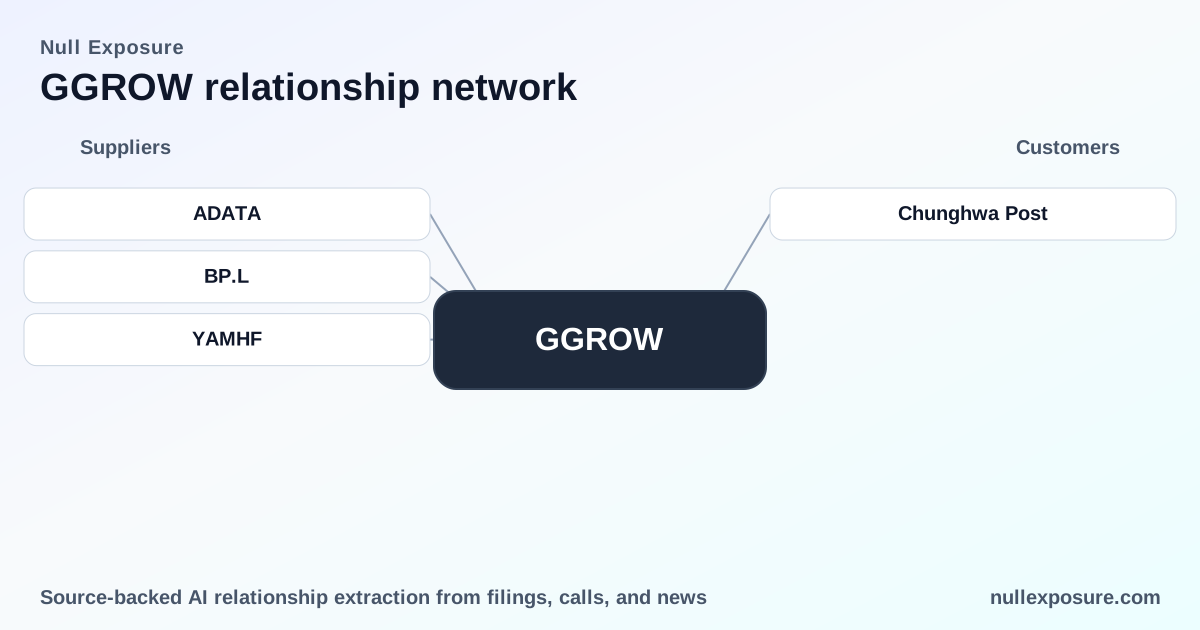
Gogoro (GGROW) supplier map: what investors should price into growth and risk
Gogoro operates a hardware-plus-platform model built around electric scooters and the battery-swapping ecosystem, monetizing through scooter and component sales, network services for battery swapping, and strategic OEM and commercial partnerships that license its electrification technology and expand distribution. The company’s commercial strategy converts product engineering into recurring value by embedding its battery-swapping standard in partner fleets and OEM models, while pilots and co-branded programs extend market access and after-sales channels. For investors, the key valuation levers are partner-led scale, diversification of revenue streams (hardware versus network/service/license), and the degree to which supplier and partner relationships are contractual and enduring.
Discover more supplier intelligence at https://nullexposure.com/.
How Gogoro contracts with partners and why that matters
Gogoro’s commercial posture is platform-centric: the company sells hardware while simultaneously licensing its swapping standard and collaborating with OEMs and ecosystem players to scale network effects. That posture produces several firm-level signals relevant to underwriting supplier risk:
- Contracting posture: Gogoro operates through strategic, relationship-driven agreements rather than spot procurement, which implies longer negotiation cycles but higher switching costs for partners and stronger lock-in for battery standard adoption.
- Concentration: Public disclosures show a small set of named partners highlighted in growth narratives, creating concentration risk if any one partner delays rollouts or changes strategy.
- Criticality: Key suppliers and partners are critical to go-to-market execution—OEMs validate technology and logistics partners deliver scale—making supplier continuity a determinant of deployment tempo.
- Maturity: Partnerships range from pilots (early commercialization) to full OEM product launches, indicating a mix of pilot-stage risk and nascent production-scale maturity across the partner base.
These company-level constraints signal that investors should underwrite Gogoro as a platform business whose commercial fate is tightly linked to partner execution rather than purely internal manufacturing metrics.
Supplier relationships called out in the latest earnings call
ADATA — logistics and heavy-duty three-wheelers gaining traction
Gogoro referenced ADATA’s heavy-duty three-wheelers scaling quickly with leading logistics platforms, signaling an enterprise-focused channel for Gogoro technology outside passenger scooters. According to Gogoro’s 2025 Q4 earnings call (reported March 2026), this relationship highlights commercial adoption in logistics fleets and B2B use cases. (Source: Gogoro 2025 Q4 earnings call, March 2026)
Castrol — a pilot program in Vietnam with a strategic local leader
Gogoro disclosed it is initiating a pilot program in Vietnam with Castrol, indicating collaboration with a major energy/oil brand to support local market entries or aftersales ecosystems. According to the 2025 Q4 earnings call, the Castrol pilot in Vietnam serves as a strategic, market-level partner for localization and potentially for service or lubricant channel synergies. (Source: Gogoro 2025 Q4 earnings call, March 2026)
Yamaha — OEM validation and product traction with CuxiE
Gogoro emphasized that partners in its PBGN continue to select Gogoro technology, noting Yamaha’s CuxiE launched in Q3 and gained substantial market traction, which functions as a high-quality OEM endorsement. The 2025 Q4 earnings call frames Yamaha as a primary electrification strategy partner whose product success validates Gogoro’s platform economics and supports scale. (Source: Gogoro 2025 Q4 earnings call, March 2026)
What these relationships imply for revenue mix and execution risk
The three named relationships illustrate Gogoro’s multi-channel commercial strategy: logistics fleet adoption via ADATA, localized pilot expansion via Castrol, and traditional OEM validation via Yamaha. Together they create diversified demand pathways—but also distinct operational requirements:
- OEM relationships (Yamaha) are high-impact and scale-enabling, because successful OEM launches translate to meaningful unit volumes and standard adoption across markets.
- Logistics and commercial vehicle partnerships (ADATA) accelerate utilization and recurring service needs for swapping networks, pushing revenue from one-off hardware to recurring service and station economics.
- Strategic pilots with incumbents (Castrol) reduce local entry friction and provide aftermarket distribution but are inherently pilot-stage and require conversion to larger programs to materially contribute to revenue.
Financials through the latest reported period show Revenue TTM of $281.48M and a negative operating margin (~-27%), underlining that partner-led growth must accelerate gross volume and improve operating leverage to reach sustainable profitability. Investors should price in the time required to convert pilots into scaled programs and OEM launches into steady production contracts.
Explore deeper supplier analytics at https://nullexposure.com/.
Key risk vectors and what to watch next
- Partner concentration: The company spotlights a small number of strategic relationships; disruption or slower-than-expected rollouts at a single anchor partner could materially slow network effects and unit growth.
- Execution cadence: Pilots (Castrol) and logistics scale (ADATA) require operational integration and capital deployment for swapping infrastructure; investors should monitor conversion rates from pilot to commercial deployment.
- OEM dependence: OEM endorsements like Yamaha’s CuxiE are high-leverage—market traction must translate into durable production and recurring revenue to justify associated investment.
- Margin recovery: With an operating margin around -27%, Gogoro’s path to profitability depends on scaling partner volumes and improving the mix toward higher-margin services and licensing.
Bottom line: how to think about investment exposure
Gogoro’s supplier and partner set demonstrates a credible pathway to diversified, partner-driven scale anchored by OEM validation and commercial fleet adoption. For investors, the calculus is simple: value accrues as Gogoro converts pilots into scale and OEM launches into repeatable production; downside sits with partner execution and the speed of infrastructure rollouts. Monitor the conversion timeline for Castrol pilots, actual fleet deployments with ADATA, and sustained sales momentum for Yamaha’s CuxiE.
If supplier continuity, pilot conversion, and OEM volume growth proceed as the company outlines, Gogoro’s platform lever will materially de-risk its path to operating leverage. For a full supplier intelligence view and ongoing monitoring of these relationships, visit https://nullexposure.com/.
Bold takeaway: Gogoro’s strategy is partner-centric—valuation depends on partner execution converting pilots and OEM launches into scale, not on discrete product announcements alone.