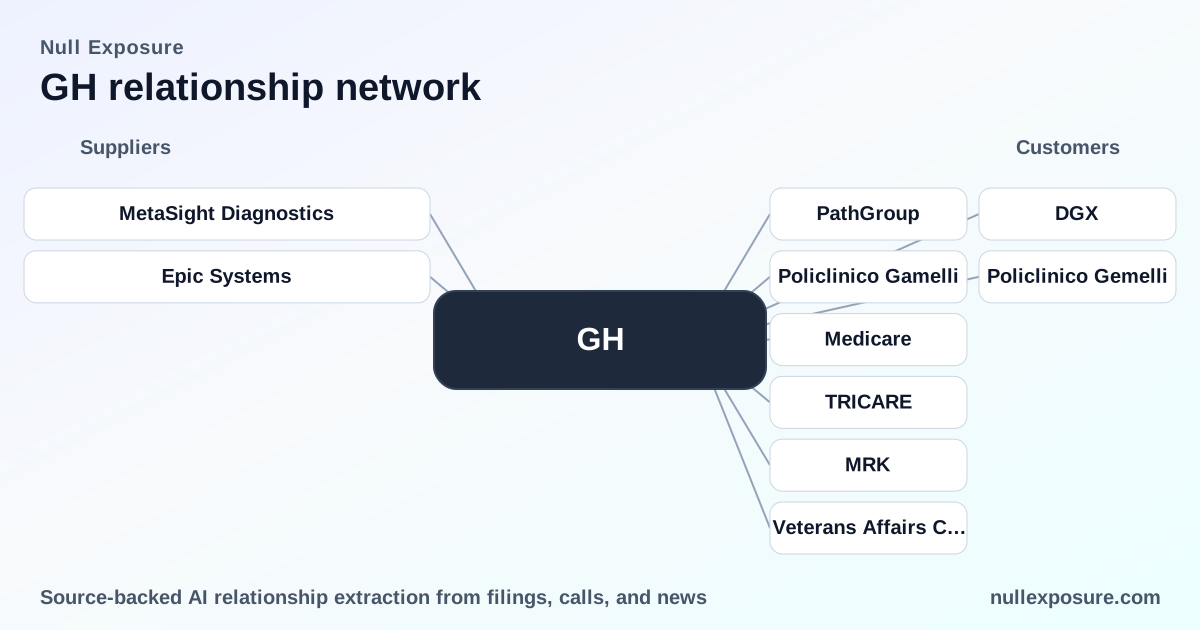
Guardant Health (GH): Supplier relationships that shape execution risk and growth optionality
Guardant Health operates a precision-oncology testing business that monetizes primarily through high-margin laboratory testing and associated clinical data services sold to providers, payers, and biopharma partners. The company scales revenue by expanding test volume and embedding its assays into clinical workflows and electronic health records, while selectively bolt‑on M&A to broaden technology and early‑detection capabilities. Revenue is driven by recurring test throughput, strategic integration with clinical systems, and targeted acquisitions that accelerate product roadmaps. For investor due diligence on supplier exposure and partner risk, Guardant’s supplier posture combines long-term purchasing commitments with operational dependence on a small set of upstream vendors and third‑party service providers. For deeper supplier analytics and relationship mapping, see https://nullexposure.com/.
Market activity in early FY2026 has two transactional headlines that shift the supplier and integration landscape: a completed acquisition that expands Guardant’s technology base, and an EHR integration that broadens clinical access. Below I parse each relationship in the public record, then synthesize constraints and investment implications.
MetaSight Diagnostics: acquisition accelerates early-detection capabilities
Guardant completed the acquisition of MetaSight Diagnostics on February 23, FY2026, adding next‑generation liquid biopsy technology aimed at early disease detection. This is an inorganic pathway to broaden Guardant’s product set and accelerate commercialization of earlier‑stage screening tests. According to Finviz reporting on March 9, 2026, Guardant finalized the transaction; Simply Wall St also noted the deal as a strategic move into early detection in FY2026. (Sources: Finviz, March 9, 2026; Simply Wall St, FY2026 reporting.)
Epic Systems: EHR integration to increase clinical access and test ordering
Epic Systems announced a partnership with Guardant to support an Epic EHR integration that streamlines patient access to cancer screening and test ordering, embedding Guardant’s workflows into provider systems. Clinical integration with Epic materially reduces friction for ordering and sample routing, directly supporting volume growth and revenue predictability. TechTarget covered the Epic announcement on March 9, 2026, describing the integration as a step to enhance patient access to cancer screening via the Epic EHR. (Source: TechTarget, March 9, 2026.)
What the relationship list collectively signals to investors
Taken together, Guardant’s FY2026 relationship activity displays a two‑pronged commercial and operational playbook: expand product breadth through targeted M&A while hard‑wiring distribution via major EHR partners. The MetaSight acquisition is a capability play; the Epic integration is a distribution play. Both are consistent with a company seeking to convert technological differentiation into durable, routinized test volume.
If you are tracking supplier concentration and partner risk across Guardant’s ecosystem, explore supplier profiles and documentation at https://nullexposure.com/ for structured vendor intelligence.
Operating constraints and supply posture — company-level signals and a named contract
Guardant’s public filings and evidence excerpts reveal a supplier model with these definitive characteristics:
- Contracting posture: Guardant holds long‑term supply agreements with key vendors. The 2014 Supply Agreement with Illumina and successive amendments through 2021 demonstrate multi‑year procurement commitments and an established buyer role. This agreement establishes an entrenched purchasing relationship with Illumina (evidence: Supply Agreement dated September 15, 2014 and Amendment #5 dated January 1, 2021).
- Concentration and criticality: The company is materially dependent on a limited number of suppliers and third‑party logistics and collection partners. Filings note that courier services, sole suppliers for laboratory instruments, and constrained reagent sources are critical to laboratory uptime and revenue continuity.
- Service dependency and maturity: Guardant relies on third‑party phlebotomy providers, including physician offices, for sample collection—a service relationship that is active and operationally central to throughput. The company’s vendor relationships are operationally mature but concentrated, which raises switching costs and transition risk.
- Role complexity: Evidence classifies Guardant as both a buyer of critical lab instruments and reagents and as a purchaser of services (phlebotomy and logistics), while also depending on manufacturers for specialized reagents that would require re‑qualification if sourced elsewhere.
These constraints translate into measurable execution risks: disruptions in courier networks, failure of a sole‑source instrument, or delays in reagent qualification would have an outsized and immediate impact on throughput and revenue. For active monitoring of those supplier dependencies, see https://nullexposure.com/.
Relationship-by-relationship implications for operations and valuation
- MetaSight Diagnostics: The acquisition broadens Guardant’s testing technology into earlier detection, increasing addressable market and future revenue optionality while also adding integration and validation tasks that consume cash and management attention. (Sources: Finviz, March 9, 2026; Simply Wall St, FY2026 reporting.)
- Epic Systems: Embedding Guardant’s ordering and results into Epic reduces clinician friction and supports sustainable volume growth; this integration is strategically important given Epic’s scale in U.S. health systems. (Source: TechTarget, March 9, 2026.)
Investment implications — what to watch next
- Revenue leverage vs. operational fragility. The combination of clinical integration (Epic) and new product tech (MetaSight) supports upside to throughput and reimbursement capture, but upside is gated by the company’s concentrated supplier base and logistics dependencies. Monitor courier performance, reagent supply notices, and instrument uptime disclosures in quarterly filings.
- Integration risk and cadence. M&A and EHR integrations require execution discipline; investors should track commercialization milestones for MetaSight technology and the rollout cadence within Epic‑enabled systems.
- Capital allocation and margins. Guardant’s balance between R&D/M&A spend and scaling laboratory margins will determine when revenue growth translates into sustained profitability. Watch gross margin trends and operating leverage in quarterly updates.
For a vendor‑level view of these supplier relationships and to map counterparty concentration against Guardant’s operating metrics, visit https://nullexposure.com/ and review supplier intelligence curated for investors.
Final takeaways
Guardant Health is executing a classic scale strategy for diagnostics: extend product capability through targeted acquisitions while embedding workflows in EHRs to capture recurring test volume. The upside is clear—expanded addressable market and routinized order flow—while the principal risk is concentrated supplier and logistics exposure that can abruptly curtail throughput. Investors should weigh integration milestones and supply‑chain resilience equally when forecasting GH’s path to durable profitability.
If you want a structured vendor-risk profile for Guardant and comparable diagnostics suppliers, start your review at https://nullexposure.com/.