GreenTree Hospitality (GHG): Supplier relationships, operating posture, and what investors need to price
GreenTree Hospitality Group Ltd (NYSE: GHG) builds, franchises, manages and sells hotels across China under the GreenTree brand and monetizes through a mix of leased-and-operated assets, franchising fees, management contracts and room revenues. With roughly $1.25B trailing revenue, EBITDA of $274M and an EV/EBITDA under 3, GreenTree combines capital-light franchising scale with a material owned/leased footprint that drives recurring cash flow and margin leverage. For investors and operator-partners, the key questions are control and concentration (high insider ownership constrains float), counterparty criticality (mixed asset models create heterogeneous supplier needs), and the maturity of distribution and IR relationships that shape market access and perception. For an organized view of counterparties and governance signals, visit https://nullexposure.com/.
The business model in plain terms — why structure matters to counterparties
GreenTree operates a hybrid model: asset-backed leased & operated hotels coexist with asset-light franchised and managed properties. That mix produces predictable room-level revenue where GreenTree operates properties directly, and high-margin, scalable fee income where it franchises or manages. Company-level signals are revealing: insiders own ~85% of outstanding stock while institutions hold ~11%, a governance posture that concentrates control and reduces public float liquidity. Financial ratios — P/E ~7.5, Price/Book ~0.52 and a modest beta (~0.61) — portray a low-risk valuation profile relative to growth, but the business still carries lodging cyclicality and regional exposure to China.
No explicit procurement or supplier constraints were surfaced in the relationship records, so the operating-model assessment above is a company-level signal derived from filings and disclosed metrics rather than constraint excerpts.
Visit https://nullexposure.com/ to benchmark GreenTree against peer supplier profiles and counterparty risk frameworks.
What the disclosed relationships actually are — every relationship in the record
This section lists every relationship referenced in available coverage and what each means for investors and operators.
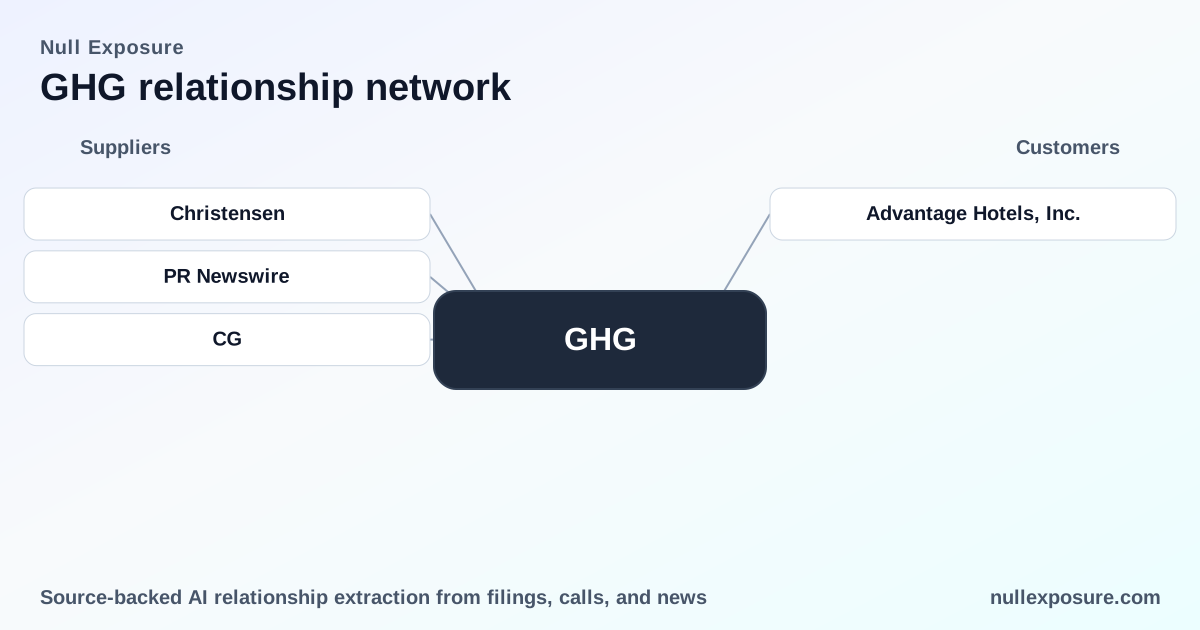
Christensen — investor relations engagement
GreenTree lists Christensen as its investor relations firm; a transcript of a GreenTree earnings call notes “Mr. Rene Vanguestaine of Christensen, GreenTree’s Investor Relations firm.” That confirms an outsourced IR relationship supporting earnings distribution and investor access. (Source: InsiderMonkey transcript of GreenTree’s Q2 2023 earnings call.)
PR Newswire — distribution channel for disclosures
GreenTree’s earnings releases are distributed publicly and “available on our IR website… as well as on PR Newswire services,” indicating the company uses mainstream press-distribution to reach institutional and retail audiences and to satisfy disclosure protocols. This is a standard, low-friction channel for external communications. (Source: InsiderMonkey transcript noting release distribution via PR Newswire and ir.998.com.)
Carlyle Group — historical strategic interest (2015)
A 2015 report recorded GreenTree pursuing a potential bid for an 80% stake in a French hotel brand then held by the Carlyle Group, suggesting prior outbound M&A ambition and willingness to pursue cross-border consolidation. This is a historical strategic data point rather than an ongoing supplier or partner agreement, but it illustrates early growth aspirations and potential appetite for asset acquisitions. (Source: Mingtiandi report on GreenTree’s 2015 interest in a Carlyle-held French hotel chain.)
How those relationships influence contract posture and execution
These relationships are predominantly communications and strategic-interest touchpoints rather than operational supply contracts. Investor relations via Christensen and distribution through PR Newswire are governance and disclosure instruments that improve market transparency and can reduce perception risk, which is material given GreenTree’s concentrated insider ownership. The Carlyle mention is a past M&A signal that indicates management’s strategic flexibility but does not imply a recurring counterparty dependency.
For operators and service suppliers negotiating with GreenTree, expect:
- Centralized decision-making driven by a tight insider base, which accelerates approvals but can compress negotiating power for external partners.
- Mixed contracting needs: franchise and management agreements will emphasize brand standards and revenue shares, while leased-and-operated properties will require commercial lease and operations contracts with different risk allocations.
- Public disclosure discipline through mainstream channels, reducing informational asymmetry for counterparties who monitor PR distributions and earnings calls.
Risk vectors investors should price now
- Governance concentration: Insider ownership near 85% constrains float, elevates the importance of related-party and insider-aligned strategic decisions.
- Operational heterogeneity: The hybrid asset model reduces single-point supplier risk but increases contract variation and administrative complexity. Expect variable counterparty criticality across owned vs. franchised hotels.
- Market perception and liquidity: Limited institutional ownership and a small free float can widen bid-ask spreads and amplify price moves on news events that IR distributes via PR channels.
Financial data reinforce a conservative valuation stance: strong trailing margins (operating margin ~15.6%) and a low EV/EBITDA make GreenTree attractive on current cash-flow metrics, but cyclical revenue trends and concentrated governance require active monitoring.
Practical guidance for investors and operators
- Operators: negotiate clear termination and fee structures that reflect whether a property is managed/franchised or leased/operated; the contracting posture will differ materially.
- Investors: discount for governance concentration and float risk despite attractive operating margins; monitor PR and earnings-distribution channels for early signals of strategic shifts.
- Both groups: use IR touchpoints — the Christensen relationship and PR Newswire distribution are the primary channels to verify guidance and disclosures in real time.
For a concise, comparable analysis of GreenTree’s counterparties and supplier risk map, explore the coverage at https://nullexposure.com/.
Bottom line — risk-adjusted opportunity
GreenTree trades at conservative valuation multiples against solid trailing profitability and uses a hybrid model that balances growth scalability with owned-asset cash flows. Key investor takeaways: governance concentration is the primary non-operational risk; IR and disclosure channels are functional and public; historical M&A activity underscores strategic flexibility. Pricing should reflect operational resilience and the potential liquidity constraints embedded in the shareholder structure.
If you want a structured counterparty-risk assessment tailored to GreenTree’s supplier relationships and contracting posture, start here: https://nullexposure.com/.