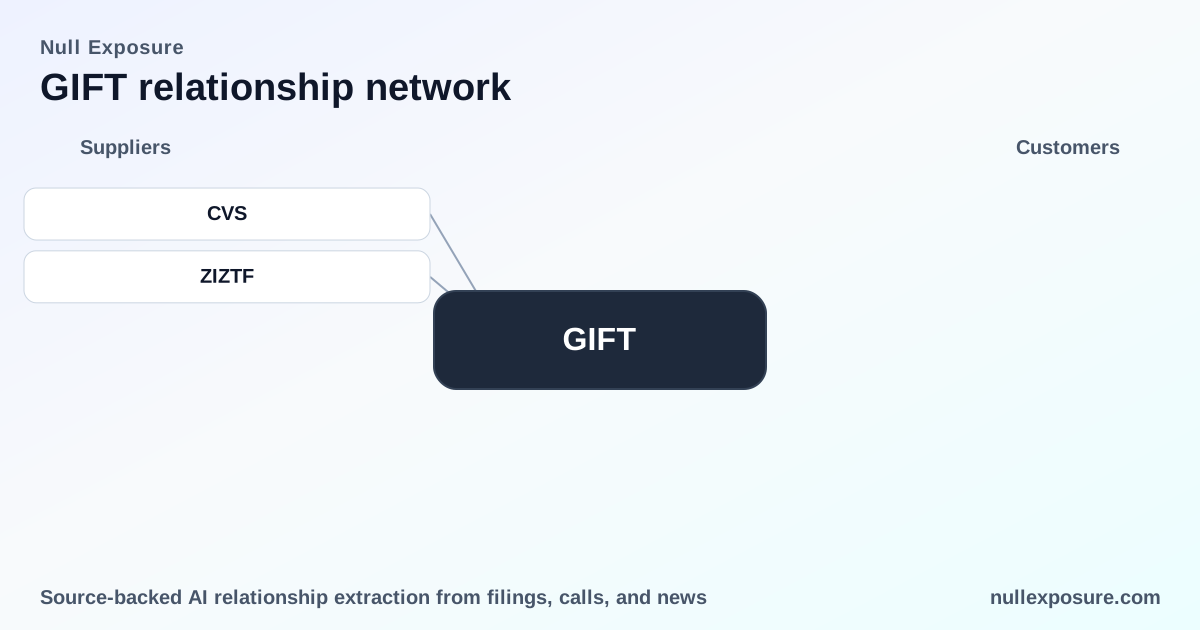
GIFT supplier relationships: what investors should know
RDE, Inc. (ticker GIFT) operates a U.S.-focused restaurant deals platform and supports supplementary commerce through a gift-card and payments business branded as Giftify; the company monetizes through merchant listing and marketing fees, gross margin on discounted gift cards and payment-facilitation relationships with retail partners and BNPL providers. For investors assessing supplier counterparty risk and commercial runway, the critical questions are whether these relationships scale distribution, diversify payment rails, and create durable spreads on gift-card inventory.
Explore the supplier map and implications on the company homepage: https://nullexposure.com/
Two supplier relationships that change distribution and payments
GIFT’s publicly visible supplier relationships concentrate on retail distribution and payment-engine partnerships. Both relationships reinforce the company’s strategy to turn gift-card liquidity into consumer-facing revenue and payment options.
CVS — large retail distribution for gift-card exchange
Giftify powers the CVS Gift Card Exchange, giving Giftify access to a national retail footprint and consumer traffic through CVS locations and online channels. According to a GlobeNewswire announcement aggregated on Finviz in March 2026, Giftify is the technology provider behind CVS’s gift-card exchange (FY2024), which positions Giftify as a merchant-facing supplier to one of the largest U.S. retail pharmacy chains. (Source: Finviz/GlobeNewswire, March 2026)
Zip Co — BNPL integration to expand payment choices
Giftify has tapped Zip Co to offer buy-now-pay-later (BNPL) options as part of its growth strategy, turning flexible payment rails into a customer acquisition and conversion lever. A Born2Invest report described the partnership as a deliberate move to make BNPL a major growth catalyst (reported in March 2026 with reference to FY2023 activity). (Source: Born2Invest, March 2026)
How these supplier ties fit into the operating model
These two relationships map to clear go-to-market vectors: retail distribution via CVS, and payment innovation via Zip Co. Together they address demand (consumer access to discounted cards), fulfillment (exchange and resale logistics), and conversion (BNPL to increase purchase frequency).
- Distribution scale: A national retail partner like CVS delivers reach and validation that is otherwise expensive for a niche vendor to replicate. That relationship increases constructible volume and reduces customer-acquisition cost per transaction if execution and economics hold.
- Payment architecture: Integrating BNPL through Zip Co broadens payment choices and can lift average order values, but it also shifts receivable and fraud dynamics onto third-party providers and requires tight reconciliation and fee management.
Company-level constraints that shape supplier risk and maturity
Several operating constraints and line-item spend signals from company filings create a picture of how mature and committed GIFT is to scaling supplier operations:
- The company’s corporate lease was executed in April 2023 for 36 months at average base rent ~$7,500 per month, indicating a multi-year fixed cost commitment and a modest physical footprint (7,850 sq. ft). This lease establishes a medium-term contracting posture and a baseline fixed-cost that sales must exceed to reach operating leverage. (Source: company filing, lease disclosure)
- Procurement and counterparty activity include repeated interaction with individual sellers of merchant gift cards; the company buys cards from the public and distributors at a discount and resells them at a markup, highlighting a mixed sourcing model that balances inventory flexibility and margin pressure. Filings describe CardCash-style purchase behavior and resale economics. (Source: company disclosure)
- The filing shows audit fees of $315,006 and smaller service fees (other fees ~$34,295 and tax fees ~$30,468), which place third-party professional services in the sub-$1m annual spend band but significant enough to indicate a governance and compliance ramp in place. These spend lines point to a company beyond the earliest startup phase but still managing relatively modest vendor budgets. (Source: company filing)
Taken together, these signals show moderate maturity: GIFT operates with contracted fixed overhead, relies on mixed sourcing of inventory from individuals and distributors, and budgets conservatively for compliance and advisory services. Those characteristics reduce near-term vendor churn risk but limit the company’s bargaining power with very large suppliers.
Financial context and supplier criticality
Investors should weigh supplier relationships against the company’s financial posture. Market capitalization is ~ $27.2M, and trailing metrics show negative profitability (TTM operating margin ≈ -13.2%, profit margin ≈ -14%). Revenue TTM is $86.1M with gross profit of $13.8M, indicating thin gross margins relative to revenue and reliance on volume to reach positive operating leverage. (Source: company financials)
- Supplier criticality: Partnerships that provide distribution or payment rails—like CVS and Zip Co—are strategically critical because they materially affect revenue growth and volume throughput. Loss of a retail distribution channel would compress sales quickly given modest market cap and operating losses.
- Concentration and counterparty risk: The company’s sourcing model includes purchases from individuals and distributors; that reduces supplier concentration but increases operational complexity (fraud detection, authentication, and margin variability). Governance and audit spend suggest the company recognizes these operational risks and budgets accordingly.
Explore supplier exposure analysis and risk dashboards at https://nullexposure.com/
Investment implications and near-term watch list
- Growth levers: Convert CVS distribution into predictable, higher-frequency volumes and scale BNPL-enabled purchases through Zip Co to raise ticket size and reduce churn. Both levers accelerate cash throughput and improve gross-margin realization.
- Operational focus: Tighten reconciliation and fraud controls for individual-sourced gift-card inventory; failures here will hit margins rapidly. The company-level evidence for audit and tax spend indicates management is already investing in controls.
- Balance-sheet risk: With negative operating margins and modest market cap, the company must extract clear margin improvement from supplier relationships to avoid dilution or emergency financing.
Final take: supplier relationships with CVS and Zip Co are strategically material—they provide distribution scale and payment flexibility but require disciplined execution on sourcing, controls, and margin capture to convert into durable shareholder value.
If you want a concise supplier risk memorandum or a comparative supplier scorecard, start here: https://nullexposure.com/
Actionables for managers and investors:
- Validate contractual exclusivity and revenue share terms with CVS to understand retention economics.
- Review BNPL receivable treatment with Zip Co to quantify fees, fraud exposure, and net revenue impact.
- Reconcile audit and professional services commitments into the operating budget to assess runway.
For a deeper supplier relationship audit and exposure modeling, visit https://nullexposure.com/ and request the supplier analysis kit.