GigCapital7 (GIG): Sponsor-funded SPAC with short-term supplier commitments — what operators and investors need to know
GigCapital7 is a SPAC that monetizes through an initial public offering and a subsequent business combination: it raises capital in a trust, lists on Nasdaq, and seeks a target company to merge with, with ultimate value creation coming from a successful de-SPAC transaction. The company carries no operating revenue today, relies on sponsor financing for near-term operations, and runs a predictable set of administrative supplier relationships that are short-term and transactional. For commercial teams evaluating exposure or counterparties, this is a liquidity-and-timing play rather than a vendor relationship with operational scale. For detailed supplier intelligence, visit https://nullexposure.com/.
What GigCapital7 is, in plain financial terms
GigCapital7 is a classic SPAC vehicle: no revenue, no EBITDA, negative EPS, and a market capitalization driven by sponsor and investor expectations about a future business combination. Key facts: Market Cap ~$354.3M, Revenue TTM = $0, EPS (diluted) = -0.162, Fiscal year end December, and NASDAQ listing. Insiders hold 51.036% of shares while institutions account for 88.890% of reported holdings — a shareholder base that is unusually concentrated and active in governance and deal approval. These metrics frame the commercial counterparties’ posture: vendors are paid to maintain the shell and support the deal process rather than to scale operations.
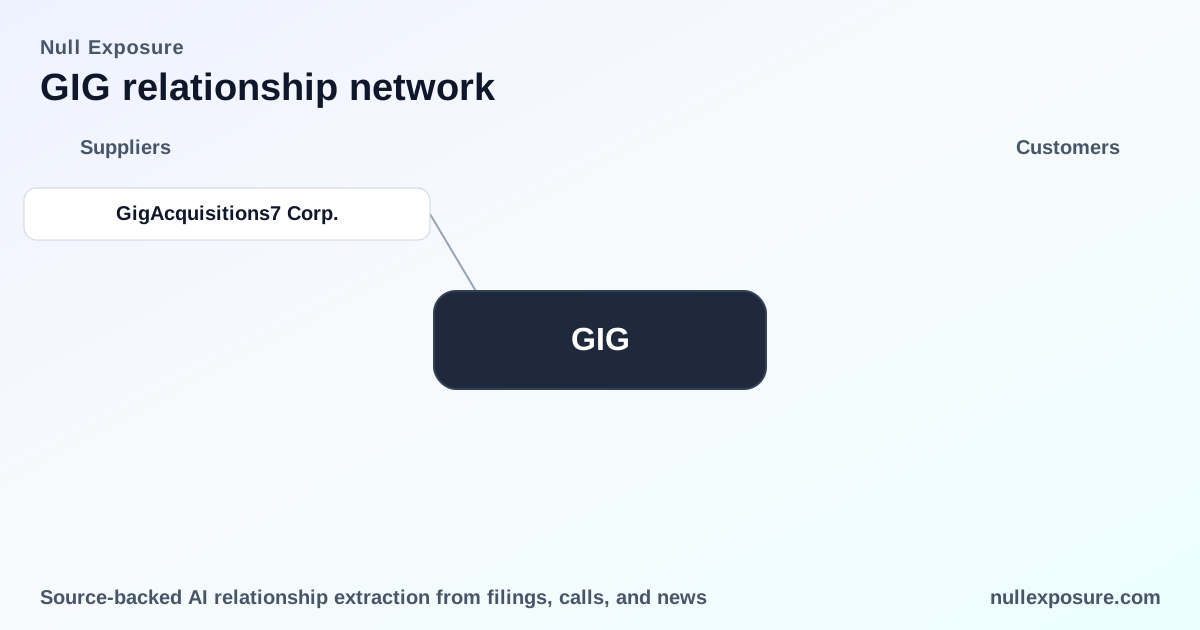
Sponsor financing: GigAcquisitions7 Corp.
GigCapital7 has an explicit sponsor funding link. According to a press release reported by The Globe and Mail, on January 30, 2026 the company issued a $148,000 unsecured, interest-free working capital note to its sponsor, GigAcquisitions7 Corp., convertible into private placement units at $10 per unit (would convert into 14,800 units if fully converted). The structure confirms direct sponsor dependence for short-term liquidity and conversion economics that mirror IPO private placement terms. (Source: The Globe and Mail press release, FY2026 — https://www.theglobeandmail.com/investing/markets/stocks/GIG-Q/pressreleases/59104/gigcapital7-issues-sponsor-working-capital-note-with-conversion/.)
Supplier and contract signals that shape counterparty risk
Company-level disclosures and offering documents produce a consistent set of constraints that define vendor relationships:
- Contracting posture: spot and short-term. The company paid an underwriting discount at IPO and describes services that “commenced on August 28, 2024” and terminate upon consummation of a business combination or liquidation, signaling transactional vendor relationships that are tied to the SPAC lifecycle (company filings, August 2024).
- Service relationships over capital contracts. Filings state recurring administrative spend — “the Company has agreed to pay $30,000 a month for office space, administrative services and secretarial support,” indicating a basic outsourced operating model for day-to-day needs rather than internal service delivery.
- Spend band consistent with mid-six-figure annualized run rate. The monthly $30,000 commitment places annual vendor exposure in the hundreds of thousands range, consistent with the 100k–1m spend-band signal.
- Maturity and criticality: low-to-medium. Contracts terminate on deal close or liquidation, making these agreements short-duration but operationally critical to keep the SPAC listed and active during deal execution.
These constraints are company-level signals drawn from the company’s own filings and offering materials; they describe GigCapital7’s operating model rather than a single named vendor relationship.
Why the sponsorship link and contract profile matter to operators
The sponsor note and the short-term service framework produce three material implications for counterparties and investors:
- Liquidity dependence increases counterparty concentration risk. Sponsor-funded working capital highlights that GigCapital7 does not generate cash from operations and depends on sponsor capital injections to maintain operating cadence and vendor payments.
- Vendor elasticity is limited but predictable. Vendors supplying office, admin, and secretarial support are servicing a time-limited enterprise; these relationships are replaceable in principle but critical in practice until a transaction closes.
- Contract maturity aligns with SPAC lifecycle. Because agreements are explicitly tied to the business-combination timeline, vendors should price for termination risk and abbreviated lifecycles rather than long-term account growth.
Relationship-by-relationship coverage (complete)
GigAcquisitions7 Corp. — The sponsor provided an unsecured, interest-free working capital note for $148,000 on January 30, 2026 convertible into private placement units at $10 per unit (14,800 units if fully converted). This is an explicit sponsor financing line that supports operating needs pending a business combination. (Source: The Globe and Mail press release, FY2026 — https://www.theglobeandmail.com/investing/markets/stocks/GIG-Q/pressreleases/59104/gigcapital7-issues-sponsor-working-capital-note-with-conversion/.)
Practical takeaways for procurement and investor diligence
- Price for termination risk. Contracts terminate on deal close or liquidation; vendors should include termination and liquidity protections in commercial terms.
- Expect sponsor-driven cash infusions. Operational continuity is contingent on sponsor support; counterparties should verify sponsor commitment and conversion mechanics.
- Monitor governance and insider dynamics. With insiders reporting ~51% ownership and institutions ~89%, approvals and deal dynamics will be tightly controlled; vendor negotiation leverage is tied to the board and sponsor incentives.
For a vendor or investor deciding exposure, treat GigCapital7 as a short-duration, sponsor-financed counterparty rather than a growth customer. For deeper supplier intelligence and monitoring of SPAC-linked counterparties, see https://nullexposure.com/.
Actionable next steps
- For procurement teams: require clear payment terms, escrow or sponsor guarantee language, and short notice termination clauses for any multi-month commitments.
- For investors and risk managers: track sponsor capital injections, conversion terms, and the timeline for a business combination to understand dilution and liquidity trajectories.
If you want granular monitoring of SPAC supplier exposures and sponsor financing events, start here: https://nullexposure.com/.
Final assessment
GigCapital7 is a funding vehicle in search of a target, not an operating enterprise. Sponsor financing is the primary lever maintaining operations, and supplier relationships are short-term, standardized, and tied to the SPAC lifecycle. Counterparties should price for abbreviated contracts and demand contractual protections for payment and termination risk. For ongoing supplier intelligence that tracks sponsor notes and contractual constraints, visit https://nullexposure.com/.