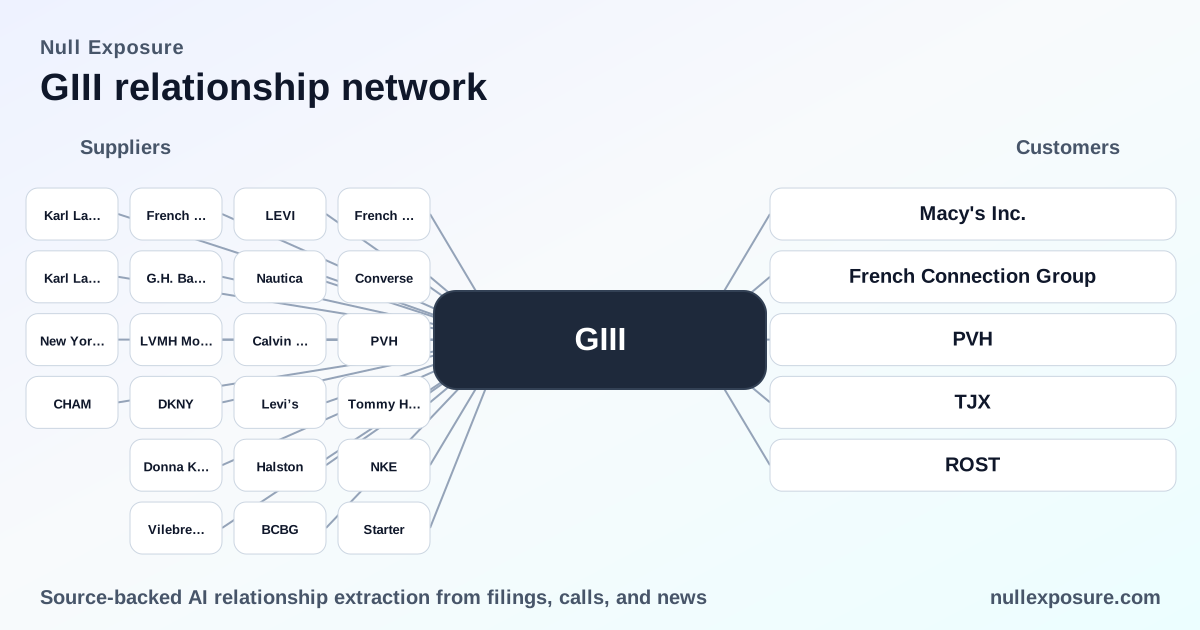
G-III Apparel Group: a licensing-first supplier with owned-brand transition under way
G-III Apparel Group designs, sources and sells apparel through a hybrid model of owned brands and large licensing agreements; it monetizes by manufacturing and distributing licensed product lines for major fashion houses and sports brands while expanding higher-margin owned brands and direct retail channels. Revenue is driven by licensing royalties and wholesale/retail margin on product that G-III sources primarily from Asia, with working capital and credit facilities supporting inventory-heavy cycles.
For an investor or operator assessing supplier relationships, the critical questions are concentration of sourcing, the durability of licenses, and how owned brands offset license roll-offs — this note walks through every cited external relationship in the public record and synthesizes company-level operating constraints and risk signals. For a deeper supplier-risk view, visit the NullExposure homepage: https://nullexposure.com/.
How G-III makes money and where supplier risk lives
G-III runs three cash-generating businesses: wholesale licensed products, owned-brand wholesale/retail, and company-operated retail/digital channels. Licensed businesses deliver scale and predictable volume in the near term; owned brands carry higher margin potential and strategy risk if they fail to scale. The company sources roughly three quarters of product from Vietnam, China and Indonesia, so supplier concentration and APAC logistics are material to gross margin outcomes.
What the public record says about supplier and license partners
Below I cover every relationship referenced in the recent filings and coverage; each entry is one or two plain-English sentences followed by the reporting source.
-
French Connection — G-III announced a long-term partnership to develop and distribute French Connection apparel and accessories in North America effective February 1, 2026, expanding G-III’s licensed portfolio. Source: G-III press release distributed on GlobeNewswire (FY2026) and commentary on SimplyWallSt (FY2026).
-
Converse — G-III operates licensed Converse product lines and launched new Converse product during fiscal 2026, contributing to sales growth in licensed categories. Source: G-III fiscal commentary reported by TradingView and WWD (FY2025–FY2026).
-
PVH (Calvin Klein, Tommy Hilfiger) — The company reported declining shipments and lower sales of Calvin Klein and Tommy Hilfiger licensed products as those licenses transition back to PVH; owned brands are intended to offset the licensing reduction. Source: coverage in WWD and company SEC filings summarized on TradingView and SimplyWallSt (FY2025–FY2026).
-
Tommy Hilfiger — Listed as one of the major licensed partners that has driven historical volume; recent commentary flags the transition of Tommy Hilfiger licenses back to PVH as a revenue headwind. Source: company press releases and WWD reporting (FY2025–FY2026).
-
Calvin Klein — Calvin Klein is among the large legacy PVH licenses noted in G-III disclosures; reductions in CK shipments materially reduced unit volume in FY2025. Source: G-III disclosures summarized on TradingView and GlobeNewswire (FY2025).
-
Starter — G-III includes Starter among its roster of licensed brands for North American distribution under recent press releases. Source: G-III press release via GlobeNewswire (FY2026).
-
Levi’s — G-III operates Levi’s-licensed businesses and cited Levi’s as one of the licensed brands contributing to wholesale licensed revenue. Source: company disclosures and GlobeNewswire / Yahoo Finance press coverage (FY2025–FY2026).
-
Nautica — Nautica is included among the licensed brands managed by G-III in public releases and campaign material for DKNY. Source: GlobeNewswire press releases and campaign materials (FY2026).
-
Halston — Halston is part of the company’s licensed brand roster and appears in G-III press materials as a brand contributing to its portfolio. Source: GlobeNewswire press releases (FY2026).
-
BCBG — BCBG is a licensed brand cited in G-III results commentary and in press coverage of new product launches. Source: GlobeNewswire and WWD reporting (FY2025–FY2026).
-
Champion — Champion is listed among the licensed sports/sportswear partners that G-III produces for under license. Source: GlobeNewswire press release and Yahoo Finance distribution (FY2026).
-
G.H. Bass — G-III sells G.H. Bass products and noted tariffs and lower digital gross profit from G.H. Bass businesses in its quarterly commentary. Source: TradingView write-up of G-III SEC filings (FY2025).
-
LVMH Moët Hennessy Louis Vuitton — Historical context: G-III acquired Donna Karan and DKNY brands from LVMH in 2016; coverage references that track record when discussing brand strategy. Source: WWD coverage of fiscal commentary (FY2025).
-
DKNY — DKNY is an owned brand operated in retail and digital channels; G-III cites DKNY retail operations as a direct-to-consumer revenue source and showcased DKNY campaigns in 2026. Source: GlobeNewswire (DKNY Spring 2026 campaign) and TradingView (FY2025).
-
Donna Karan — Donna Karan is one of G-III’s owned brands used to grow higher-margin retail and direct sales. Source: TradingView summary of company retail operations (FY2025).
-
Vilebrequin — Vilebrequin and Karl Lagerfeld were cited as business lines contributing to product sales in G-III’s retail operations commentary. Source: TradingView (FY2025).
-
Karl Lagerfeld / Karl Lagerfeld Paris — Karl Lagerfeld-related sales are part of G-III’s owned-brand retail operations and were called out in quarterly results commentary. Source: TradingView SEC-summary reporting (FY2025).
-
New York Yankees — G-III’s DKNY campaign included collaborations featuring licensed Major League Baseball properties such as the New York Yankees, demonstrating its sports-licensing activities. Source: GlobeNewswire (DKNY Spring 2026 campaign) (FY2026).
Notes: multiple press releases from GlobeNewswire (December 9, 2025 and March 5, 2026), Yahoo Finance and SimplyWallSt were used to compile these relationship references. When a specific entry cited PVH or brands like Calvin Klein and Tommy Hilfiger, that reporting reflected FY2025–FY2026 transitional headlines.
Company-level constraints that shape supplier exposure
G-III’s public filings and press reports give five operational constraints that matter to buyers and financiers:
-
Contracting posture — long-term and usage components: The company uses a five-year ABL revolving credit facility and leases that commonly run 1–10 years, with some leases carrying contingent rent tied to retail sales; this indicates a mix of long-term credit commitments and usage-based lease exposure. Evidence: the Third ABL Credit Agreement and lease accounting comments in SEC summaries.
-
Geographic sourcing concentration — APAC reliance: Approximately 76% of product sourced from Vietnam, China and Indonesia, making supply-chain disruption, tariffs or labor issues in APAC a principal operational risk.
-
Materiality of finance covenants and liquidity: Management flagged that restrictions on credit facilities could have a material adverse effect on operations, underscoring covenant sensitivity for an inventory-heavy business.
-
Relationship roles — buyer, manufacturer network and third-party services: G-III acts as buyer/brand owner and arranges production through independent third-party manufacturers, does not own factories, and outsources services including cybersecurity monitoring to third parties.
-
Scale of spend and capital structure: Historical redemption of $400 million of senior secured notes and use of revolving credit indicate large absolute working-capital and capital-market activity, consistent with a spend band above $100 million in fiscal support and refinancing.
These constraints together indicate concentration risk, lease and credit maturity risk, and operational dependency on third-party manufacturing in Asia — all central to supplier negotiation and contingency planning.
What this means for investors and operators
-
License transitions are the headline risk: the return of Calvin Klein and Tommy Hilfiger licenses to PVH is a discrete revenue event; investors should underwrite the pace at which owned brands and new licenses (French Connection, Converse runs, etc.) replace that volume. Source: WWD and TradingView coverage (FY2025–FY2026).
-
APAC sourcing is a single point of failure for margins. Tariffs or shipping disruptions will show up quickly; management has already disclosed tariff impacts on certain product lines. Source: TradingView reporting (FY2025).
-
Liquidity and credit posture deserve active monitoring. With large working capital swings and material credit agreements, covenant headroom is an investment risk factor. Source: SEC summary excerpts in press coverage (FY2025–FY2026).
For a hands-on supplier risk and exposure review, explore NullExposure’s platform here: https://nullexposure.com/.
Actionable next steps
- For investors: model scenarios where PVH license revenue declines accelerate and stress-test gross margins with a 5–10% APAC-cost or tariff shock.
- For procurement and operations: prioritize dual-sourcing for high-volume SKUs in Vietnam/China/Indonesia and negotiate lease clauses that reduce contingent, sales-linked rent exposure.
- For credit and treasury: map covenant triggers against seasonal inventory and run a 12-month liquidity projection under slower sell-through assumptions.
If you want an investor-grade supplier risk report tailored to G-III and its partner roster, start here: https://nullexposure.com/.
Bold takeaway: G-III is a licensing-centric apparel operator transitioning to owned brands; success depends on replacing PVH volume with higher-margin owned or newly licensed lines while managing APAC sourcing concentration and credit/leasing maturities.